


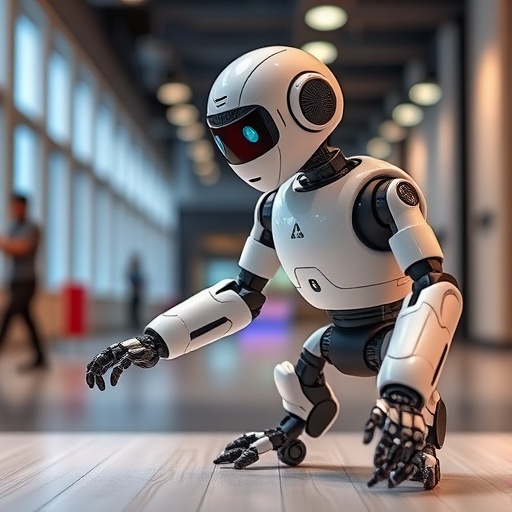
Aston University researchers have unveiled a transformative AI-driven approach to training advanced robotic systems, representing a significant leap forward in bridging the persistent ‘sim-to-real’ gap. This gap, a major obstacle in robotics, denotes the challenges in transferring behaviors learned in simulation environments accurately to unpredictable real-world settings. Robots trained only in simulated environments often falter when confronted with real-life variabilities such as material inconsistencies, fluctuating forces, and sensor noise, which severely limit their deployment in practical tasks.
Dr. Alireza Rastegarpanah, an assistant professor specializing in applied AI and robotics at Aston University, has spearheaded collaborative research with the University of Birmingham’s Extreme Robotics Lab, led by Jamie Hathaway. Their joint efforts focus on developing a novel method that harnesses artificial intelligence to synthesize diverse environmental conditions artificially, thus enabling robots to generalize learned tasks more robustly under real-world uncertainties. This advancement is poised to revolutionize how robots are trained to execute complex operations like material cutting and assembly significantly beyond traditional methodologies.
Traditional robotic training heavily relies on simulation because real-world experiential data acquisition is often prohibitively expensive, time-consuming, and at times dangerous, especially for tasks demanding physical interaction. The researchers addressed this by constructing an AI framework that effectively combines high-fidelity simulation with minimal but strategically gathered real-world data. This hybrid methodology eliminates the need for exhaustive data collection post-simulation, drastically increasing the feasibility and scalability of deploying robots in dynamically changing operational contexts.
At the core of this innovation is a reinforcement learning (RL) policy transfer technique augmented by neural stylisation, which allows a robot to learn task-specific behaviors end-to-end within a virtual environment and seamlessly adapt these skills to tangible applications. The AI system deliberately introduces controlled random variations mimicking real-world situations during the training phase, thus fortifying the robot’s ability to handle unexpected conditions autonomously once in the field.
The breakthrough facilitates adaptive, resilient robotic actions without necessitating the extensive retraining or fine-tuning processes usually required when transitioning from simulation to real environments. This leads to significant reductions in the time, cost, and risks associated with robot deployment. Robots can now execute precise cutting tasks or manipulate heterogeneous materials reliably, even amid unseen or uncertain variables, thus overcoming a long-standing barrier in the robotics domain.
Industries that are set to benefit immensely from this technology include sustainable manufacturing, recycling, and hazardous environment operations. Particularly, the recycling sector, dealing with complicated processes such as lithium battery disassembly, stands to gain through automating labor-intensive and risky tasks swiftly and safely. Additionally, the circular economy initiatives would find this AI-based robotic deployment critical in enhancing efficiency and environmental impact mitigation.
Moreover, the methodology promotes the vision of plug-and-play intelligent robotic systems. Such systems can be trained exclusively through simulation and rapidly deployed into novel environments with minimal calibration or configuration changes. This potential to slash innovation cycles enables industries to adapt more agilely to emerging challenges, thereby catalyzing advanced applications in autonomous industrial systems, including nuclear decommissioning or other domains requiring precision and operational safety under unpredictable conditions.
The research meticulously published in the peer-reviewed journal Scientific Reports outlines experimental protocols demonstrating the practical feasibility and performance gains of this approach. The method’s experimental foundation firmly establishes that maintaining robust sim-to-real transfer is achievable, fundamentally advancing the practical utility of reinforcement learning in robotics and pushing the envelope of what AI-enabled automation can accomplish.
Dr. Rastegarpanah emphasizes that this work marks a critical step toward more stable and efficient robot training paradigms leveraging simulated environments augmented by minimal real-world corrections. The implications extend beyond mere technical improvement—this approach embodies a paradigm shift promoting faster, safer, and more flexible deployment of robotic solutions, vital for industries facing both economic and societal pressures to innovate rapidly while maintaining high safety standards.
Supporting this robust experimentation is the REBELION project, funded by UK Research and Innovation (UKRI) alongside European collaborative efforts focused on automated safety in lithium battery recycling. This underscores the strategic importance and practical applications of the novel training approach, aligning with broader industrial and environmental goals to foster sustainable robotics integration.
Ultimately, the significance of this AI-based training technique lies not only in its immediate robotic task performance but also in its foundational role in creating autonomous agents capable of learning and adapting in complex, real-world scenarios. This promises a future where robotic systems can be trusted partners in diverse sectors, transitioning smoothly from virtual training grounds to operations with tangible benefits and minimal human intervention.
As robotics increasingly occupy crucial roles in industrial and hazardous settings, the capability to simulate, learn, and adapt concurrently in diverse conditions eliminates previously insurmountable barriers. This approach heralds a new era in robotics research and application, intertwining machine learning advances with physical automation to deliver unparalleled efficiency, reliability, and practicality.
News Publication Date: 12-Mar-2026
Web References:
https://www.nature.com/articles/s41598-026-41735-5
http://dx.doi.org/10.1038/s41598-026-41735-5
Cite Scienmag News
Denise Maddox. (May 6, 2026). Aston University Develops Innovative AI Method to Train Robots for Real-World Applications. Scienmag. https://scienmag.com/aston-university-develops-innovative-ai-method-to-train-robots-for-real-world-applications/
Denise Maddox. "Aston University Develops Innovative AI Method to Train Robots for Real-World Applications." Scienmag, 6 May 2026, https://scienmag.com/aston-university-develops-innovative-ai-method-to-train-robots-for-real-world-applications/. Accessed 3 September 2026.
Denise Maddox. "Aston University Develops Innovative AI Method to Train Robots for Real-World Applications." Scienmag. May 6, 2026. https://scienmag.com/aston-university-develops-innovative-ai-method-to-train-robots-for-real-world-applications/


