


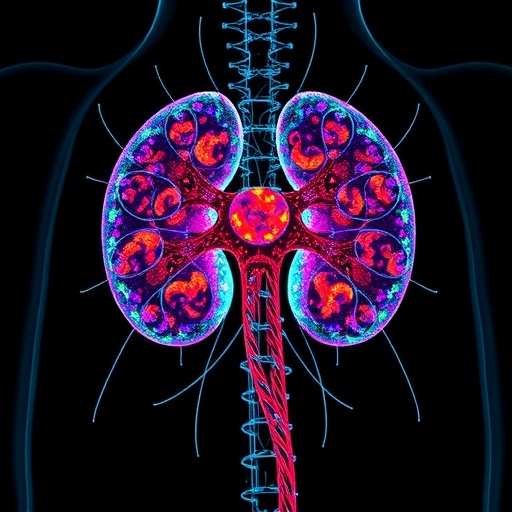
In a groundbreaking advance for kidney research and regenerative medicine, a team led by Wang, Zhao, Chen, and colleagues has unveiled unparalleled insights into the cellular and molecular mechanisms underlying kidney repair after acute injury. Utilizing an innovative technique known as single-cell Stereo-seq, their study elucidates how injured proximal tubules—the essential nephron segments responsible for reabsorbing vital substances—initiate and coordinate regenerative programs following acute kidney injury (AKI). This cutting-edge spatial transcriptomic technology enables unprecedented resolution of gene expression patterns at the single-cell level within intact tissue architecture, delivering a holistic view of cellular states, interactions, and regulatory networks during tissue regeneration.
The proximal tubule represents a vital yet highly vulnerable structure within the nephron, the kidney’s functional unit. Damage to these tubules during AKI can critically impair renal function and often determines patient prognosis. Historically, the complexity and heterogeneity of tubule cell populations have posed significant challenges for researchers seeking to understand the intrinsic regenerative capacity and molecular drivers of repair after injury. Previous bulk sequencing or traditional histological models failed to capture the nuanced spatial gene expression and cellular diversity that underpins the regeneration process. The application of single-cell Stereo-seq therefore marks a pivotal technological leap that bridges this gap between molecular detail and spatial organization.
By integrating spatially resolved single-cell RNA sequencing data across the entire kidney cortex, the researchers mapped the transcriptional landscape of regenerating proximal tubules with single-cell resolution while preserving their native histological context. This enabled identification not only of known tubular epithelial subtypes but also of transient cell populations and precursor-like intermediates that emerge in response to injury. More importantly, these dynamic cellular states were correlated with specific regenerative gene expression programs, revealing temporal waves of activation in signaling pathways that govern proliferation, differentiation, and tissue remodeling.
Central to the study’s findings is the delineation of regulatory mechanisms orchestrating proximal tubule regeneration. The authors illuminated how key transcription factors and signaling molecules are spatially and temporally coordinated to drive the repair cascade. For instance, activation of pathways such as Wnt/β-catenin, Notch, and Hippo—long known regulators of stemness and organ development—was detected in distinct tubular cell clusters transitioning towards a regenerative phenotype. Moreover, the work highlighted novel ligand-receptor interactions between tubular epithelial cells and infiltrating immune populations, suggesting a critical role for immune-epithelial crosstalk in facilitating efficient repair.
One particularly striking discovery was the identification of a dedicated “regeneration niche” within the injured proximal tubule microenvironment. This niche is characterized by a specialized composition of extracellular matrix proteins, stromal cells, and signaling gradients that collectively create permissive conditions for tubular cell proliferation and differentiation. The spatial transcriptomic data revealed how disruption to this niche during AKI impairs regenerative outcomes, offering new avenues for therapeutic intervention. Modulating niche components or enhancing pro-regenerative signaling represents a compelling strategy for accelerating kidney repair in clinical contexts.
Importantly, the authors provided evidence that the regenerative response is not uniform across the proximal tubule but exhibits marked segmental variation. This spatial heterogeneity in gene expression programs correlates with differences in metabolic activity, susceptibility to damage, and capacity for proliferation across specific tubular segments. Such compartmentalization underscores the complexity of kidney repair and emphasizes the need for precision medicine approaches that account for microenvironmental and cellular diversity within nephron compartments.
From a methodological standpoint, single-cell Stereo-seq harnesses cutting-edge spatial barcoding and ultra-high-throughput sequencing, capturing transcriptomic profiles of tens of thousands of cells with subcellular spatial resolution. This enables comprehensive reconstruction of three-dimensional cellular architectures and molecular cartographies, a feat unattainable by previous single-cell or spatial transcriptomic platforms. The integration of histopathology with transcriptomics hence provides a multi-dimensional perspective on AKI pathophysiology and kidney regeneration.
This study’s implications for chronic kidney disease, which often arises from unresolved injury and maladaptive repair, are vast. Understanding the intrinsic mechanisms that enable successful tubular regeneration could guide the development of novel therapeutics that promote tissue healing while inhibiting fibrosis, inflammation, and scarring. The identification of regenerative signaling hubs and cell populations further offers biomarkers for prognosis and treatment response in AKI patients.
Beyond kidney biology, Wang et al.’s work establishes a powerful paradigm for leveraging spatially resolved single-cell transcriptomics to unravel complex regenerative processes in diverse organ systems. The ability to dissect cellular identity, lineage relationships, and signaling microenvironments in situ provides transformative potential to decode development, injury, and repair across tissues. The technological innovations and biological insights presented represent a significant milestone in the field of regenerative medicine and systems biology.
Future directions stemming from this research include functional validation of candidate regulatory genes and signaling pathways using organoid models, gene editing, and in vivo lineage tracing. Moreover, extending single-cell spatial mapping to longitudinal studies will be instrumental in deciphering the temporal progression from injury to complete repair or maladaptation. Combining Stereo-seq with emerging modalities such as spatial proteomics and metabolomics holds promise for constructing an integrated, multi-omic atlas of kidney regeneration.
The study also raises intriguing questions about inter-organ crosstalk during AKI recovery and systemic factors influencing renal regeneration. Given the centrality of immune-epithelial interactions revealed, further exploration of immune cell subtypes, their activation states, and secreted mediators will deepen understanding of inflammation-resolved repair balance. Targeting immune modulators to shape the regeneration niche may represent an innovative therapeutic frontier.
In conclusion, the employment of single-cell Stereo-seq has unlocked a new dimension in kidney regenerative biology, unveiling a finely tuned and spatially organized molecular choreography driving proximal tubule repair after acute injury. The intricate interplay of transcriptional circuits, microenvironmental cues, and cell-cell communication mapped in this study offers a comprehensive framework for advancing the diagnosis, monitoring, and treatment of AKI and potentially other regenerative pathologies. This paradigm-shifting research not only advances fundamental knowledge but also charts a translational path toward improving renal health outcomes worldwide.
Cite Scienmag News
Juliet Wilcox. (May 6, 2026). Single-cell Stereo-seq uncovers kidney repair mechanisms. Scienmag. https://scienmag.com/single-cell-stereo-seq-uncovers-kidney-repair-mechanisms/
Juliet Wilcox. "Single-cell Stereo-seq uncovers kidney repair mechanisms." Scienmag, 6 May 2026, https://scienmag.com/single-cell-stereo-seq-uncovers-kidney-repair-mechanisms/. Accessed 4 September 2026.
Juliet Wilcox. "Single-cell Stereo-seq uncovers kidney repair mechanisms." Scienmag. May 6, 2026. https://scienmag.com/single-cell-stereo-seq-uncovers-kidney-repair-mechanisms/


