


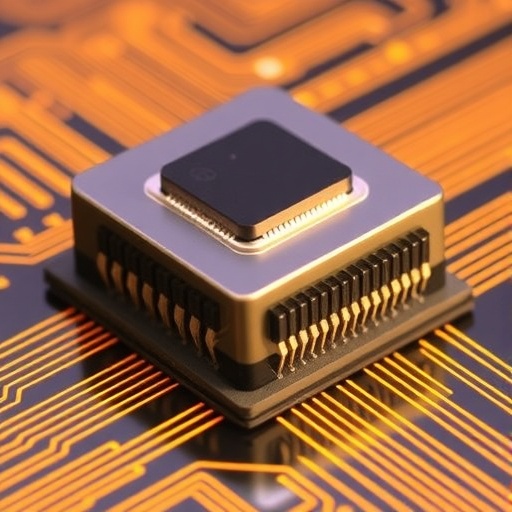
In the rapidly evolving landscape of power electronics, the latest breakthrough introduced by Jin, Xi, Thomas, and their colleagues promises to redefine the way we approach gate driver isolation, a critical component for efficient and safe power device operation. Their pioneering work on a microwave-acoustic-based isolated gate driver represents a significant leap forward, harnessing the unique properties of coupled microwave and acoustic waves to achieve unprecedented levels of galvanic isolation, high efficiency, and miniaturization. This innovation, detailed in their forthcoming publication in Communications Engineering, is poised to revolutionize power electronics modules used in everything from electric vehicles to renewable energy inverters.
Isolation techniques have long been a bottleneck in power electronics design. Traditional isolated gate drivers often rely on transformers, optocouplers, or capacitive coupling methods, each with inherent limitations such as size, bandwidth restrictions, and susceptibility to electromagnetic interference (EMI). Jin and colleagues circumvents these limitations by integrating microwave and acoustic wave interactions within a novel device architecture, thus enabling high-fidelity signal transmission across isolation barriers without the bulk or noise drawbacks commonly encountered in conventional designs.
At the heart of their approach lies the exploitation of microwave-acoustic interactions—a field that blends aspects of high-frequency electromagnetics with acoustics to manipulate signals in new and efficient ways. Microwave signals, typically employed for wireless communication, provide a robust carrier for information, while acoustic waves, which travel at much slower speeds, offer a novel medium to modulate these signals within a tightly confined and engineered environment. By coupling these two domains, the team has engineered a compact device capable of isolating gate drive signals, preserving waveform integrity, and maintaining electrical separation essential for safety.
Their research describes the design and fabrication of a thin-film acoustic resonator integrated with microwave circuitry on a common substrate. The resonator converts microwave input signals into acoustic vibrations, which traverse an isolation gap—a meticulously engineered non-conductive barrier—before being reconverted into electrical signals to control the gate of a power transistor. This method achieves galvanic isolation by physically separating the electrical input and output sides, while the microwave-acoustic transduction ensures information fidelity and reduces interference susceptibility.
One notable technical challenge addressed by the team was maintaining signal integrity amidst complex transduction processes and at high switching frequencies typical of modern power devices. Through advanced material engineering, including piezoelectric thin films with optimized frequency responses, and careful electromagnetic shielding, the researchers minimized distortion, loss, and phase shifts. This refinement is essential not only for efficiency but for the precise timing control required in power inverters and converters to ensure smooth operation and avoid device failure.
A further advantage of the microwave-acoustic approach is its potential for integration into existing semiconductor fabrication workflows. Unlike bulky transformers or optocouplers, the thin-film acoustic resonator can be fabricated using lithographic methods compatible with silicon wafer-scale processing. This means gate drivers can be co-packaged with power transistors, leading to significant reductions in module size and parasitic inductance, both critical for improving overall system responsiveness and reducing electromagnetic interference.
The impact of this technology extends beyond industrial power control. In electric vehicles, for example, the isolated gate driver can enable safer and more compact inverter designs, improving vehicle efficiency and range. Similarly, in renewable energy systems such as solar inverters and wind turbine converters, the technology can contribute to reliability and reduce maintenance costs by providing more robust isolation that withstands harsh environmental conditions and noise.
This breakthrough also has implications for future smart grid and aerospace applications, where robust isolation and signal fidelity are paramount. Power electronics in these domains must operate under extreme conditions, with high voltage transients and intense electromagnetic interference. The microwave-acoustic isolated gate driver’s immunity to EMI and its intrinsic electrical isolation make it a promising candidate for these demanding environments.
The team’s experiments, as reported, demonstrated stable operation at switching frequencies exceeding hundreds of kilohertz, with isolation voltages surpassing several kilovolts. These benchmarks outperform many existing technologies and open the door to new power module architectures capable of handling increasingly high power densities. This performance level is vital as the industry trends toward smaller, faster, and more integrated power systems.
Moreover, the device’s inherently low power consumption during signal transmission contributes to overall system efficiency. By reducing the power losses typically affiliated with gate drives, the microwave-acoustic isolated gate driver supports greener electronics, an essential consideration as the world shifts toward more sustainable energy usage and stricter regulatory standards.
The authors also outline the potential scalability of their technology. By tuning the acoustic resonator dimensions and microwave signal parameters, the device can be engineered for diverse voltage and power ratings, making it versatile across a range of power electronic modules. This adaptability ensures the technology’s relevance for both low-voltage consumer electronics and high-voltage industrial applications.
However, challenges remain before widespread industrial adoption. Manufacturing consistency of acoustic resonators with tight specification tolerances is non-trivial, and long-term reliability under field conditions must be rigorously evaluated. The team has begun accelerated aging tests and environmental stress simulations to ensure durability, an essential step toward commercial viability.
Future research directions highlighted by Jin and colleagues include integrating advanced materials such as piezoelectric single crystals with higher electromechanical coupling, further enhancing efficiency and signal purity. Additionally, exploring hybrid isolation schemes that combine microwave-acoustic methods with emerging 2D materials or nanoelectromechanical systems (NEMS) could unlock new performance territories.
In summary, Jin, Xi, Thomas, and their collaborators have delivered a visionary step forward in the quest for isolated gate driver solutions that meet the stringent demands of modern power electronics. By creatively leveraging microwave-acoustic coupling phenomena, their device delivers superior isolation, signal fidelity, integration potential, and efficiency. As the field advances, this technology is set to propel the next generation of power modules, fueling innovations that will ripple across electric transportation, renewable energy, and beyond.
The microwave-acoustic isolated gate driver not only exemplifies cutting-edge scientific innovation but also embodies the interdisciplinary approach necessary to solve complex engineering challenges. Combining electromagnetics, material science, microfabrication, and power electronics, this work is a beacon of the collaborative ingenuity required to meet the energy demands and safety standards of the future.
The community eagerly anticipates further experimental data and validation studies as this technology matures. Should it fulfill its promise, the microwave-acoustic isolated gate driver will become a foundational component in the smart, sustainable power electronics ecosystems of tomorrow, enabling safer, more compact, and highly efficient energy conversion devices worldwide.
Cite Scienmag News
Denise Maddox. (May 5, 2026). Microwave-Acoustic Isolated Gate Driver Revolutionizes Power Electronics. Scienmag. https://scienmag.com/microwave-acoustic-isolated-gate-driver-revolutionizes-power-electronics/
Denise Maddox. "Microwave-Acoustic Isolated Gate Driver Revolutionizes Power Electronics." Scienmag, 5 May 2026, https://scienmag.com/microwave-acoustic-isolated-gate-driver-revolutionizes-power-electronics/. Accessed 7 September 2026.
Denise Maddox. "Microwave-Acoustic Isolated Gate Driver Revolutionizes Power Electronics." Scienmag. May 5, 2026. https://scienmag.com/microwave-acoustic-isolated-gate-driver-revolutionizes-power-electronics/


