


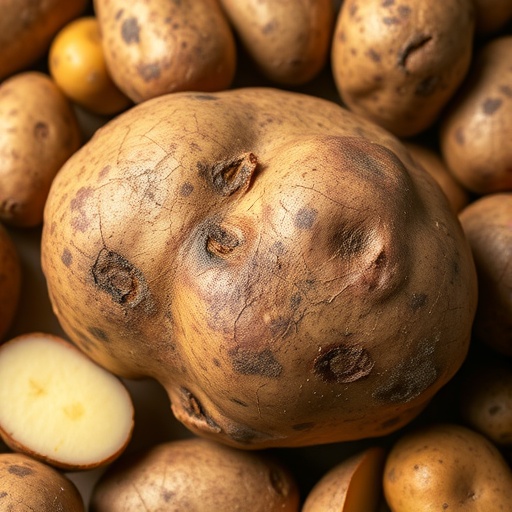
BUFFALO, N.Y. — Long before the global ubiquity of the potato, it was the Indigenous peoples of the Andean highlands who first domesticated this starch-rich tuber, intricately weaving it into the fabric of their diet. This agricultural innovation not only transformed their subsistence strategies but also set the stage for a remarkable evolutionary journey. Recent research unveils that the descendants of these early cultivators in present-day Peru possess the highest documented number of copies of the AMY1 gene, which encodes salivary amylase, an enzyme crucial for initiating starch digestion in the mouth.
The study, co-led by evolutionary biologists and anthropologists from the University at Buffalo and UCLA and published in the prestigious journal Nature Communications, offers compelling evidence that natural selection actively favored individuals with elevated AMY1 copy numbers within this population approximately 6,000 to 10,000 years ago, coinciding precisely with the dawn of potato cultivation in the Andes. This discovery underscores the profound interplay between human genetics and dietary practices, offering a rare, concrete instance of evolutionary adaptation in response to a compositional shift in diet during the Holocene.
Understanding the function of AMY1 is pivotal: salivary amylase initiates the hydrolysis of starch molecules beginning in the oral cavity, facilitating more efficient carbohydrate metabolism downstream. Populations with a higher AMY1 copy number generally produce greater quantities of this enzyme, bolstering their capacity to digest starch-rich foods. The Indigenous Andeans’ exceptional AMY1 gene amplification reflects a sophisticated evolutionary response shaped by millennia of consuming potatoes, highlighting the dynamic nature of gene-diet interactions in human populations.
Lead investigator Dr. Omer Gokcumen, a professor of biological sciences at UB, emphasizes that this finding elevates the evidence for adaptive genetic modifications tied to human dietary habits. “Biologists have long hypothesized that humans evolved distinct genetic traits according to dietary pressures, but the strength of genetic selection observed here is particularly striking,” he remarks. This work builds upon Gokcumen’s previous research revealing that the initial duplication events leading to multiple AMY1 gene copies occurred at least 800,000 years ago, well before modern humans occupied the Andes.
The investigative team collected genome samples from Quechua-speaking Indigenous Peruvians, employing cutting-edge ultra-long DNA sequencing technology that afforded unparalleled resolution of gene copy number variability. These data were integrated with extensive genomic repositories encompassing genetic information from dozens of global populations, enabling comparative analyses to contextualize the Andean AMY1 expansion. The results showed that Indigenous Peruvians have an average of approximately 10 AMY1 copies, considerably higher than the typical six copies seen in many other populations worldwide.
Importantly, the observed increase in AMY1 copy number is not a recent artifact explained by historical events such as the population bottleneck following European colonization but predates such disruptions by thousands of years. This conclusion was drawn by disentangling selective evolutionary pressures from recent demographic upheavals, a challenging task facilitated by advanced sequencing technologies and comprehensive genetic datasets. This temporal context for adaptation underscores the profound and lasting biological impacts of ancient agricultural practices.
The study sheds light on the mechanism through which this adaptation occurred, illustrating evolution as a sculptor, favoring individuals harboring higher AMY1 copies, who presumably enjoyed greater reproductive success, thus gradually shifting the population genetic landscape. The process did not create new copies spontaneously but rather amplified the prevalence of preexisting high-copy variants by selective retention over generations. This nuanced understanding enriches evolutionary theory by highlighting selective pressures that refine, rather than reconstruct, genetic architectures in human populations.
Furthermore, the research addresses potential confounding variables by juxtaposing Indigenous Peruvians with the Maya, a Mesoamerican population sharing a common ancestry yet lacking a tradition of potato domestication. The Maya’s consistently lower AMY1 copy number average underscores the dietary specificity of this genetic adaptation, enhancing the causal link between starch consumption of potatoes and AMY1 gene amplification. This comparative perspective strengthens the argument for targeted natural selection instigated by cultural and ecological conditions unique to the Andean environment.
Beyond its evolutionary implications, the research provides fertile ground for contemplating future intersections of genetics and nutrition. As salivary amylase levels influence carbohydrate metabolism, individual AMY1 variation might inform personalized dietary recommendations. People with fewer AMY1 gene copies could potentially benefit from tailored carbohydrate intake strategies, adjusting potato consumption or preparation methods to optimize digestion and metabolic outcomes. This concept paves the way for genomically guided nutrition, an emerging frontier with significant implications for public health.
The findings also provoke provocative questions about how modern, globally homogenized diets might shape human evolutionary trajectories. Historically, humans consumed relatively stable diets linked to local ecologies, limiting selective pressures to long-standing food sources. “The question now becomes how humans will adapt, if at all, to an unprecedented exposure to diverse and processed carbohydrates introduced by modern globalization and the proliferation of foods such as French fries worldwide,” notes co-author Kendra Scheer. This inquiry exemplifies the dynamic interplay between cultural shifts and biological evolution, with potential impacts on population health over coming generations.
Contrary to the common assumption that human metabolism remains primarily adapted to the Paleolithic era, this research reveals a more nuanced picture where significant genetic adaptations have occurred within the past 10,000 years, coinciding with the Neolithic revolution and agriculture. Dr. Abigail Bigham, an anthropologist specializing in high-altitude populations, stresses this point by highlighting the Andes as a unique natural laboratory not only for adaptations to hypoxia but also for metabolic shifts driven by dietary environments. This broadens our understanding of human evolutionary plasticity in response to a variety of ecological pressures.
The integration of high-resolution genomic sequencing with anthropological and evolutionary inquiry exemplifies the multidisciplinary approach essential to unraveling complex biological phenomena. Collaborative efforts spanning institutions from the University of Kansas to the University of Puerto Rico and universities abroad underscore the global dimension of investigating human genetic diversity. Funding from major agencies, including the National Science Foundation, NIH, and the Leakey Foundation, underscores the broader scientific and societal value of this research.
In conclusion, the rapid adaptive increase in AMY1 gene copy number among Indigenous Andeans represents a striking example of how human populations have genetically tailored themselves to changes in diet induced by agriculture. This evolutionary tale, etched in the genetic code, speaks to the ongoing relationship between culture, environment, and biology. As the world grapples with dietary transitions and their health implications, understanding such ancient genetic adaptations offers vital context and avenues for future exploration.
News Publication Date: 5-May-2026
Web References: http://dx.doi.org/10.1038/s41467-026-71450-8
Cite Scienmag News
Gavin Prescott. (May 5, 2026). How Potatoes Influenced the Genetic Evolution of Indigenous Andeans. Scienmag. https://scienmag.com/how-potatoes-influenced-the-genetic-evolution-of-indigenous-andeans/
Gavin Prescott. "How Potatoes Influenced the Genetic Evolution of Indigenous Andeans." Scienmag, 5 May 2026, https://scienmag.com/how-potatoes-influenced-the-genetic-evolution-of-indigenous-andeans/. Accessed 5 September 2026.
Gavin Prescott. "How Potatoes Influenced the Genetic Evolution of Indigenous Andeans." Scienmag. May 5, 2026. https://scienmag.com/how-potatoes-influenced-the-genetic-evolution-of-indigenous-andeans/


