


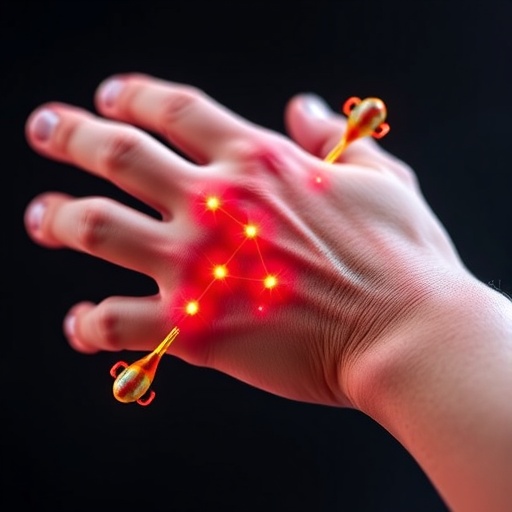
In a groundbreaking advancement at the intersection of nanotechnology and dermatological therapy, researchers have unveiled a novel approach harnessing Janus nanomotors for the topical treatment of radiation-induced dermatitis. This innovation promises a transformative shift in how clinicians manage the often debilitating skin inflammation caused by ionizing radiation exposure, common among cancer patients undergoing radiotherapy. The study, published in Nature Communications in 2026, introduces an unprecedented delivery system that actively navigates the complex skin microenvironment to mitigate inflammation and promote tissue repair with exceptional precision.
Radiation-induced dermatitis (RID) remains a significant clinical challenge due to the skin’s sensitivity and limited regenerative capacity following therapeutic radiation. Traditional treatments predominantly focus on symptom mitigation through topical emollients and corticosteroids, yet these often provide inconsistent relief and carry the risk of systemic side effects. The engineering of Janus nanomotors—microscopic particles featuring two distinct hemispheres with contrasting physical or chemical properties—offers an innovative solution by transforming passive drug administration into an active, targeted intervention.
At the core of this technology is the asymmetrical design of Janus nanomotors, which confers multifunctionality and anisotropic propulsion capabilities. These nanomotors exhibit autonomous movement powered by catalytic reactions on one hemisphere, typically involving biocompatible fuel sources present in the skin microenvironment, such as hydrogen peroxide generated during oxidative stress. This propulsion mechanism allows the nanomotors to actively traverse the damaged epidermal layers, circumventing the impediments of diffusion that restrict conventional topical therapies.
Intricately engineered to respond to the unique biochemical milieu of radiation-damaged tissue, these nanomotors are encapsulated with anti-inflammatory agents and growth factors. Their controlled magnetically or chemically guided navigation enhances targeted delivery, ensuring sustained therapeutic concentrations locally while minimizing systemic exposure and adverse effects. By penetrating deeper into the dermis, the Janus nanomotors address both the epidermal disruption and subdermal inflammatory cascades that characterize severe RID.
The researchers employed advanced characterization techniques, including high-resolution electron microscopy and dynamic light scattering, to verify the Janus structure and quantify the nanomotors’ size distribution, surface charge, and propulsion velocity. In vitro assays utilizing human keratinocyte cultures subjected to ionizing radiation demonstrated the nanomotors’ ability to reduce pro-inflammatory cytokine secretion significantly. These findings were bolstered by in vivo murine models, where topical application of the nanomotor formulation markedly reduced erythema, edema, and histopathological markers of dermatitis compared to conventional treatments.
Importantly, the Janus nanomotors’ biocompatibility was rigorously tested, revealing minimal cytotoxicity and negligible induction of immune responses. The catalytic hemisphere’s material composition—utilizing platinum nanoparticles or enzyme-mimicking compounds—was optimized to balance propulsion efficacy with safety, ensuring rapid biodegradation and clearance post-therapy. This holistic approach addresses one of the pivotal concerns in nanomedicine: achieving therapeutic benefit without provoking undesirable systemic implications.
The therapeutic mechanism exploits the reactive oxygen species (ROS) abundant in irradiated skin tissue. While excessive ROS cause cellular damage and inflammation, controlled catalytic decomposition by the nanomotors mitigates oxidative stress, simultaneously generating movement propellant and fostering a microenvironment conducive to tissue repair. This synergy highlights the elegance of the Janus design—where propulsion and therapy are intrinsically linked, enhancing the treatment’s efficacy.
This study also explored the dynamic interplay between the nanomotors and the extracellular matrix. The active motility aids in traversing dense collagen networks and disrupted barrier structures, overcoming one of the major limitations of topical drug penetration. Moreover, the nanomotors promote localized modulation of metalloproteinases, enzymes that regulate matrix remodeling, thereby accelerating the restoration of skin integrity post-radiation.
Future perspectives indicate that this technology could be adapted for a wide array of dermatological applications beyond RID, including chronic wounds, psoriasis, and localized infections. The modular design of Janus nanomotors allows for facile surface functionalization, enabling precision targeting of pathological markers or integrating diagnostic capabilities via responsive fluorescence or magnetic resonance imaging contrast.
Despite the promising therapeutic implications, the translation of Janus nanomotor technology to clinical practice entails navigating regulatory pathways rigorously to confirm long-term safety and efficacy in diverse patient populations. Large-scale manufacturing, reproducibility, and cost-effectiveness constitute additional challenges needing resolution before widespread adoption.
Nevertheless, this pioneering research underscores the paradigm shift from static topical formulations to smart, active nanocarriers capable of self-guided navigation within complex biological systems. By turning passive treatment into an intelligent therapeutic expedition, Janus nanomotors are poised to redefine the management of skin injuries induced by radiation therapy, ultimately improving patients’ quality of life and treatment outcomes.
As radiotherapy continues to be a mainstay in cancer treatment modalities, innovations addressing its collateral skin toxicity are critical. Zhang, Liu, Zhao, and colleagues’ work epitomizes the interdisciplinary synergy between materials science, nanotechnology, and clinical medicine. Their Janus nanomotor platform exemplifies how nanoscale engineering can surmount biological hurdles, harness intrinsic tissue chemistry, and deliver precise, effective therapy to sites previously difficult to reach.
The advent of Janus nanomotors heralds a future where nanomedicine is not just a passive carrier but an active participant in cellular and tissue healing processes. This research opens avenues for custom-tailored nanomotors with programmed responses to environmental cues, enabling personalized treatment regimens with unprecedented specificity. Such advancements bring the promise of transforming dermatological care from symptom management to targeted molecular repair.
Further investigations are warranted to optimize the formulation parameters, including propulsion kinetics, drug loading capacity, and release profiles under physiological skin conditions. Moreover, integrating real-time monitoring technologies could provide feedback loops for adaptive therapy, enhancing safety and effectiveness. The convergence of machine learning algorithms with nanomotor behavior prediction could accelerate this development, fostering next-generation smart therapeutic platforms.
In conclusion, the successful demonstration of Janus nanomotors for topical treatment of radiation-induced dermatitis stands as a landmark achievement. It harnesses the power of asymmetrical nanomaterials to actively negotiate biological barriers, combat inflammation, and facilitate tissue regeneration. This innovation not only addresses an unmet clinical need but also propels nanotechnology into the forefront of precision dermatological therapy with broad implications for future biomedical applications.
Cite Scienmag News
Ophelia Keating. (May 4, 2026). Janus Nanomotors Target Radiation-Induced Dermatitis Treatment. Scienmag. https://scienmag.com/janus-nanomotors-target-radiation-induced-dermatitis-treatment/
Ophelia Keating. "Janus Nanomotors Target Radiation-Induced Dermatitis Treatment." Scienmag, 4 May 2026, https://scienmag.com/janus-nanomotors-target-radiation-induced-dermatitis-treatment/. Accessed 3 September 2026.
Ophelia Keating. "Janus Nanomotors Target Radiation-Induced Dermatitis Treatment." Scienmag. May 4, 2026. https://scienmag.com/janus-nanomotors-target-radiation-induced-dermatitis-treatment/


