


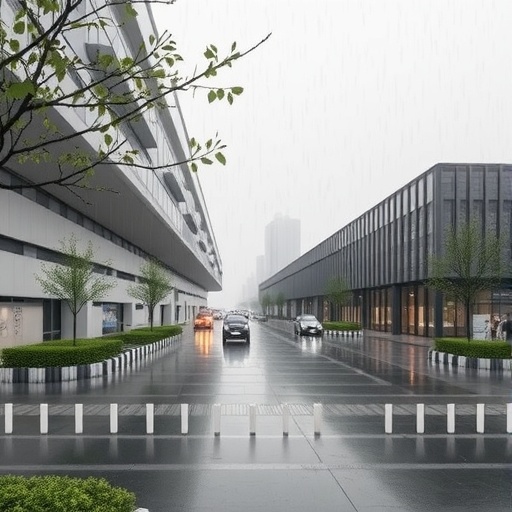
Urban environments across the globe are grappling with the persistent challenge of rainfall-induced pollution, a phenomenon where stormwater runoff carries a mixture of contaminants from city surfaces into water bodies, severely impacting ecological and human health. A groundbreaking study led by Li, Zhu, Ma, and colleagues, published in npj Urban Sustainability in 2026, proposes a transformative approach to managing urban rainfall pollution by shifting from traditional static control systems to dynamic resilience frameworks. This innovative work offers a new lens for urban planners and environmental engineers, emphasizing ecological infrastructure’s ability to adapt and respond to the multifaceted stressors brought on by urban runoff.
The conventional strategies employed in urban centers rely heavily on static control mechanisms—fixed engineering solutions such as retention basins, separation of pollutants at source, and standard drainage systems—that attempt to mitigate the impacts of stormwater pollution. While these methods have achieved varying degrees of success, they falter in their rigidity, often unable to adjust to shifting environmental conditions, climate variability, and escalating urbanization pressures. The team’s research underscores the importance of moving towards a dynamic resilience model, which integrates ecological infrastructure capable of evolving with changing urban stressors and maintains ecosystem functionality in the face of unpredictable rainfall patterns.
Central to this research is the introduction of a multi-stress pathway framework that recognizes the intricate web of pollution pathways during urban rainfall events. Unlike singular mitigation systems focused solely on pollutant removal, this framework holistically addresses multiple interacting pathways—including chemical contaminants, sediment load, thermal pollution, and microbial agents—simultaneously. By analyzing these diverse stressors together, the framework guides the design of ecological infrastructure that promotes synergistic resilience rather than isolated interventions, providing a comprehensive shield against the complexity of urban rainfall-induced contamination.
City landscapes are dynamic and complex ecosystems where impervious surfaces such as rooftops, roads, and parking lots contribute significantly to urban runoff. The study details how these surfaces accelerate the transport of pollutants into natural water channels, bypassing conventional filters and overwhelming existing treatment systems. The researchers emphasize that ecological infrastructure—like green roofs, permeable pavements, bioswales, and constructed wetlands—can be dynamically managed and engineered to intercept and treat runoff across various pathways. These living systems enhance the urban landscape’s capacity to buffer against pollution surges, cycling nutrients effectively, and maintaining hydrological balance in ways static structures cannot.
What sets this study apart is its analytical focus on resilience as a dynamic property rather than a static state. Resilience, in ecological and engineering terms, is the capacity of a system to absorb disturbances and reorganize while undergoing change to retain essentially the same function and structure. The research posits that urban resilience to rainfall-induced pollution must be adaptive—capable of learning from environmental feedback and evolving. This perspective demands a paradigm shift in urban water management policies, urging practitioners to design infrastructure with embedded flexibility and self-regulation enabled by advances in smart technology and ecological design principles.
The authors further explore the temporal dynamics of urban pollutants, noting how rainfall intensity and duration can drastically alter the pollutant profile. Short, intense storms may spike heavy metals and hydrocarbons from road surfaces, while prolonged rainfall events may mobilize nutrients and organic matter from diverse urban substrates. This temporal variability, often overlooked in traditional control systems, necessitates dynamic infrastructure that can reconfigure treatment processes in real-time or through phased responses. The multi-stress pathway framework proposed is capable of informing such temporal modulation, ensuring that ecological interventions remain effective throughout varying rainfall episodes.
Another critical insight from the research highlights the interconnected nature of urban ecosystems and their catchment areas. The authors stress the need for integrated watershed management strategies that extend beyond individual city limits to consider upstream and downstream interactions. This spatial approach accounts for pollutant sources and sinks across the broader hydrological network, enabling ecological infrastructure to function at multiple scales. By coordinating green infrastructure implementation at neighborhood, city, and regional levels, cities can leverage natural processes to enhance resilience, reduce pollutant loads, and restore urban water quality.
Technological innovation plays a vital role in enabling this new framework. The study presents how real-time monitoring systems, embedded sensors, and data-driven models can track pollutant flows, environmental conditions, and infrastructure performance. These technologies facilitate an adaptive management approach where infrastructure components learn and adjust autonomously based on observed changes, mimicking natural ecosystem responses. By integrating digital technologies with ecological design, cities can optimize pollutant mitigation and realize dynamic resilience to rainfall-induced stressors.
Moreover, the multi-stress pathway concept addresses the cumulative impact of multiple pollutants acting simultaneously or sequentially—a crucial advancement over previous models that often tackled single contaminants independently. Urban runoff contains cocktails of chemicals, nutrients, sediments, and microbial pathogens whose combined effects can amplify ecological harm. Understanding synergistic and antagonistic interactions among pollutants allows the design of ecological infrastructure capable of multifunctional pollutant removal, reducing risks more effectively than one-dimensional solutions.
The research also explores policy implications, recognizing that regulatory frameworks must evolve to support dynamic resilience approaches. Current regulations tend to favor prescriptive and static control measures, which do not incentivize innovation or adaptability in urban water management. By incorporating resilience metrics and endorsing flexible ecological infrastructure deployment, governance systems can align with scientific advancements, promoting sustainable investments and long-term viability. Policy shifts are essential to transition from narrowly focused compliance towards proactive, system-wide environmental stewardship.
In terms of societal impacts, embracing dynamic resilience through multi-stress pathways offers considerable benefits. Improved water quality enhances public health by reducing exposure to harmful contaminants. Ecological infrastructure also provides ancillary benefits such as urban heat island mitigation, habitat creation, and aesthetic improvements, enriching urban life quality. The adaptive nature of this infrastructure ensures continued service provision amid changing climate conditions and urban expansion, enhancing city livability and resilience against future environmental uncertainties.
The study’s comprehensive modeling and pilot implementations demonstrate the feasibility and effectiveness of this approach. Case studies reveal ecological infrastructures’ capability to intercept diverse pollutants, self-regulate, and recover from disturbance episodes, providing empirical support for the proposed framework. These findings encourage urban planners and engineers to adopt systems thinking, integrating multiple ecological and infrastructural components to achieve holistic and robust urban water management.
Scientific and engineering challenges remain, including optimizing infrastructure design for specific multi-stressor contexts, balancing cost and functionality, and improving long-term monitoring techniques. The authors call for interdisciplinary collaborations spanning ecology, hydrology, engineering, urban planning, and data science to refine and scale this framework. Such cross-sector efforts are critical to operationalize the theoretical concepts into standardized practice and policy.
In conclusion, this pioneering research advances the science and practice of urban runoff management by reframing resilience as a dynamic, multifunctional capacity embedded within ecological infrastructure. By addressing the complexity of multiple pollutant pathways and environmental variability, it paves the way for cities to develop smarter, more adaptable flood and pollution control systems. Its integrative framework holds promise to significantly reduce the ecological footprint of urban rainfall events and contribute to the global mission of sustainable urban resilience in the Anthropocene era.
Cite Scienmag News
Courtney Benton. (May 4, 2026). Dynamic Resilience in Urban Rainfall Pollution Control. Scienmag. https://scienmag.com/dynamic-resilience-in-urban-rainfall-pollution-control/
Courtney Benton. "Dynamic Resilience in Urban Rainfall Pollution Control." Scienmag, 4 May 2026, https://scienmag.com/dynamic-resilience-in-urban-rainfall-pollution-control/. Accessed 4 September 2026.
Courtney Benton. "Dynamic Resilience in Urban Rainfall Pollution Control." Scienmag. May 4, 2026. https://scienmag.com/dynamic-resilience-in-urban-rainfall-pollution-control/


