


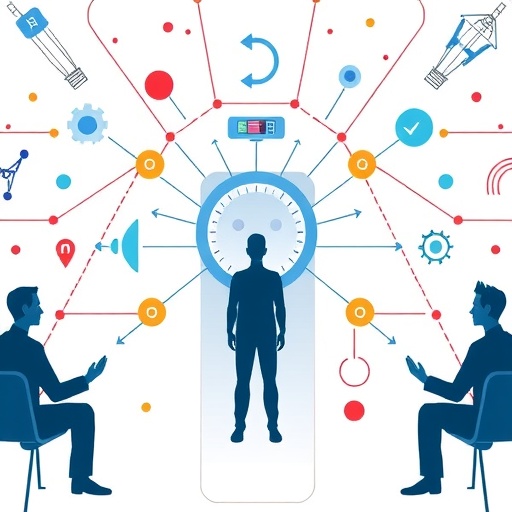
As artificial intelligence (AI) continues its rapid integration into the very fabric of critical decision-making processes across diverse sectors, the conversation has shifted fundamentally. The question is no longer whether humans and AI will work together, but how this collaboration can be optimally structured to harness the unique strengths of both, achieving what experts term “true complementarity.” This evolving dynamic was explored in depth in a groundbreaking new study titled “Toward a Science of Human–AI Teaming for Decision Making: A Complementarity Framework,” recently published in PNAS Nexus. The paper presents an innovative framework aimed at understanding and designing teams comprising humans and AI systems, ultimately to improve decision-making outcomes.
The multidisciplinary team behind the research, hailing from prestigious institutions including Carnegie Mellon University, MIT, University of Illinois at Urbana-Champaign, Microsoft Research, Harvard University, and the University of Tennessee at Knoxville, brought a holistic perspective to the challenge. Their collective expertise spans organizational behavior, cognitive decision science, computer science, and social psychology. This convergence allowed the researchers to blend insights from collective intelligence with advanced AI methodologies, focusing especially on three core cognitive processes: reasoning, memory, and attention.
The central premise of the framework is that these cognitive functions, fundamental to decision-making, can be dynamically and strategically distributed between human and AI team members. By partitioning these processes effectively, teams can transcend the performance of either humans acting alone or AI systems operating in isolation. This approach moves beyond the simplistic framing of “humans versus AI” and instead advocates for a design paradigm that leverages AI’s computational strengths to augment human contextual understanding and ethical judgment.
One of the framework’s salient contributions is its articulation of the sociotechnical conditions under which human-AI teams achieve complementarity. Team composition, a critical element, addresses the selection of human expertise and AI capabilities that align with task requirements. Trust calibration emerges as another vital factor, highlighting the importance of appropriately balancing confidence and skepticism toward AI outputs to avoid overreliance or underuse. Shared mental models, or the mutual understanding of team roles, goals, and processes, are emphasized as crucial for seamless coordination and communication within the team.
Training and task structure further shape the effectiveness of human-AI collaboration. Continuous and adaptive training protocols are recommended to evolve team competencies in response to new challenges and AI system updates. Task structure is examined with attention to how workflows, decision paths, and information exchange can be orchestrated to maximize the synergistic potential of human and machine partners. The framework insists that such deliberate design choices are necessary to cultivate an environment where human and AI capabilities complement rather than compete.
Beyond outlining these conditions, the paper advances concrete design principles to guide practitioners in building robust human-AI teams. Definitions of clear goals and operational constraints serve as the foundation, ensuring alignment in expectations and outcomes. Role partitioning follows, assigning tasks based on the comparative advantages of humans and AI, such as AI’s speed and scale in data processing versus humans’ nuanced judgment and accountability.
Orchestration of attention and interrogation processes is another intriguing aspect of the framework. It advocates designing systems that foster interactive dialogues, enabling humans to probe AI reasoning and verify outputs actively. This iterative interrogation aims to enhance transparency and trustworthiness, preventing the opaque “black box” problem that has long hindered AI acceptance in sensitive domains. Additionally, building robust knowledge infrastructures supports continuous learning and shared understanding within human-AI teams, anchoring decisions in a collective and evolving knowledge base.
The framework’s emphasis on continuous training and evaluation mechanisms addresses the necessity for adaptability in an ever-changing technological and social landscape. By incorporating real-time feedback and performance assessment, teams can refine their collaboration, improve error detection, and respond proactively to emerging risks. This cyclical process forms the backbone of resilient human-AI partnerships capable of sustaining high performance under uncertainty.
The implications of this research are profound, extending to theoretical, practical, and policy realms. At the theoretical level, it pushes the frontier of understanding collective intelligence in hybrid human-AI contexts, challenging existing models that predominantly consider humans or machines in isolation. Practically, it offers a scaffold for organizations to engineer teams where AI does not supplant human workers but rather amplifies their strengths and mitigates limitations.
From a policy perspective, the framework underscores the non-negotiable dimensions of ethical alignment, accountability, and equity in the deployment of AI systems in decision-making. It calls for governance structures that ensure these human-centric values are codified and upheld, acknowledging that technology deployment cannot be divorced from societal impact and fairness considerations. Such a stance resonates strongly in domains like healthcare, emergency response, finance, transportation, and governance, where decisions carry profound human consequences.
One of the paper’s lead authors, Professor Cleotilde Gonzalez of Carnegie Mellon University, highlights the seismic nature of this transformation: “AI is becoming deeply embedded in collective decision-making, marking a profound transformation in how decisions are made across domains.” This transformation also necessitates not just technological sophistication but principled governance and rigorous empirical evaluation. The framework serves as a roadmap guiding researchers, practitioners, and policymakers in navigating this complex terrain responsibly.
Professor Anita Williams Woolley, another prominent contributor from Carnegie Mellon’s Tepper School of Business, offers a nuanced perspective countering adversarial metaphors. “Organizations often frame the issue as humans versus AI,” she explains, “but the better question is how to design teams so AI expands what people can notice, remember, and reason through while people provide context, judgment, and accountability.” Her insights call for a paradigm shift in how organizations conceptualize working with AI—from competition to complementarity.
The urgency of this research cannot be overstated. AI systems are increasingly positioned not just as tools but as active team members in decision processes. Without deliberate and scientifically guided design, the risk of suboptimal outcomes, decreased accountability, and ethical lapses escalates. This framework provides a much-needed scientific scaffold to engineer human-AI interactions that are not only efficient but also equitable, transparent, and ultimately human-centered.
Finally, the implications of this work hint at a future where human cognitive capabilities and AI computational power coalesce to foster decision-making systems that are adaptive and trustworthy. By embedding AI in collaborative socio-technical systems designed around human values, this research illuminates a path toward harnessing artificial intelligence not merely as an automaton but as an intelligent partner. The complementarity framework, therefore, offers both a vision and actionable guidelines that promise to reshape the landscape of decision-making in the AI era.
Cite Scienmag News
Courtney Benton. (April 30, 2026). New Framework Harnesses Collective Intelligence to Boost Collaboration in Human-AI Teams. Scienmag. https://scienmag.com/new-framework-harnesses-collective-intelligence-to-boost-collaboration-in-human-ai-teams/
Courtney Benton. "New Framework Harnesses Collective Intelligence to Boost Collaboration in Human-AI Teams." Scienmag, 30 April 2026, https://scienmag.com/new-framework-harnesses-collective-intelligence-to-boost-collaboration-in-human-ai-teams/. Accessed 1 September 2026.
Courtney Benton. "New Framework Harnesses Collective Intelligence to Boost Collaboration in Human-AI Teams." Scienmag. April 30, 2026. https://scienmag.com/new-framework-harnesses-collective-intelligence-to-boost-collaboration-in-human-ai-teams/


