


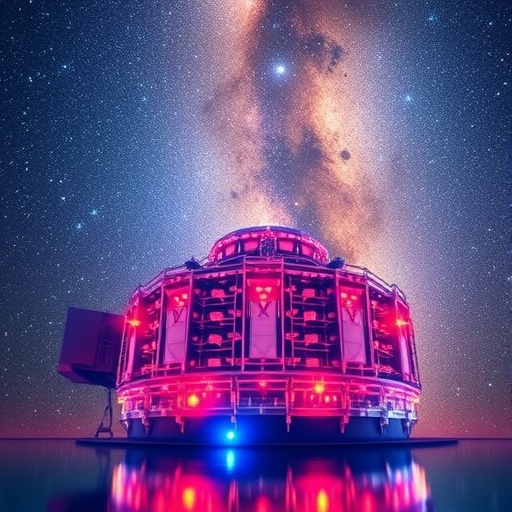
In a landmark development poised to reshape our understanding of the most extreme environments in the cosmos, the Large High Altitude Air Shower Observatory (LHAASO) has recorded ultra-high-energy (UHE) gamma rays emanating from a gamma-ray binary system known as LS I +61° 303. This system, previously observed only up to energies around 10 trillion electron volts (TeV), has now been observed to emit gamma rays with energies surpassing 100 TeV—a scale of energy that challenges and expands the boundaries of modern particle astrophysics. The findings, reported in the prestigious journal Physical Review Letters, mark a significant stride in decoding the origins of cosmic rays, a mystery that has perplexed scientists for over a century.
Gamma-ray binaries, celestial systems comprising a massive star paired with a compact object—either a neutron star or a stellar-mass black hole—have long fascinated astronomers due to their extreme and energetic environments. These binaries serve as natural astrophysical laboratories where particles can be accelerated to staggering energies. Until now, only a handful of such binaries have been confirmed to emit very-high-energy gamma rays, generally up to a few tens of TeV. The revelation that LS I +61° 303 can generate gamma rays an order of magnitude higher thrusts this system into uncharted territory, hinting that it functions as a site for particle acceleration at velocities previously unverified in such binaries.
LHAASO’s unique sensitivity and expansive energy detection capabilities have been instrumental in this discovery. By meticulously analyzing the gamma-ray spectrum of LS I +61° 303, scientists could extend measurements into the ultra-high-energy regime, precisely up to 200 TeV. This remarkable feat confirms LS I +61° 303 as a bona fide UHE gamma-ray binary and implies the presence of extraordinarily powerful accelerators within the system. The observatory’s high-altitude location and cutting-edge detector array enable it to capture extensive air showers produced when cosmic gamma rays strike Earth’s atmosphere, providing unparalleled insight into these energetic phenomena.
Crucially, the LHAASO collaboration uncovered that the intensity of gamma-ray emissions from LS I +61° 303 exhibits a distinctive modulation synchronized with the binary’s orbital period of approximately 26.5 days. This orbital modulation is not uniform across energies, demonstrating a complex dependence on gamma-ray energy that signals intricate internal processes governing particle acceleration and emission within the binary. Understanding this modulation enhances our comprehension of how dynamic interaction between the stellar wind of the massive star and the compact object’s environment shapes the acceleration mechanisms at play.
Recent theoretical models have struggled to explain how electrons can reach the energy levels required to generate gamma rays beyond 100 TeV in such systems. Strong magnetic fields typically induce intense synchrotron radiation losses for high-energy electrons, effectively preventing their acceleration to these daunting scales. The detection of gamma rays at energies exceeding 100 TeV thus strongly suggests a hadronic origin: high-energy protons, rather than electrons, are likely being accelerated within the system. These protons then interact with the dense stellar wind, creating ultra-high-energy gamma rays through proton-proton collisions that produce neutral pions, which decay into gamma photons.
This fascinating interpretation carries profound implications. It positions gamma-ray binaries like LS I +61° 303 as potential “PeVatrons,” astrophysical accelerators capable of propelling particles to the PeV (peta-electron-volt) regime—a milestone long sought by cosmic ray researchers. Identifying such PeVatrons is essential in unraveling the enigmatic sources of the highest-energy cosmic rays that constantly bombard Earth. These cosmic rays hold clues to the mechanisms that govern extreme particle acceleration, and confirming their astrophysical sources will unlock new chapters in high-energy astrophysics.
The detection of LS I +61° 303 as a UHE gamma-ray emitter also places stringent constraints on existing theoretical frameworks. Particle acceleration models must now account for mechanisms robust enough to overcome both magnetic energy losses and complex orbital dynamics. They must explain how protons are energized and efficiently interact with local matter to yield the observed gamma-ray flux and modulation characteristics. Moreover, these models advance the dialogue of how various binary system parameters, such as orbital eccentricity, stellar wind density, and magnetic field structure, synergize to create energetic radiation signatures observed across electromagnetic spectra.
From a broader perspective, the results achieved by the LHAASO collaboration enrich the burgeoning field of multi-messenger astronomy, which integrates information from electromagnetic signals with neutrinos, cosmic rays, and gravitational waves to paint a holistic portrait of energetic astrophysical events. The identification of hadronic processes in LS I +61° 303 aligns with expectations that such binaries could be sources of neutrinos, tantalizing prospects for coincident detections by neutrino observatories worldwide. Such cross-disciplinary investigations will deepen our grasp of extreme particle physics phenomena occurring far beyond our solar system.
The instruments and techniques deployed by LHAASO underscore the technological leaps necessary to unlock these astrophysical riddles. Located at a high elevation to maximize the detection of cosmic-ray air showers, its detectors combine a water-Cherenkov array, muon detectors, and wide-field Cherenkov telescopes, all collaboratively enhancing gamma-ray sensitivity from multi-TeV to PeV energies. This comprehensive array enables continuous monitoring of the northern sky, capturing temporal variations and extending energy reach beyond previous observatories—capabilities pivotal for characterizing the ephemeral and orbitally modulated emissions of sources like LS I +61° 303.
Historically, the pursuit of the sources of high-energy cosmic rays has been likened to a cosmic detective story, tracing particles from their Earthly detections back to their astrophysical origins. The confirmation of UHE gamma rays from LS I +61° 303 brings this quest one critical step closer to resolution. It offers a rare observational window into natural cosmic accelerators functioning at near-imaginable energy scales, inviting a re-examination of the physical conditions that can forge such extreme particle energies and trigger observable gamma-ray emissions.
As investigators delve deeper into these findings, future studies will likely focus on refining orbital modulation models, exploring multi-wavelength observational campaigns, and coordinating with neutrino and gravitational wave observatories. These efforts will help tease apart the subtle interplay between particle acceleration, radiation processes, and binary system dynamics. The LHAASO collaboration’s breakthrough thus not only illuminates a long-standing astrophysical mystery but also paves the way for innovative, interdisciplinary explorations that promise to redefine high-energy astrophysics for decades to come.
In summary, the groundbreaking detection of ultra-high-energy gamma rays from the gamma-ray binary LS I +61° 303 heralds an epochal advance in astroparticle physics. This discovery reshapes our conceptual and theoretical frameworks regarding particle acceleration mechanisms in binary systems and broadens the scope of viable cosmic ray sources. With its unique observational capabilities, LHAASO has propelled a venerable astrophysical puzzle into a new arena of discovery—one that promises thrilling scientific revelations at the intersection of cosmic rays, gamma-ray astronomy, and multi-messenger astrophysics.
News Publication Date: 30-Apr-2026
Web References:
Physical Review Letters DOI 10.1103/7xhp-tff7
References:
The study published in Physical Review Letters by the LHAASO collaboration and affiliated researchers from the Institute of High Energy Physics and Shanghai Astronomical Observatory of the Chinese Academy of Sciences.
Cite Scienmag News
Nicholas Scott. (April 30, 2026). LHAASO Unveils New Ultra-High-Energy Particle Accelerator Within the Milky Way. Scienmag. https://scienmag.com/lhaaso-unveils-new-ultra-high-energy-particle-accelerator-within-the-milky-way/
Nicholas Scott. "LHAASO Unveils New Ultra-High-Energy Particle Accelerator Within the Milky Way." Scienmag, 30 April 2026, https://scienmag.com/lhaaso-unveils-new-ultra-high-energy-particle-accelerator-within-the-milky-way/. Accessed 1 September 2026.
Nicholas Scott. "LHAASO Unveils New Ultra-High-Energy Particle Accelerator Within the Milky Way." Scienmag. April 30, 2026. https://scienmag.com/lhaaso-unveils-new-ultra-high-energy-particle-accelerator-within-the-milky-way/


