


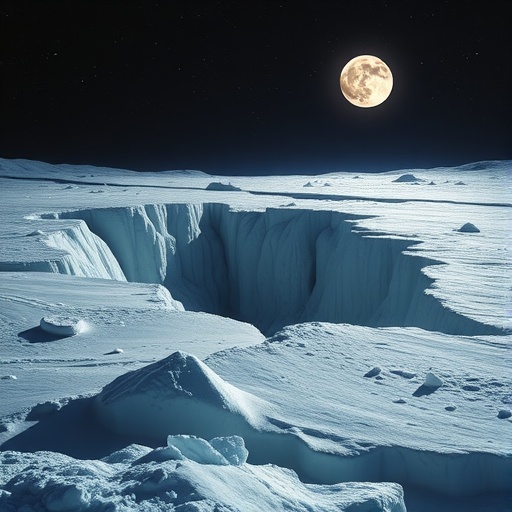
More than fifty years have passed since the final human footsteps were imprinted on the lunar surface, yet the Moon continues to captivate scientific intrigue and ambitious exploration plans. The nascent 21st-century lunar space race has reignited with unprecedented zeal, marked most recently by NASA’s Artemis II mission, which promises to carry humans back to lunar orbit after decades. Unlike the Apollo era’s widely distributed landing sites, present-day and upcoming missions concentrate their efforts on the Moon’s enigmatic South Pole. This region is not only geologically fascinating but is also believed to harbor one of the most precious resources for sustained extraterrestrial presence: water ice.
The hypothesis that water ice might exist within the Moon’s polar craters was first proposed by rocket pioneer Robert H. Goddard over a century ago, based on the idea that permanently shadowed regions on the Moon could trap volatiles. More recent observational data from spacecraft orbiting the lunar surface, notably NASA’s Lunar Reconnaissance Orbiter (LRO), have provided indirect but persuasive evidence supporting this hypothesis. Water ice is a cornerstone in the future of space exploration, offering vital life-support elements such as drinking water and agricultural irrigation, as well as potential raw material for rocket fuel through electrolysis. Moreover, the study of ice deposits can unveil significant clues about the solar system’s history.
Now, a groundbreaking study conducted by scientists at the Weizmann Institute of Science alongside collaborators in the United States has illuminated how ice has been steadily accumulating in the Moon’s polar cold traps for over 1.5 billion years. Published in the prestigious journal Nature Astronomy, this research pivots on the identification and dating of ancient permanently shadowed regions—deep craters near the lunar poles where sunlight never reaches—offering a refined map of promising icy deposits essential for future explorations and potential human habitation.
The Moon’s axial tilt, or obliquity, plays a central role in creating these cold traps. Unlike Earth’s 23.5-degree tilt, which directs sunlight to different hemispheres throughout the year, the Moon’s axial tilt is almost negligible, slightly shifting the Sun’s apparent path only near the equator. Observers standing at the lunar poles would experience the Sun skimming just above the horizon in slow monthly cycles rather than rising and setting daily, leaving the floors of many polar craters eternally bathed in shadow. Such shadowed conditions maintain temperatures low enough to preserve ice deposits over geologic timescales.
Intriguingly, the Moon’s axial tilt was not always as minimal as it is today. Geological and orbital analyses indicate that billions of years ago, the lunar tilt was significantly greater, resulting in a dynamic past where regions previously exposed to sunlight gradually transitioned into permanent shadows as the tilt decreased. Researchers have reconstructed the timeline of these transitions, revealing the ages of the cold traps and opening new avenues to correlate crater shadowing history with ice accumulation.
In their study, Prof. Oded Aharonson of the Weizmann Institute and colleagues applied sophisticated geometric and ultraviolet spectral analyses to test the relationship between the age of permanently shadowed regions and the incidence of ice coverage within them. Since ice exhibits distinctive ultraviolet (UV) reflectance properties compared to the lunar regolith, particularly in UV wavelengths emitted not only by the Sun but also by distant stellar sources, UV-sensitive instruments like NASA’s Lyman-Alpha Mapping Project on the LRO have been instrumental in mapping surface ice with high precision.
The team’s analysis yielded a revelatory trend: craters that became permanently shadowed earlier tend to harbor greater extents of ice. This finding implies a long-term, nearly continuous process of ice accretion spanning at least 1.5 billion years, rather than ice delivery from one-off events like massive comet impacts. Crucially, however, not all shadowed craters are equally proficient at trapping ice. For instance, the well-studied Shackleton Crater, located closest to the lunar South Pole and long considered a prime ice candidate, was found to have only become a sufficiently cold trap approximately 500 million years ago, due to heating effects from crater walls. Conversely, the less heralded Haworth Crater emerged as a model cold trap, maintaining ultra-cold conditions and ice accumulation potential for over 3 billion years.
Ultra-low temperatures—around minus 160 degrees Celsius—are essential for the stability of water ice on the lunar surface over extended periods. “Cold traps” are thus defined not only by permanent shadow but also by their ability to maintain these frigid conditions without intrusive thermal radiation from their surroundings. By combining geometric modeling of crater topography with thermal data, the researchers classified which permanently shadowed regions truly act as long-lived cold traps. This differentiation is vital for mission planners aiming to sample the most pristine and abundant ice reserves.
The implications of this study are profound for NASA’s Artemis program and the broader ambition of establishing permanent lunar settlements. Locating ancient cold traps with thick ice deposits enhances the prospects of using in-situ resources to support human outposts, reducing dependence on costly Earth-based supply chains. It also gives insights into the Moon’s water cycle and the provenance of extraterrestrial water—a fundamental question linking planetary science and astrobiology.
The exact origins of lunar water remain an open scientific puzzle. The researchers employed mathematical modeling to examine water sources, losses, and redistribution on the Moon’s surface. Water supply mechanisms likely include the outgassing of volatile compounds from the interior via ancient volcanic activity, hydrogen implantation by the solar wind, and continual infall of water-rich asteroids and comets—none individually sufficient alone but potentially acting together to sustain ice accumulation. Evaporation and “impact gardening,” a dynamic process where frequent micrometeorite impacts churn and mix surface layers, influence the sustenance and spatial distribution of ice deposits.
These findings underscore the Moon’s unique role as a celestial laboratory—a comparative ground for investigating Earth’s watery history and a testbed for human exploration technologies. As Prof. Aharonson eloquently highlights, sampling lunar ice could definitively confirm its chemical composition vis-à-vis terrestrial water, illuminating pathways for sustainable human presence on the Moon and potentially guiding resource utilization strategies on other icy bodies across the solar system.
As humanity stands on the cusp of its next giant leap, this research indelibly advances our understanding of lunar polar science, providing a detailed roadmap for future missions to probe cold traps like Haworth Crater. The promise of unlocking the Moon’s icy reserves not only propels scientific discovery but also catalyzes the enduring dream of living and thriving beyond Earth.
News Publication Date: 7-Apr-2026
Web References:
References:
- Aharonson, O., Hayne, P., & Schörghofer, N. (2026). Observational constraints on the history of lunar polar ice accumulation. Nature Astronomy. https://doi.org/10.1038/s41550-026-02822-9
Keywords
Lunar Ice, Moon South Pole, Permanently Shadowed Regions, Cold Traps, Artemis Mission, Water Ice Accumulation, Ultraviolet Reflectance, Lunar Reconnaissance Orbiter, Lunar Exploration, In-Situ Resource Utilization, Planetary Science, Space Exploration
Cite Scienmag News
Grant Pearson. (April 30, 2026). Hidden Cold Traps May Reveal the Secrets of Lunar Ice. Scienmag. https://scienmag.com/hidden-cold-traps-may-reveal-the-secrets-of-lunar-ice/
Grant Pearson. "Hidden Cold Traps May Reveal the Secrets of Lunar Ice." Scienmag, 30 April 2026, https://scienmag.com/hidden-cold-traps-may-reveal-the-secrets-of-lunar-ice/. Accessed 3 September 2026.
Grant Pearson. "Hidden Cold Traps May Reveal the Secrets of Lunar Ice." Scienmag. April 30, 2026. https://scienmag.com/hidden-cold-traps-may-reveal-the-secrets-of-lunar-ice/


