


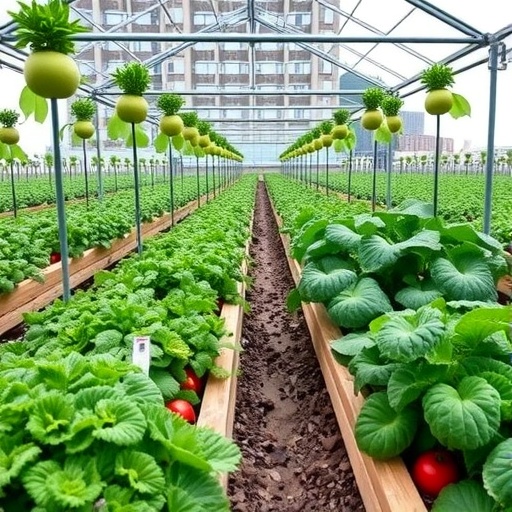
A revolutionary new study spearheaded by researchers from the Netherlands and Germany has unveiled the tremendous potential of urban agriculture across Europe’s cities in bolstering local food production. Published in the esteemed journal Sustainable Cities and Society on April 22, 2026, the research meticulously assesses how vegetable cultivation integrated into urban landscapes could serve as a game-changer in addressing food security challenges. Using advanced geospatial analysis, the study estimates that European urban agriculture could yield up to 20 million tons of vegetables annually, accounting for roughly one-third of Europe’s current vegetable output.
This landmark investigation, led by Stepan Svintsov from the Leibniz Institute of Ecological Urban and Regional Development (IOER) in Germany, systematically analyzes 840 cities across 30 European countries. It leverages high-resolution land-use data, building footprints, population density metrics, and regional climate classifications to map underutilized urban spaces ripe for agricultural transformation. By combining these rich datasets within a GIS-based framework, the study offers one of the most comprehensive evaluations of urban agriculture’s scope to date, bringing empirical rigor to discussions around sustainable city food systems.
The integration of agriculture into urban environments emerges as a multifaceted strategy to strengthen resilience against growing environmental and societal pressures. As cities continue to grapple with the intersecting threats of climate change, rapid population growth, and disruptions in global food supply chains, localized vegetable production offers a meaningful buffer. Prajal Pradhan, associate professor at the University of Groningen and corresponding author, emphasizes the urgency: “Urban agriculture can play a critical role in building more resilient and sustainable urban food systems amid escalating challenges.”
A key highlight of the study is its focus on open-air, soil-based vegetable cultivation methods that capitalize on accessible urban spaces without dependence on high-tech infrastructures. This approach underscores the practical reality of converting readily available rooftops, residential gardens, vacant lots, and public green spaces into productive food-growing areas. The findings suggest an attainable use of between 4,500 and 7,500 square kilometers of such urban land, an area comparable in size to one or two islands like Mallorca, for vegetable production.
By tapping into this vast but often overlooked potential, urban agriculture could supply approximately 28 percent of the vegetable demand for nearly 190 million urban residents. This projection reframes urban land not as a constraint but as an asset in entire food production systems. Svintsov summarizes the transformative outlook: “Harnessing unused urban land and rooftops for vegetable cultivation can significantly shift current dependency on rural agriculture and long supply chains.”
The environmental benefits of embedding agriculture within cities are substantial. Localized production directly reduces the carbon footprint associated with transporting fresh vegetables over long distances. Additionally, the presence of urban farms invigorates green space availability, improving urban microclimates, enhancing biodiversity, and offering ecosystem services such as pollination and air purification. From a sustainability perspective, integrating food cultivation aligns closely with circular urban economy principles, reducing waste and enhancing resource efficiency.
Importantly, the study stresses that urban agriculture is not proposed as a wholesale substitute for traditional rural farming but rather as a complementary system that diversifies food supply chains. Diverse and distributed food networks improve overall system robustness and adaptive capacity in the face of external shocks like pandemics, geopolitical conflicts, or climate-induced disruptions. Urban agriculture’s contribution to food security therefore transcends purely production metrics and encompasses strengthening systemic resilience.
One of the most notable dimensions of variation identified in the study relates to geographic and climatic heterogeneity across Europe. Southern European cities contend with challenges including water scarcity, which could constrain irrigation-dependent crop growth, while Northern European urban centers face shorter growing seasons and limited sunlight exposure. These complexities emphasize the need for context-specific urban agriculture strategies tailored to local environmental and infrastructural conditions.
The research also draws connections between urban agriculture and contemporary urban planning paradigms, particularly the “15-Minute City” concept. This forward-looking urban design philosophy advocates for residents’ access to essential services, including fresh food, within a short walk or bike ride. Embedding productive vegetable gardens and farms in neighborhoods aligns organically with this vision, improving food accessibility and fostering stronger community ties.
Healthcare and nutrition stand to gain from increased urban agriculture adoption. Access to fresh, nutritious vegetables within local urban environments encourages healthier diets and lifestyle choices. Community garden initiatives further promote social cohesion and active participation in food systems, building awareness around sustainable consumption. These socio-cultural benefits complement the direct environmental advantages highlighted in the study, positioning urban agriculture as a holistic urban development tool.
The authors caution, however, that successful implementation requires policy support and strategic urban planning interventions. Regulatory frameworks must navigate barriers such as land tenure complexities, zoning restrictions, and competing urban land use priorities. Concerted efforts by municipalities, planners, and stakeholders are essential to unlock urban agriculture’s full potential and integrate it seamlessly into broader urban infrastructure.
Furthermore, the study notes that while advanced farming technologies like hydroponics and vertical farming hold promise, their exclusion from this assessment underscores the vast potential of simpler, less resource-intensive methods. This pragmatic approach demonstrates that transformative gains can be accomplished even with modest technological inputs, making urban agriculture a more accessible and scalable solution.
As cities globally seek pathways to sustainability, circularity, and resilience, this study provides a robust evidence base advocating for agriculture’s central role within urban environments. By harnessing overlooked urban spaces for meaningful vegetable production, European cities can pioneer models for sustainable food systems that are environmentally sound, socially inclusive, and economically viable. This research sets the stage for new policies and innovations that will redefine the interface between urban life and food production in the years ahead.
Cite Scienmag News
Alan Morgan. (April 30, 2026). Urban Agriculture Could Meet Nearly 28% of Europe’s Vegetable Demand, Study Finds. Scienmag. https://scienmag.com/urban-agriculture-could-meet-nearly-28-of-europes-vegetable-demand-study-finds/
Alan Morgan. "Urban Agriculture Could Meet Nearly 28% of Europe’s Vegetable Demand, Study Finds." Scienmag, 30 April 2026, https://scienmag.com/urban-agriculture-could-meet-nearly-28-of-europes-vegetable-demand-study-finds/. Accessed 31 August 2026.
Alan Morgan. "Urban Agriculture Could Meet Nearly 28% of Europe’s Vegetable Demand, Study Finds." Scienmag. April 30, 2026. https://scienmag.com/urban-agriculture-could-meet-nearly-28-of-europes-vegetable-demand-study-finds/


