


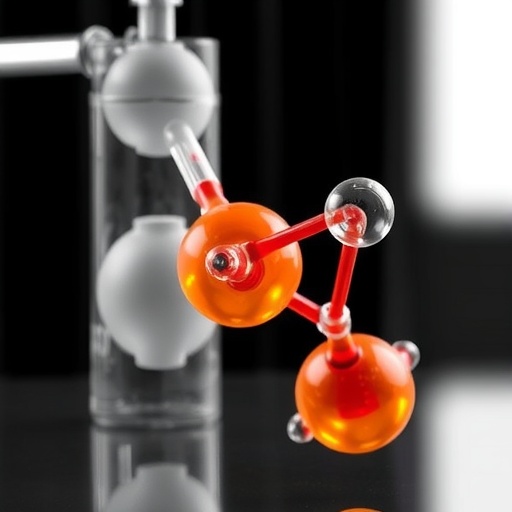
In a groundbreaking advancement that could reshape the landscape of sustainable polymer production, researchers have unveiled a detailed mechanistic understanding of low-pressure carbon dioxide (CO2) insertion during epoxide–CO2 copolymerization catalysis. This breakthrough provides crucial insights into how CO2, a greenhouse gas, can be efficiently and effectively converted into valuable polymeric materials under mild conditions, a feat that has eluded chemists for decades. By elucidating the intricate chemistry governing this catalytic process, the study opens new avenues for designing next-generation polymers with enhanced properties and environmental benefits.
At the heart of this research lies the phenomenon of CO2 insertion into an evolving polymer chain during the copolymerization with epoxides. Traditionally, generating polycarbonates from CO2 and epoxides requires substantial pressure and temperature, which complicates the process and increases costs. The newly revealed low-pressure insertion mechanics provide a paradigm shift, suggesting that milder and more sustainable conditions are not only possible but can be systematically optimized. This discovery could ultimately enable the widespread industrial adoption of CO2 valorization in polymer production, reducing reliance on petrochemical feedstocks.
The study meticulously charts the catalytic cycle involved in epoxide–CO2 copolymerization, highlighting how the catalyst interacts with CO2 molecules at different reaction stages. One of the pivotal findings is that the catalytic system mediates CO2 insertion at surprisingly low pressures by stabilizing transition states that have previously been considered energetically inaccessible under such conditions. This stabilization is achieved through precise molecular engineering of the catalyst’s active site, which enhances the binding affinity for CO2 and controls the spatial orientation of reactants to favor insertion.
A detailed analysis of the catalyst structure reveals that fine-tuning the ligand environment profoundly affects the energetics and kinetics of CO2 insertion. By modifying donor atoms and electronic properties, the researchers demonstrated a delicate balance between reactivity and selectivity, ensuring that CO2 integrates into the polymer chain without generating unwanted side products. This rational catalyst design showcases the power of combining computational modelling with experimental validation to tailor catalytic performance.
Moreover, the research highlights the importance of dynamic ligand behavior during catalysis. Unlike static catalytic paradigms, the ligands in this system exhibit flexibility, adapting their conformation in response to substrate binding and insertion events. This flexibility is essential to accommodate the ring-opening of epoxides and the subsequent CO2 insertion while maintaining overall catalyst stability. Such mechanistic insights underline the potential for creating even smarter catalysts that can respond to reaction conditions dynamically, optimizing efficiency.
Another transformative aspect covered in the study is the interplay between CO2 pressure and polymer microstructure. By fine-tuning the reaction environment, the researchers demonstrated control over not just the polymer’s growth but also its architecture at the molecular scale. This control translates directly into tailored physical properties, such as polymer crystallinity, mechanical strength, and thermal stability. These advancements offer promising directions for creating biocompatible, durable, and recyclable materials suited for diverse applications ranging from biomedical devices to sustainable packaging.
Importantly, the study also probes the thermodynamics underlying CO2 activation and insertion. It identifies key energetic barriers that have historically impeded low-pressure processes and outlines strategies to overcome them through catalyst design. This thermodynamic framework clarifies why certain catalytic systems falter at low pressures and provides a roadmap for developing catalysts that can work effectively under industrially relevant mild conditions, significantly reducing energy consumption.
The implications of this research extend beyond the laboratory, positioning CO2-derived polycarbonates as viable alternatives to traditional plastics. Given the global drive to mitigate climate change, the ability to sequester CO2 in durable materials is a major step toward a circular carbon economy. The insights from this work help bridge a crucial gap in understanding how to harness atmospheric or flue gas CO2 levels without resorting to high-pressure reactors, which are costly and energy-intensive.
Additionally, the research team utilized state-of-the-art spectroscopic techniques and in situ monitoring to observe the polymerization process in real-time. These cutting-edge tools provided unprecedented resolution into intermediate species and reaction dynamics, confirming theoretical predictions and offering direct evidence for proposed mechanistic pathways. This comprehensive approach—integrating theory, synthesis, and advanced characterization—exemplifies the best practices in modern catalysis research.
The environmental significance of low-pressure CO2 insertion chemistry cannot be overstated. By reducing the energetic burden of producing polycarbonates, this technology promises a leap forward in green chemistry principles. It encourages the development of manufacturing methodologies that minimize waste, decrease carbon footprints, and promote renewable feedstocks. As industries pivot towards sustainability, such catalytic processes are anticipated to become cornerstones in the production of eco-friendly materials.
Future prospects indicated by this study are equally exciting. The detailed mechanistic understanding lays the foundation for exploring other heterocyclic monomers and copolymer combinations. Expanding the scope of CO2 copolymerization could unlock an array of new materials with customizable properties, further contributing to the design of circular, sustainable material economies. This research effectively sets a new benchmark for innovation in CO2 utilization chemistry.
In conclusion, the unveiled understanding of low-pressure CO2 insertion chemistry within epoxide copolymerization catalysis represents a milestone in sustainable polymer science. It marries fundamental mechanistic insights with practical catalyst design, thereby transcending theoretical interest and paving the way for industrial relevance. As the world seeks alternatives to fossil-based plastics, such inventive chemical solutions highlight how sophisticated catalysis can turn environmental challenges into tangible opportunities.
The dissemination of this knowledge is likely to inspire further interdisciplinary collaborations, merging catalysis, materials science, and environmental engineering. By continuing to refine catalytic systems and process conditions, the research community moves ever closer to realizing the vision of carbon-neutral polymer production. The resonance of this discovery is poised to influence policy-making, innovation strategies, and educational priorities globally.
Undoubtedly, this work will captivate chemists, environmentalists, and industry leaders alike, fueling a wave of interest in green polymerization techniques. Its viral potential stems from the elegant solution it offers to a pressing global problem—transforming CO2 from an environmental burden into a versatile building block for advanced materials. This synthesis of sustainable chemistry and practical utility underscores the transformative power of catalytic science in the 21st century.
Cite Scienmag News
Bethany Barker. (April 30, 2026). Decoding Low-Pressure CO2 Insertion in Epoxide Catalysis. Scienmag. https://scienmag.com/decoding-low-pressure-co2-insertion-in-epoxide-catalysis/
Bethany Barker. "Decoding Low-Pressure CO2 Insertion in Epoxide Catalysis." Scienmag, 30 April 2026, https://scienmag.com/decoding-low-pressure-co2-insertion-in-epoxide-catalysis/. Accessed 1 September 2026.
Bethany Barker. "Decoding Low-Pressure CO2 Insertion in Epoxide Catalysis." Scienmag. April 30, 2026. https://scienmag.com/decoding-low-pressure-co2-insertion-in-epoxide-catalysis/


