


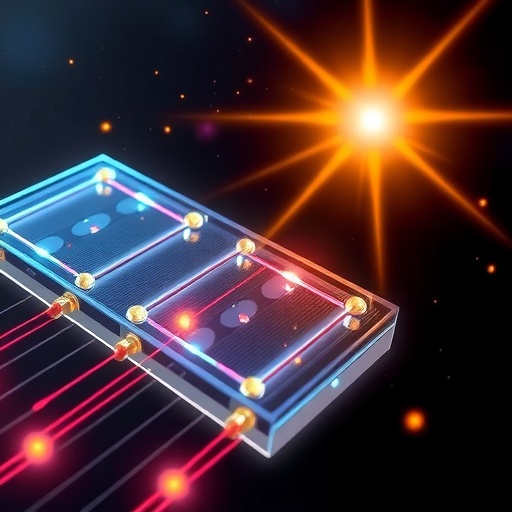
In a groundbreaking development poised to redefine the field of organic photovoltaics (OPVs), researchers have unveiled a novel mechanism to reclaim energy previously thought irrevocably lost in solar cells. Traditionally, non-geminate recombination processes in OPVs foster the formation of low-energy spin-triplet excitons, known as T1 states. These excitons are notorious for triggering irreversible, non-radiative decay pathways, which manifest as energy losses and significantly undermine the overall efficiency of organic solar devices.
The newly reported study, published in Nature in April 2026, turns this limitation on its head. By engineering an OPV system using a non-fullerene acceptor characterized by a narrowed singlet–triplet energy gap, the researchers have demonstrated that T1 excitons are not dead ends. Instead, these triplet excitons can be channelled back, redissociating through an interfacial charge-transfer (CT) state to regenerate free charge carriers. This discovery challenges the longstanding paradigm that triplet excitons are merely energy sinks, opening avenues for harnessing their latent potential to enhance device performance.
Carefully designed experiments have corroborated this mechanism by selectively sensitizing the triplet states of the acceptor molecules within the OPV blend. This sensitization notably increased the population of free carriers—a direct indicator that triplet excitons were being successfully recycled rather than lost. The study elucidates how the interplay between triplet and charge-transfer states evolves over time, revealing a dynamic equilibrium that can be manipulated to favor charge extraction instead of energy dissipation.
Central to this breakthrough is the intricate relationship between molecular orbital distribution and exciton delocalization within condensed-phase aggregates of the acceptor. The way excitons spread across these molecular assemblies significantly influences singlet–triplet energetics, allowing the system’s spin-triplet CT state population to be controlled. By fine-tuning these electronic properties, the researchers can effectively regulate the “traffic” between the T1 excitons and the spin-triplet CT states, a control previously unattainable in organic solar materials.
Taking this concept beyond a single system, the team introduced the specialized non-fullerene acceptor as a ternary component within established OPV blends. Remarkably, this strategy not only recovers triplet-mediated losses but also leads to tangible improvements in device efficiency by maximizing the extraction of photogenerated charge carriers. This approach redefines how ternary blends can be leveraged, transforming them from simple material hybrids into complex systems with actively controllable excitonic pathways.
This research significantly deepens our fundamental understanding of the physics underpinning organic photovoltaics. It dispels the fatalistic view of triplet excitons as mere parasitic species and instead positions them as valuable intermediates whose energy can be recycled and redirected towards usable electricity generation. This paradigm shift is anticipated to have far-reaching implications for the design and optimization of next-generation organic optoelectronic devices.
The potential ramifications of this discovery extend beyond photovoltaics. Since triplet excitons are pervasive in organic semiconductors, the insights gleaned here could impact the development of organic light-emitting diodes (OLEDs), photodetectors, and other technologies where exciton management is critical. By enabling the recovery of low-energy excitons into free charges, device longevity and efficiency can substantially benefit from this mechanism.
Underlying this innovative approach is the keen manipulation of molecular design elements, such as orbital symmetry and exciton delocalization, which govern the energetics of singlet–triplet transitions within the acceptor. Tailoring these features to narrow the singlet-triplet gap without compromising other electronic properties is a subtle art, one which the researchers have mastered. Their meticulous optimization underscores the delicate balance between material chemistry and photophysics necessary to enable triplet recycling.
Having identified the link between triplet sensitization and charge carrier regeneration, the team employed advanced spectroscopic and kinetic techniques to trace the evolution of exciton and charge populations in real-time. These methods revealed a sophisticated feedback loop in which triplets are temporarily stored and subsequently re-emitted as free carriers, a process previously hypothesized but not empirically demonstrated with such clarity.
The demonstration of this triplet recycling mechanism also suggests new strategies for mitigating voltage loss in high-efficiency OPVs. Voltage losses attributed to non-radiative recombination to triplet states have long constrained device performance. By converting the traditionally loss-inducing triplet excitons back into charge carriers, this technique potentially closes one of the key inefficiency gaps that have limited organic solar cell commercialization.
This newly uncovered pathway provides a fresh blueprint for molecular engineers, emphasizing the importance of exciton dynamics control to push organic solar technologies towards and beyond current efficiency plateaus. The adoption of acceptors with tunable singlet-triplet energetics is poised to be a focal point for future research, enabling the design of OPVs that not only capture sunlight effectively but also recycle every quantum of absorbed energy.
In summary, the research heralds a transformative advance for organic photovoltaics. By converting previously “lost” spin-triplet excitons into functional charge carriers, the study not only enhances the understanding of excitonic processes but also sets the stage for constructing more efficient, durable, and cost-effective solar energy devices. This breakthrough paves the way for the future of organic optoelectronics, where low-energy excitons are no longer liabilities but rather assets that drive enhanced performance and sustainability.
Cite Scienmag News
Denise Maddox. (April 30, 2026). Recycling Spin-Triplet Excitons Boosts Organic Solar Cells. Scienmag. https://scienmag.com/recycling-spin-triplet-excitons-boosts-organic-solar-cells/
Denise Maddox. "Recycling Spin-Triplet Excitons Boosts Organic Solar Cells." Scienmag, 30 April 2026, https://scienmag.com/recycling-spin-triplet-excitons-boosts-organic-solar-cells/. Accessed 31 August 2026.
Denise Maddox. "Recycling Spin-Triplet Excitons Boosts Organic Solar Cells." Scienmag. April 30, 2026. https://scienmag.com/recycling-spin-triplet-excitons-boosts-organic-solar-cells/


