


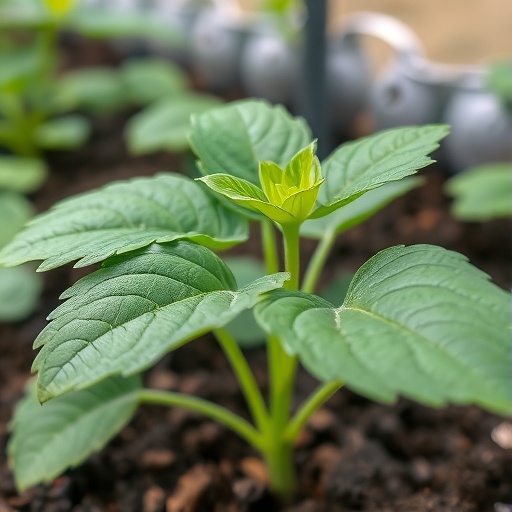
Plant immune inducers represent a transformative frontier in sustainable agriculture, offering novel solutions to combat destructive crop diseases without relying on environmentally damaging chemical pesticides. Among these, oligochitosan (COS), a naturally derived biopolymer, has garnered significant attention for its ability to prime plant defense responses against a spectrum of pathogens including fungi, bacteria, and viruses. While previous investigations predominantly highlighted COS effectiveness against tobacco mosaic virus, its potential mechanisms conferring resistance to the economically devastating potato virus Y (PVY) had remained largely uncharted—until now.
PVY is notorious for inflicting severe yield losses in staple crops such as potatoes and tobacco, especially in developing countries where agricultural practices may be constrained by resources and technology. This global threat necessitates innovative, sustainable strategies to bolster plant immunity. Addressing this urgent need, a team of researchers led by Academician Baoan Song at the State Key Laboratory of Green Pesticide, Guizhou University, embarked on a comprehensive study to decode the molecular underpinnings of COS-induced resistance against PVY. Their findings were recently published in Frontiers of Agricultural Science and Engineering.
Using Nicotiana benthamiana as a model organism, the research revealed that applying COS at an optimized concentration of 100 μg·mL^–1 significantly dampened PVY infection, achieving a preventive efficacy exceeding 54%. This suppression notably mitigated viral damage and symptom development in treated plants. The extent of resistance triggered by COS was remarkable in light of PVY’s high virulence, marking a critical advance in plant virology and immunity research.
At the biochemical level, COS provoked a robust enhancement in enzymatic activities pivotal to plant defense. Key antioxidant enzymes—including catalase (CAT), peroxidase (POD), phenylalanine ammonia-lyase (PAL), and superoxide dismutase (SOD)—showed elevated activity, collectively orchestrating a fortified oxidative stress response. Concurrently, COS treatment increased intracellular hydrogen peroxide (H_2O_2) levels, a signaling molecule known to activate systemic resistance pathways. These molecular shifts suggest that COS primes plants to generate a rapid, multifaceted response upon viral attack.
Intrigued by these biochemical transformations, the researchers delved deeper employing integrated transcriptomic and proteomic approaches to chart the signaling pathways modulated by COS. Their analyses identified differential expression of pivotal genes and proteins linked to reactive oxygen species (ROS) signaling and the mitogen-activated protein kinase (MAPK) cascade, essential components of innate immunity. Notably, COS stimulated upregulation of genes such as OXI1, NDPK4, and MAPKKK21, which are recognized mediators of redox signaling and defense activation.
The OXI1 gene emerged as a central player in COS-induced immunity. Functional assays revealed that elevated OXI1 expression directly stimulated downstream effectors MAPKKK21 and NDPK4, thereby triggering the MAPK signaling pathway. This cascade ultimately amplified plant resistance mechanisms against PVY infection. Such delineation of the signaling hierarchy offers crucial insights into how external elicitors like COS interface with intrinsic plant defense networks.
To validate the indispensable role of OXI1, transgenic N. benthamiana lines were engineered for either overexpression or RNA interference-mediated silencing of OXI1. Plants overexpressing OXI1 displayed markedly reduced severity of PVY symptoms, exhibiting a 40% decrease in viral coat protein accumulation. Conversely, OXI1 silencing rendered plants more vulnerable, with PVY coat protein levels surging by over 110%, underscoring OXI1’s key function in antiviral defense.
This nuanced understanding of ROS-mediated MAPK signaling clarifies the immunomodulatory effects of COS against PVY, bridging a significant knowledge gap that previously hindered practical application. The identification of OXI1 as a molecular linchpin not only advances fundamental plant pathology but also provides a strategic target for enhancing crop resilience via biostimulant development.
The implications of this research extend beyond academic curiosity. The eco-friendly nature of COS offers a promising path to reduce dependence on synthetic chemical pesticides, aligning with global efforts to implement sustainable agriculture and mitigate environmental pollution. Its application could safeguard food security, particularly in regions hardest hit by viral crop epidemics.
Moreover, these findings set a precedent for exploring similar immune-inducing agents across diverse plant species vulnerable to viral pathogens. The deployment of such natural inducers can be integrated into holistic pest management systems, complementing genetic resistance and agricultural best practices.
As plant virology moves toward more environmentally conscious interventions, the elucidation of COS-induced pathways exemplifies how molecular biology and biotechnology converge to yield practical agricultural innovations. Future research may expand on this mechanistic framework to optimize dosage, delivery methods, and field efficacy of COS-based treatments under variable environmental conditions.
The work spearheaded by Academician Baoan Song’s team stands as a testament to the potential of plant immune inducers to revolutionize green crop protection. Ensuring sustainable agriculture in the face of increasing biotic stresses represents a pivotal challenge—one that COS and its mechanistic revelations are uniquely poised to help meet.
News Publication Date: 15-Jun-2026
Web References:
https://journal.hep.com.cn/fase/EN/10.15302/J-FASE-2025666
http://dx.doi.org/10.15302/J-FASE-2025666
Cite Scienmag News
Kristina Jarvis. (April 29, 2026). How Oligochitosan Activates Plant Defenses Against Potato Virus Y. Scienmag. https://scienmag.com/how-oligochitosan-activates-plant-defenses-against-potato-virus-y/
Kristina Jarvis. "How Oligochitosan Activates Plant Defenses Against Potato Virus Y." Scienmag, 29 April 2026, https://scienmag.com/how-oligochitosan-activates-plant-defenses-against-potato-virus-y/. Accessed 1 September 2026.
Kristina Jarvis. "How Oligochitosan Activates Plant Defenses Against Potato Virus Y." Scienmag. April 29, 2026. https://scienmag.com/how-oligochitosan-activates-plant-defenses-against-potato-virus-y/


