


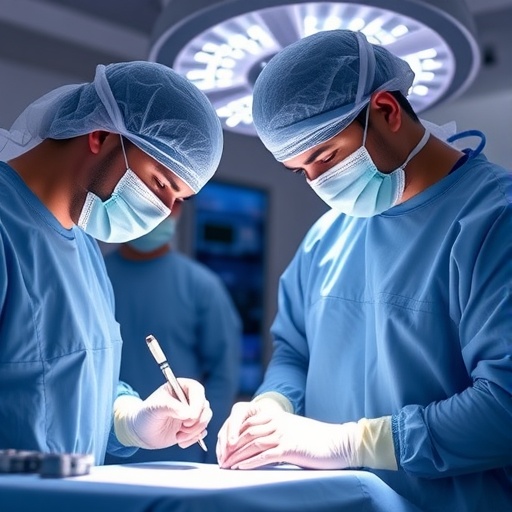
In a transformative leap for minimally invasive surgery, researchers at New York University Abu Dhabi have pioneered a novel class of soft, flexible sensors meticulously designed to reinstate the surgeon’s lost sense of touch. These innovative devices signify a critical advance in surgical technology, addressing a pivotal challenge that has long impeded the tactile feedback crucial to delicate tissue manipulation during “keyhole” procedures.
Minimally invasive surgeries, while revolutionizing patient outcomes by significantly reducing recovery time and postoperative pain, impose a notable sensory limitation on surgeons. The long, slender instruments used in these procedures inherently diminish haptic perception, making it difficult to gauge the force applied to fragile tissues. This loss can lead to inadvertent tissue damage, underscoring the urgent need for sensory restoration at the instrument interface.
Published in the esteemed journal Microsystems & Nanoengineering, the study spearheaded by Associate Professor Mohammad A. Qasaimeh integrates cutting-edge mechanical engineering and bioengineering principles to develop multichannel soft microfluidic force sensors. These sensors boast the remarkable ability to capture an extensive range of forces, from the faintest touch to robust grasps, capturing real-time data otherwise imperceptible to the human hand during minimally invasive interventions.
The sensor architecture is grounded in a soft silicone matrix embedded with intricate, minuscule channels filled with liquid metal. When mechanical pressure is exerted on the sensor, these channels undergo subtle deformation, modulating the electrical properties within the fluid. This deformation translates into quantifiable changes, enabling precise force measurement with high sensitivity and responsiveness—a feat unattainable with traditional rigid sensor designs.
To validate this technology’s clinical relevance, the research team seamlessly integrated these sensors into a laparoscopic grasper, a staple tool in minimally invasive surgery. One sensor is positioned strategically on the handle, monitoring the surgeon’s applied force, while another is affixed directly to the tool’s jaw, providing real-time feedback on the interaction forces with biological tissues, thereby offering dual vantage points of surgical force dynamics.
Professor Qasaimeh emphasizes the intrinsic challenge posed by conventional laparoscopic instruments: “Minimally invasive surgery benefits patients immensely, yet it strips away a fundamental human faculty—the sense of touch. Our soft sensors are designed not only to capture a broad spectrum of forces but also to harmonize effortlessly with existing surgical devices, steering the future of safer, smarter instruments.”
First author Wael Othman, who transitioned to an assistant professorship at Khalifa University subsequent to this project, underscores the dual imperatives of sensitivity and pragmatism in the sensor design. “Our goal was to engineer sensors nimble enough to detect both delicate and firm forces, compact enough for integration, and robust enough for surgical sterility and usability,” he explains, highlighting the sensor’s tailored scalability for various operative scenarios.
The multidimensional flexibility of these sensors extends beyond surgical handle placement. By modulating sensor dimensions and material properties, they can be positioned on the jaw for pinpoint force detection or distally on the handle to maintain sterility and unobstructed instrument function. This adaptability ensures comprehensive applicability in diverse procedural contexts.
Critically, the soft microfluidic sensors respond linearly across force ranges, offering reliable and repeatable measurements vital for nuanced tissue handling. The liquid metal channels’ resistance changes correlate finely with applied stress, providing surgeons with a quantifiable sense of pressure intensity that was previously absent and advancing the paradigm of force feedback in robotic and manual laparoscopy.
Beyond the immediate surgical realm, these sensors portend wider technological applications. Their capability to measure subtle to substantial forces accurately and flexibly positions them as prime candidates for integration into robotics, wearable health-monitoring devices, and any biomechanical systems where precise force quantification is pivotal.
This research marks a compelling confluence of microfluidics, soft materials science, and biomedical engineering. By marrying softness and sensitivity with practical design considerations, the NYU Abu Dhabi team has delivered a blueprint for future smart surgical instruments, promising to elevate surgical precision, reduce operative risks, and enhance patient outcomes fundamentally.
As the landscape of medical technology continues to evolve, innovations like these soft microfluidic force sensors exemplify the critical strides necessary to restore and enhance human capabilities amid increasing technological mediation. Surgeons, empowered with renewed tactile feedback, can perform with unprecedented confidence and delicacy, ultimately redefining standards in minimally invasive surgery.
Keywords
Applied sciences and engineering, soft sensors, minimally invasive surgery, laparoscopic instruments, force sensing, microfluidics, bioengineering, liquid metal sensors, surgical robotics, haptic feedback, sensor integration, medical devices
Cite Scienmag News
Ophelia Keating. (April 28, 2026). NYU Abu Dhabi Innovates Smart Soft Sensors to Reinstate Surgeons’ Sense of Touch in Minimally Invasive Surgery. Scienmag. https://scienmag.com/nyu-abu-dhabi-innovates-smart-soft-sensors-to-reinstate-surgeons-sense-of-touch-in-minimally-invasive-surgery/
Ophelia Keating. "NYU Abu Dhabi Innovates Smart Soft Sensors to Reinstate Surgeons’ Sense of Touch in Minimally Invasive Surgery." Scienmag, 28 April 2026, https://scienmag.com/nyu-abu-dhabi-innovates-smart-soft-sensors-to-reinstate-surgeons-sense-of-touch-in-minimally-invasive-surgery/. Accessed 4 September 2026.
Ophelia Keating. "NYU Abu Dhabi Innovates Smart Soft Sensors to Reinstate Surgeons’ Sense of Touch in Minimally Invasive Surgery." Scienmag. April 28, 2026. https://scienmag.com/nyu-abu-dhabi-innovates-smart-soft-sensors-to-reinstate-surgeons-sense-of-touch-in-minimally-invasive-surgery/


