


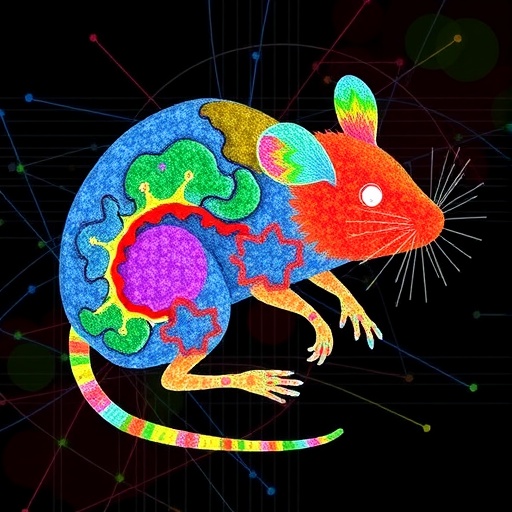
In the ever-complex landscape of neural circuitry, the basal ganglia and the thalamic parafascicular nucleus have long captured scientific focus due to their profound roles in motor control, cognitive processes, and behavioral regulation. A breakthrough study published in Nature Neuroscience has now illuminated the intricate genoarchitecture and the input–output organization of these mouse brain regions, shedding light on the cellular and circuit-level underpinnings that could have vast implications for understanding neurological diseases and developing targeted therapeutics.
The basal ganglia, a group of subcortical nuclei, are pivotal for volitional movement and habit formation. Yet, despite decades of research, a comprehensive map detailing their precise genetic and connectivity profiles remained elusive, mainly due to the high cellular heterogeneity and complex synaptic architecture. The parafascicular nucleus, a thalamic structure deeply interwoven with basal ganglia circuits, similarly posed unresolved questions about its input-output organization. This study by Wang et al. rises to the challenge by integrating cutting-edge genetic profiling with advanced neuroanatomical tracing techniques to decode these enigmatic brain regions in unprecedented detail.
A foundational aspect of the study was the employment of single-cell transcriptomics, allowing researchers to parse the diverse neuronal populations based on distinct gene expression signatures. This genomic fingerprinting revealed previously unrecognized subtypes within the basal ganglia and parafascicular nucleus, highlighting not only a structural but also a molecular complexity that refines the traditional view of these regions as uniform neuronal clusters. The implications here ripple outward: the specific gene expression profiles hint at differential vulnerability and specialized functions of these subpopulations.
Beyond transcriptional profiling, the researchers mapped the afferent and efferent connections meticulously, using viral tracers and sophisticated imaging modalities. They unveiled distinct input streams converging onto the basal ganglia from cortical and subcortical regions, establishing a layered understanding of how sensory, motor, and modulatory information streams integrate here. Similarly, the parafascicular nucleus was shown to act as a crucial relay hub, with bidirectional connectivity patterns that suggest its role in filtering and disseminating salient signals across the broader thalamocortical and basal ganglia circuitry.
Particularly striking was the finding of specialized projection neurons within the parafascicular nucleus, each genetically distinguished and linked to discrete output targets in the basal ganglia and cortex. This specificity translates to a fine-tuned regulatory mechanism, wherein the parafascicular nucleus does not simply relay information but actively shapes the flow and integration of signals, potentially modulating motor and cognitive functions dynamically.
The clarity of the genoarchitectural map also illuminates how pathological conditions might arise. For instance, neurodegenerative disorders such as Parkinson’s disease have been associated with basal ganglia dysfunction, yet the cellular origins and circuit-specific degeneration patterns remained obscure. The stratification of neuron types and their input-output schemas presented in this study provide a foundational template upon which disease models can be refined—allowing for the identification of vulnerable circuits and the development of targeted interventions.
Moreover, the study’s integrative methodology sets a new standard for neuroanatomical research. Combining molecular genetics with circuit tracing and functional connectivity analyses offers a holistic perspective that transcends the limitations of any single technique. This interdisciplinary approach not only enriches our understanding of fundamental brain organization but also paves the way for exploring circuit-based therapeutic strategies, such as optogenetic modulation or cell-type-specific gene therapies.
The basal ganglia’s role extends beyond motor control to include reward processing and habit formation, implicating its dysregulation in disorders like addiction and obsessive-compulsive disorder. By delineating the exact neuron types and their networks within this system, the study equips neuroscientists with the tools to dissect these complex behaviors at a granular level. Understanding how specific neuronal subpopulations contribute to pathological habits versus adaptive learning holds promise for innovative psychiatric treatments.
On a broader scale, the dynamics of thalamic nuclei, including the parafascicular nucleus, influence arousal, attention, and sensory processing. The granularity introduced by this research implicates distinct neuronal cohorts in modulating these states, suggesting potential mechanisms for attention-deficit and sensory integration disorders. Future research leveraging these findings could thus revolutionize how clinicians approach cognitive and attentional impairments.
From a methodological standpoint, the application of high-throughput single-cell RNA sequencing was crucial for disentangling the complex cellular milieu. Coupled with retrograde and anterograde tracing, this approach yielded a bidirectional map of connectivity, revealing how individual neuron types receive and send signals across distributed networks. Such data are invaluable for constructing computational models that predict circuit function and dysfunction, heralding a new era of neuroscience where data-driven insights inform experimental and clinical paradigms.
The study also unearthed the temporal dynamics of gene expression and connectivity across developmental stages, providing a glimpse into how these neural circuits mature. This developmental perspective is critical, as many neuropsychiatric conditions manifest during early life. Deciphering how the basal ganglia and parafascicular nucleus establish and refine their connections could identify critical periods for intervention and the molecular cues that guide normal and abnormal development.
Importantly, the research underscores that the basal ganglia and parafascicular nucleus should not be viewed as isolated entities but as integrated nodes within a vast neural network. Their connectivity profiles demonstrate a tightly regulated balance of excitation and inhibition, with neuron-type-specific modulatory functions. Disrupting this balance may underlie several neurological deficits, and the precise molecular markers identified open avenues for selective targeting of dysfunctional circuits without impairing overall brain function.
Wang and colleagues also explored the electrophysiological characteristics associated with the genetically defined neuron types, correlating firing patterns with connectivity and gene expression. These multidimensional datasets provide a comprehensive framework that links form, function, and genetics—essential for deciphering the operational principles of the basal ganglia-thalamic axis.
Beyond the immediate scientific ramifications, this study represents a paradigm shift in how we conceptualize subcortical brain architecture. By moving past gross anatomical divisions and embracing cellular-level diversity within interconnected networks, the research advocates for a more nuanced treatment of brain function and dysfunction. It positions the basal ganglia and parafascicular nucleus as dynamic, genetically diverse hubs whose modulation could be precisely controlled for therapeutic benefit.
The implications extend into translational neuroscience, where understanding the specific input-output patterns and molecular identities may inform the design of brain-machine interfaces and neuroprosthetics. Tailoring these technologies to interact selectively with defined circuit components could dramatically enhance efficacy and minimize side effects in the treatment of motor and cognitive disorders.
In summary, this landmark investigation offers a richly detailed genoarchitectural and connectivity atlas of the mouse basal ganglia and thalamic parafascicular nucleus—a feat that brings us closer to unraveling the cerebral code underlying sensorimotor integration, cognition, and behavior. The interdisciplinary approach combining high-resolution genetic maps with connectivity analyses paves the way for novel insights into brain function and dysfunction, setting a new benchmark in systems neuroscience.
As neuroscience continues to advance, studies like that of Wang et al. exemplify the power of integrating molecular, anatomical, and functional data to crack open the black box of brain circuits. Their work not only enriches fundamental neuroscience but also sparks hope for more precise interventions and informed translational strategies addressing a wide array of neurological and psychiatric disorders that implicate the basal ganglia-thalamic network.
Cite Scienmag News
Cassandra Pierce. (April 28, 2026). Mapping Mouse Basal Ganglia and Thalamic Circuits. Scienmag. https://scienmag.com/mapping-mouse-basal-ganglia-and-thalamic-circuits/
Cassandra Pierce. "Mapping Mouse Basal Ganglia and Thalamic Circuits." Scienmag, 28 April 2026, https://scienmag.com/mapping-mouse-basal-ganglia-and-thalamic-circuits/. Accessed 5 September 2026.
Cassandra Pierce. "Mapping Mouse Basal Ganglia and Thalamic Circuits." Scienmag. April 28, 2026. https://scienmag.com/mapping-mouse-basal-ganglia-and-thalamic-circuits/


