


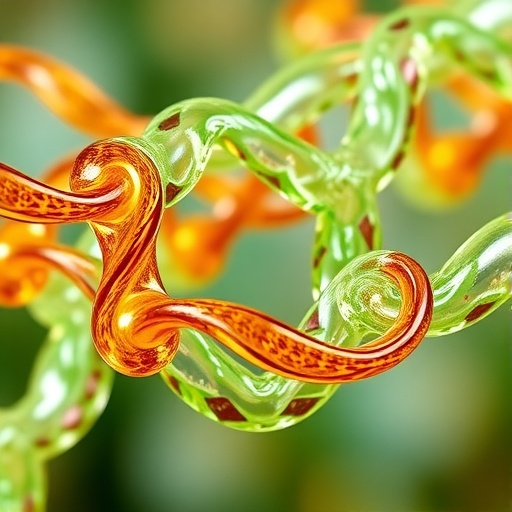
In the ever-evolving landscape of materials science, nature’s intricate designs continue to inspire pioneering innovations. Among the most captivating natural motifs that underpin life itself is the helical structure—quintessentially embodied by DNA and prevalent in protein architectures. This elegant spiral not only embodies aesthetic finesse but imparts critical dynamic functionality, enabling biomolecules to adapt structurally in response to their environment. Capitalizing on this biological blueprint, a multidisciplinary team from Japan and the United Kingdom has synthesized a chlorophyll-based supramolecular polymer that uniquely transitions through multiple helical states as it matures, revealing a novel paradigm of dynamic helicity in synthetic polymers.
This groundbreaking research, led by Professor Shiki Yagai at Chiba University, presents an unprecedented molecular system where the supramolecular fibers evolve sequentially from initially nonhelical assemblies into progressively tighter helices over several days. Unlike conventional synthetic polymers that might adopt a helical form instantaneously, this system embodies a kinetic trapping mechanism that allows it to explore multiple metastable conformations before stabilizing into tightly wound helical structures. Such dynamic and staged helicity evolution, never before explicitly observed in synthetic supramolecular materials, heralds a new frontier in the controlled formation of complex nanostructures.
At the molecular core of this system lies a chlorophyll derivative meticulously functionalized with barbituric acid moieties and extended alkyl chains. These modifications enable the molecules to self-assemble via directional hydrogen bonding into discrete, planar ring constructs termed “rosettes.” In solvent environments of low polarity, these rosettes stack atop one another forming elongated, fibrous polymers. However, due to the substantial steric hindrance and the considerable molecular size of each chlorophyll unit, the stacking arrangement is initially disordered, prohibiting immediate organization into helices. This kinetic frustration results in early formation of nonhelical fibers that serve as a scaffold for gradual structural refinement into helices.
Atomic force microscopy (AFM) unveiled four distinct fiber morphologies during this transformation. The initial nonhelical fiber (NF) arises from vertically aligned rosettes stacked without lateral offsets. Subsequent helical forms—designated HF1, HF2, and HF3—exhibit progressive twisting caused by incremental translational shifts between rosettes in the stack. These shifts generate right-handed helices distinguishable by their pitch lengths: 26 nm for HF1, 13 nm for HF2, and a remarkably tight 8 nm for HF3. This spectrum of helical pitches illustrates the multistep nature of helicity maturation within the supramolecular polymer.
Temporal studies employing advanced imaging captured the kinetics of this sequential evolution. The initial solution predominated by nonhelical fibers demonstrates rapid depletion of NF within minutes, supplanted by coexistence of HF1 and HF2 within half an hour. Over subsequent hours, a near-complete conversion of HF1 to HF2 structures occurs, indicating a cooperative rearrangement within polymer chains. The final and slowest metamorphosis from HF2 to HF3 spans several days, emphasizing the energy barriers involved in achieving the most twisted, energetically favored conformation.
Notably, this helical progression does not occur randomly but propagates cooperatively along the polymer backbone. Localized reorganization in one segment encourages conformational transitions in adjacent areas, suggesting an intrapolymer communication that orchestrates large-scale morphological transformation. This cooperative behavior parallels allosteric effects in biological macromolecules, where local structural changes propagate to influence global functions.
The implications of this study extend beyond fundamental supramolecular chemistry. It offers a blueprint for engineering materials with adaptive, time-responsive structural behavior—a critical attribute for next-generation smart materials. By designing molecular units exhibiting multiple stable binding modes with small energy differentials, scientists can achieve materials capable of switching between discrete states, mimicking the environmental responsiveness observed in natural biopolymers.
Beyond the immediate molecular insights, the research opens avenues to investigate the spatial dynamics of helicity development: whether the structural evolution initiates stochastically at multiple nucleation points or progresses directionally from distinct seeds along the fibers. Decoding this aspect could unlock precise spatiotemporal control over polymer behavior, empowering designers to fabricate materials with programmable morphologies and functions.
This multidisciplinary effort leverages an array of characterization methodologies encompassing synthesis, spectroscopic analysis, atomic force microscopy, and computational modeling. The chlorophyll-based design capitalizes on nature’s photonic and electronic properties, providing an added functional dimension alongside structural adaptability. Such supramolecular systems may one day underpin innovations in optoelectronics, sensing platforms, and responsive biomedical devices.
Professor Yagai’s team underscores the rarity and significance of this cooperatively evolving helicity within a one-dimensional supramolecular polymer. Their observations challenge existing paradigms by demonstrating that polymer backbone reorganizations can traverse a rugged energy landscape through discrete structural intermediates. This enriches the conceptual framework of supramolecular polymerization and expands the toolkit available for molecular architects.
With the study published in the Journal of the American Chemical Society, the scientific community gains invaluable insights into dynamic self-assembly processes. Continued investigation promises to illuminate the intricate interplay between molecular design, kinetic trapping, and cooperative transformations in complex polymeric systems, edging science closer to creating synthetic materials that rival biological sophistication.
As the research progresses, the team aims to elucidate the directional nature of helicity propagation, potentially discovering mechanisms to harness or manipulate these processes in synthetic contexts. Understanding such mechanisms could enable the fabrication of highly ordered nanomaterials exhibiting controlled switching between functional states—a long-sought goal in materials science.
In sum, this work exemplifies how biomimetic approaches can revolutionize synthetic material design by embracing complexity and temporal evolution, rather than static assembly, fostering the generation of materials that dynamically respond to their environments much like living systems.
News Publication Date: April 20, 2026
Web References:
https://pubs.acs.org/doi/10.1021/jacs.6c03125
https://www.cn.chiba-u.jp/en/news/
References:
Vedhanarayanan B., Tsuchida R., Kudo R., Hanayama H., Datta S., Seetha Lakshmi K.C., Tamiaki H., Hara N., Hori Y., Rogers S.E., Fujita T., Hollamby M.J., Kawai S., Yagai S. Sequential, Multistep, and Cooperative Helicity Evolution in Supramolecular Polymers of Chlorophyll Rosettes. Journal of the American Chemical Society. 2026 Apr 20; doi:10.1021/jacs.6c03125.
Keywords
Helical polymers, supramolecular assembly, chlorophyll derivatives, dynamic helicity, kinetic trapping, cooperative transformation, nanostructure evolution, molecular self-assembly, hydrogen bonding, chlorophyll rosettes, atomic force microscopy, biomimetic materials.
Cite Scienmag News
Neil Sanderson. (April 27, 2026). Nature’s Twist in Motion: Unraveling Time-Evolving Helicity in Polymers. Scienmag. https://scienmag.com/natures-twist-in-motion-unraveling-time-evolving-helicity-in-polymers/
Neil Sanderson. "Nature’s Twist in Motion: Unraveling Time-Evolving Helicity in Polymers." Scienmag, 27 April 2026, https://scienmag.com/natures-twist-in-motion-unraveling-time-evolving-helicity-in-polymers/. Accessed 4 September 2026.
Neil Sanderson. "Nature’s Twist in Motion: Unraveling Time-Evolving Helicity in Polymers." Scienmag. April 27, 2026. https://scienmag.com/natures-twist-in-motion-unraveling-time-evolving-helicity-in-polymers/


