


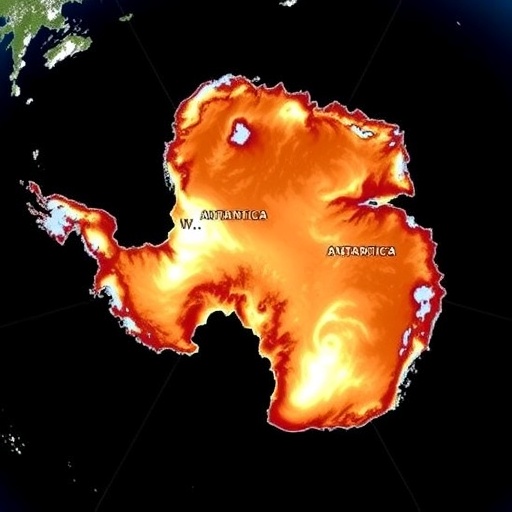
In a groundbreaking study poised to redefine our understanding of Antarctica’s geological past, a team of researchers has unveiled a comprehensive revision of the tectonic chronology of East and West Antarctica since the breakup of the ancient supercontinent East Gondwana. Published in Nature Communications in 2026, this research challenges long-standing paradigms about the continent’s tectonic evolution and offers profound insights into the complex interplay of plate tectonics, continental drift, and regional geodynamics in one of Earth’s most enigmatic and least accessible regions.
The breakup of East Gondwana, which began over 180 million years ago, set into motion a cascade of tectonic events that ultimately shaped not only Antarctica but also the surrounding southern continents. Historically, the tectonic history of East and West Antarctica has been studied as discrete entities, each with distinct crustal compositions and structural features. However, the newly proposed chronology bridges this dichotomy, suggesting a far more integrated and interdependent tectonic evolution influenced by both intracontinental and intercontinental forces.
Central to the study is the synthesis of extensive geochronological data obtained through advanced radiometric dating techniques, including U-Pb zircon dating and Ar-Ar thermochronology. This robust dataset allowed the researchers to meticulously reconstruct the timing and sequence of tectonic events, revealing previously unrecognized phases of rifting, magmatism, and major crustal deformation. Notably, the work identifies key overprinting tectonic episodes that blur the distinction between East and West Antarctic geological provinces, signifying a continuum of crustal processes rather than discrete regional histories.
The revised tectonic framework elucidates the relationship between the Antarctic Peninsula and the Transantarctic Mountains—features long debated regarding their origin and temporal correlation. The research underscores that both regions experienced synchronous tectonothermal events linked to the initial stages of East Gondwana fragmentation. This revelation challenges prior assumptions that interpreted their development as largely independent phenomena and has significant implications for understanding continental margin evolution in polar settings.
Moreover, the research intricately details the role of mantle dynamics beneath Antarctica in driving surface tectonics. The presence of mantle plumes and related magmatic activity is argued to have played a pivotal role in initiating lithospheric thinning and facilitating rift propagation. By integrating seismic tomography data with surface geology, the study provides compelling evidence for mantle upwelling beneath East Antarctica during critical windows of tectonic reorganization, impacting crustal stability and driving episodic magmatism.
An equally transformative aspect of the study involves reevaluating the timing of major orogenic belts that traverse Antarctica. The researchers present compelling arguments for revising the ages of the East Antarctic Orogen and the West Antarctic Rift System, illustrating their formation as part of a protracted and complex orogenic cycle rather than brief or isolated events. This has far-reaching implications for global models of supercontinent assembly and dispersal, particularly concerning the interplay of Gondwana’s constituent landmasses.
Significantly, this new chronology offers novel explanations for enigmatic geological formations previously misaligned with conventional plate tectonic models. For instance, discordant stratigraphic sequences and anomalous crustal blocks are reassessed in light of complex transpressional and transtensional regimes inferred from the updated timeline. The study suggests that these tectonic regimes were modulated by shifts in plate boundary dynamics, perhaps influenced by evolving Pacific and Indian Ocean gateway configurations.
The comprehensive revision also sheds light on the paleoenvironmental context in which Antarctica’s tectonic evolution unfolded. By correlating tectonic phases with climatic proxies and sedimentary records, the authors propose a mechanism linking tectonic uplift and rift activity with episodic glaciations and shifts in ocean circulation patterns. This nexus between tectonics and climate underscores Antarctica’s profound influence on Earth’s system-level processes over geological timescales.
In addition to the geological implications, this research carries profound significance for understanding Antarctic ice sheet dynamics. The tectonic architecture controls crustal elevation and topography, which in turn regulate ice sheet stability and patterns of glacial advance and retreat. The new tectonic timeline facilitates more accurate modeling of ice sheet responses to past tectonic and climatic changes, enhancing predictive capabilities for future ice mass behavior in a warming world.
Importantly, the interdisciplinary approach adopted in this study—integrating geochronology, structural geology, geophysics, and paleoenvironmental data—represents a methodological blueprint for future tectonic reconstructions. The authors emphasize that resolving Antarctica’s geology demands the convergence of diverse datasets and innovative analytical frameworks capable of transcending traditional disciplinary boundaries.
The study’s findings also reopen discussions regarding the geological links between Antarctica and other southern continents, such as Australia, South America, and Africa. The temporal refinement of East Gondwana’s breakup stages enables more precise correlations of tectonic and magmatic events across these regions, fostering a better understanding of supercontinental cycles and mantle convection’s role in driving plate reorganizations.
Furthermore, the authors identify several remaining uncertainties and propose targeted areas for future research. These include high-resolution geophysical surveys in underexplored regions, more detailed sampling along key tectonic transects, and integration of paleomagnetic data to constrain past plate configurations more tightly. Such efforts promise to refine, and potentially further transform, the tectonic narrative presented.
The article’s publication in Nature Communications highlights the global scientific community’s recognition of Antarctica’s critical role as a natural laboratory for tectonic and climate change studies. By shifting paradigms and incorporating novel analytical techniques, the research exemplifies scientific innovation that challenges conventional wisdom and sparks new lines of inquiry.
In conclusion, this exhaustive revision of Antarctica’s tectonic chronology since the breakup of East Gondwana is set to become a foundational reference for geologists and geophysicists alike. It reshapes our comprehension of continental dynamics in polar environments, elucidates the interconnectedness of tectonic, climatic, and ice sheet processes, and underscores the continent’s significance for Earth’s geological and environmental history. As researchers continue to probe the frozen continent’s secrets with growing technological prowess, such studies will be pivotal in unravelling the complex legacy of Antarctica’s deep-time evolution.
Choi, H., Kim, SS., Kim, S. et al. Revising the tectonic chronology of East–West Antarctica since the breakup of East Gondwana.
Nat Commun (2026). https://doi.org/10.1038/s41467-026-72500-x
Cite Scienmag News
Eleanor C. (April 27, 2026). New Tectonic Timeline for East-West Antarctica Unveiled. Scienmag. https://scienmag.com/new-tectonic-timeline-for-east-west-antarctica-unveiled/
Eleanor C. "New Tectonic Timeline for East-West Antarctica Unveiled." Scienmag, 27 April 2026, https://scienmag.com/new-tectonic-timeline-for-east-west-antarctica-unveiled/. Accessed 28 August 2026.
Eleanor C. "New Tectonic Timeline for East-West Antarctica Unveiled." Scienmag. April 27, 2026. https://scienmag.com/new-tectonic-timeline-for-east-west-antarctica-unveiled/


