


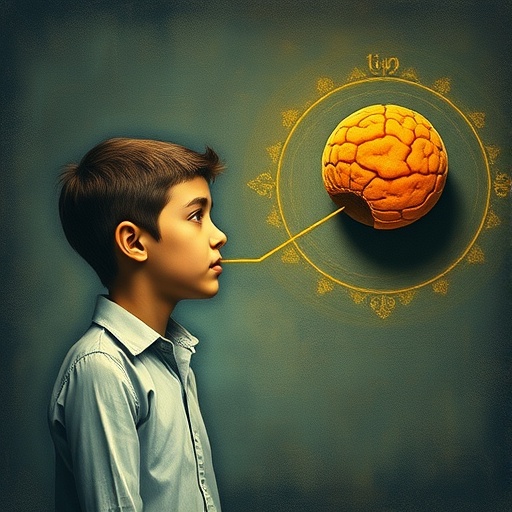
In a groundbreaking advancement in psychiatric research, a collaborative team led by Halverson, Kittleson, and Liu has unveiled novel insights into the cognitive and affective underpinnings of delusional experiences. Their study, published in the upcoming 2026 issue of Schizophrenia (Schizophr), provides a compelling framework that integrates latent reasoning factors and affective dimensions to unravel the complexity of delusions, a core symptom of psychotic disorders such as schizophrenia.
Delusions, characterized by firmly held false beliefs resistant to counterevidence, have long eluded a mechanistic understanding. Traditional approaches have predominantly focused on overt symptomatology or broad neurobiological correlates. This new research pivots from these paradigms, delving deeply into latent constructs—hidden cognitive and affective processes that collectively influence subjective reality without direct measurement. By applying advanced statistical modeling to multifaceted clinical and neuropsychological datasets, the scientists have isolated intrinsic reasoning patterns that predispose individuals to delusional ideation.
A critical innovation in this study lies in the division of reasoning into distinct latent factors, rather than treating thought distortions as monolithic. These factors encompass deductive inference biases, probabilistic reasoning impairments, and deficits in metacognitive awareness. Each factor subtly distorts the interpretative frameworks that patients use to process ambiguous or contradictory information about their environment. The researchers argue that these latent reasoning aberrations fundamentally alter how new evidence is integrated, preferentially reinforcing delusional beliefs instead of challenging them.
Complementing the cognitive analysis is an exploration of affective influences on delusional experience. Emotional valence and regulation were found to modulate the impact of reasoning biases, suggesting that affective dysregulation exacerbates the rigidity and emotional salience of delusions. For instance, heightened anxiety or dysphoria may intensify the personal relevance of delusional content, making false beliefs more resistant to cognitive reappraisal. This multidimensional approach recognizes that delusions are not merely cognitive errors but are embedded within an affective landscape.
Methodologically, the researchers employed latent variable modeling techniques integrated with machine learning algorithms to parse large-scale psychometric and neuroimaging data. This approach allowed for the identification of hidden variable structures that traditional factor analyses might obscure. Importantly, neuroimaging correlates validated the cognitive-affective model by demonstrating specific patterns of aberrant connectivity in brain regions associated with reasoning and emotional processing, such as the prefrontal cortex and amygdala.
The implications of this integrative framework extend beyond theoretical understanding. Clinically, these findings hold promise for developing targeted interventions aimed at specific reasoning distortions and their affective modulators. Cognitive remediation therapies could be tailored to address identified reasoning biases, while adjunctive mood stabilization strategies may reduce the emotional reinforcement of delusional thinking. Such precision medicine approaches could improve prognosis in psychotic disorders characterized by persistent delusions.
Moreover, this study challenges the conventional categorical classification of psychoses by emphasizing dimensional cognitive-affective processes rather than diagnostic labels. The latent factor approach transcends traditional boundaries, suggesting that delusional experiences represent emergent phenomena from overlapping cognitive and emotional dysfunctions. This dimensional reconceptualization resonates with the Research Domain Criteria (RDoC) initiative, advocating for a mechanistic taxonomy grounded in neurobiological and psychological substrates.
The research also opens avenues for exploring the temporal dynamics of delusion formation and persistence. By longitudinally tracking latent reasoning and affective factors, future studies may elucidate how fluctuations in these dimensions predict the onset, evolution, or remission of delusional states. Detecting early shifts in reasoning biases or emotional regulation could enable preemptive therapeutic interventions, potentially mitigating the chronicity and disability associated with psychoses.
Furthermore, the neurocognitive insights gleaned from this work may generalize to other neuropsychiatric conditions involving distorted belief systems, such as bipolar disorder or severe depression with psychotic features. Understanding the shared and distinct latent mechanisms could refine differential diagnosis and tailor multifaceted treatment strategies accordingly.
The interdisciplinary collaborative effort exemplifies the synergy of cognitive neuroscience, clinical psychiatry, computational modeling, and affective science. By bridging these domains, the study represents a significant leap toward a unified account of how the brain’s reasoning capacities and emotional states intertwine to shape subjective realities that deviate from consensus truth.
Importantly, the authors advocate for integration of patient perspectives to enrich the modeling of delusional experiences. Incorporating qualitative data and lived experiences may illuminate aspects of the affective-cognitive interplay that purely quantitative paradigms overlook. This humanistic dimension aligns with contemporary emphases on personalized mental health care and participatory research.
While the findings mark a substantial advance, challenges remain in translating latent cognitive-affective constructs into practical clinical tools. For instance, the time and resource intensity of sophisticated neuropsychological assessments and neuroimaging may limit widespread application. However, ongoing efforts to develop brief, scalable proxies for latent factors hold promise for implementation in diverse clinical settings.
As the field moves forward, integrating genetic and molecular biomarkers with latent reasoning-affect models may yield a more comprehensive biopsychosocial framework for psychosis. Understanding how genetic vulnerabilities influence the emergence of latent cognitive and affective dysfunctions could elucidate etiological pathways and identify novel therapeutic targets.
This research underscores the importance of moving beyond surface symptoms to dissect the underlying computational and emotional architectures of psychiatric disorders. By illuminating how latent latent reasoning distortions and affective dysregulation converge in delusional experiences, the study charts a path toward mechanistically informed diagnostics and precision therapies that could revolutionize care for millions affected by psychotic illnesses worldwide.
In conclusion, the synergistic analysis by Halverson and colleagues not only enriches the scientific understanding of delusions but also signals a paradigm shift towards integrative, computationally rigorous, and clinically translatable psychiatry. Their work stands as a beacon for future research endeavors aiming to unravel the enigma of the human mind when it strays into firmly deceptive beliefs powered by intricate but hidden cognitive and affective forces.
Cite Scienmag News
Glenn Wilkins. (April 25, 2026). Linking Reasoning, Emotion, Cognition to Delusions. Scienmag. https://scienmag.com/linking-reasoning-emotion-cognition-to-delusions/
Glenn Wilkins. "Linking Reasoning, Emotion, Cognition to Delusions." Scienmag, 25 April 2026, https://scienmag.com/linking-reasoning-emotion-cognition-to-delusions/. Accessed 30 August 2026.
Glenn Wilkins. "Linking Reasoning, Emotion, Cognition to Delusions." Scienmag. April 25, 2026. https://scienmag.com/linking-reasoning-emotion-cognition-to-delusions/


