


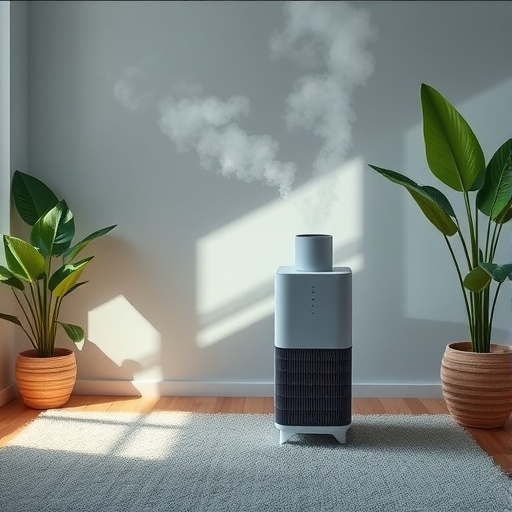
In an age where urban living spaces are increasingly compact and pollution levels continue to rise, the quality of indoor air has become a critical public health concern. Recent scientific advances have highlighted the efficacy of portable air cleaners (PACs) in mitigating one of the most insidious indoor pollutants: fine particulate matter, known as PM2.5. These microscopic particles, less than 2.5 micrometers in diameter, penetrate deep into the respiratory tract, leading to a host of adverse health effects including respiratory and cardiovascular diseases. A groundbreaking study published this year sheds new light on the actual impact of portable air cleaners within real-world residential settings.
The research, carried out by Mendell, Lee, and Siegel, offers a meticulously designed randomized crossover trial involving multifamily residential buildings. This experimental design is particularly significant since it accounts for the variability inherent in everyday living environments—factors such as occupant behavior, building ventilation, and ambient outdoor pollution influence indoor air quality. Using PACs equipped with high-efficiency particulate air (HEPA) filters, the researchers aimed to quantify the degree of improvement in PM2.5 concentrations and assess residents’ perceptions of indoor air quality.
One of the standout aspects of the study was its focus on actual multifamily buildings rather than controlled laboratory environments. This real-world approach provides highly relevant insights because many urban dwellers live in multi-unit apartments where indoor pollutants often accumulate due to limited ventilation and indoor activities like cooking, smoking, or candle burning. By deploying PACs across different units and systematically rotating their usage throughout the study period, the team was able to create a robust dataset reflecting the dynamic interactions between portable air purifiers and indoor particulate matter levels.
The findings revealed a dramatic reduction in PM2.5 concentrations when PACs were operational. On average, particulate matter levels dropped by more than 50%, demonstrating the powerful filtration capabilities of modern air cleaners. This magnitude of reduction is not merely a statistical artifact but translates into tangible health benefits. Lower PM2.5 exposure is associated with fewer episodes of asthma exacerbations, heart attacks, and other pollution-related conditions, underscoring the potential of PACs as a practical intervention for protecting vulnerable populations.
Beyond quantitative data, the study also explored subjective outcomes by surveying building residents about their perceptions of indoor air quality. Interestingly, many participants reported a noticeable improvement in air freshness and comfort coinciding with periods when air cleaners were in use. This psychological impact is essential because how occupants perceive their environment can influence their well-being, productivity, and even long-term health outcomes. The combination of objective measures and subjective experiences makes this research a comprehensive examination of indoor air cleaning efficacy.
Technically, PACs operate by drawing ambient air through high-efficiency filters designed to trap particles as small as 0.3 micrometers. The HEPA filters capture ultrafine particulate matter that would otherwise evade typical ventilation systems, which are often ill-equipped to tackle fine particles. The study’s implementation deployed PACs that could process the volume of air typical for small to medium-sized rooms, ensuring the results hold practical significance for residential use. Such specifications resonate with consumers considering personal or shared air cleaner solutions for improved indoor environments.
One technical challenge addressed by the authors relates to the placement and operational patterns of the PACs. The efficacy of any filtration device is contingent upon strategic positioning to maximize airflow and avoid dead zones where particles could accumulate undisturbed. The study rigorously accounted for unit layout variations and resident behaviors to optimize PAC performance, illustrating that successful deployment requires more than just plug-and-play convenience—it demands thoughtful integration into the building’s existing airflow dynamics.
Moreover, the trial’s crossover design means each apartment unit served as its own control, enhancing the reliability of observed changes attributable solely to the PACs. Such design elements bolster the scientific rigor of the findings and help dispel concerns about confounding factors such as seasonal variations or outdoor pollution influx. This methodology stands as a model for future indoor environmental health studies aiming to evaluate interventions under realistic living conditions.
While the reduction in PM2.5 is promising, the research team also acknowledges that PACs are a complement, not a replacement, for broader air quality management strategies. Good building design, regular maintenance of heating and ventilation systems, and policies aimed at reducing outdoor air pollution remain indispensable. However, the study confirms that in situations where environmental control is limited, particularly in aging multifamily housing stock, portable air cleaners can serve as a practical and cost-effective mitigation strategy.
The implications of this research extend beyond immediate health benefits into areas such as building design standards, urban planning, and public health policy. If portable air cleaners become widely adopted and integrated into multi-occupancy buildings, cities could potentially mitigate some of the burden caused by poor air quality without expensive infrastructural overhauls. This democratizes access to cleaner indoor air, especially vital for lower-income populations who are disproportionately exposed to environmental pollutants.
The study also sparks important questions for future research. For example, longitudinal investigations could explore the long-term health outcomes of sustained PAC usage, and whether reductions in particulate matter exposure translate into measurable decreases in healthcare utilization. Additionally, exploring the efficacy of PACs against other indoor air pollutants, such as volatile organic compounds (VOCs) and biological contaminants, would broaden understanding of their full health protective potential.
Critical too is how residents’ perceptions evolve with extended PAC use and whether behavioral variables change—for instance, whether individuals modify ventilation habits or indoor pollution sources when relying on air cleaners. Understanding these interactions will inform guidelines for optimal use and maintenance, thus maximizing both efficacy and user satisfaction.
Furthermore, technological innovations continue to emerge in this field. Enhanced filter materials, smart sensors integrated within PAC units, and hybrid devices combining air filtration with indoor environmental monitoring represent exciting avenues. This study’s foundational findings provide a valuable benchmark for evaluating these next-generation technologies in real-world settings.
In conclusion, this comprehensive randomized crossover trial conducted by Mendell, Lee, and Siegel represents a significant advancement in environmental health science. It confirms that portable air cleaners substantially reduce indoor fine particulate concentrations and positively influence occupants’ perceptions of air quality in multifamily residential buildings. As urban populations grow and environmental health challenges intensify, accessible technologies such as PACs could play a pivotal role in safeguarding public health by transforming the air we breathe inside our homes.
As awareness about indoor air pollution grows, so too does the appreciation for practical, science-driven interventions. This research promises to inspire policymakers, healthcare providers, and residents alike to consider the critical impact of indoor air quality and to embrace portable air cleaning technologies as a means to foster healthier living spaces. The findings resonate not only in scientific circles but hold potential for widespread societal benefit given the universality of indoor air exposure and the mounting evidence linking clean air with improved quality of life.
Cite Scienmag News
Russell Cooper. (April 22, 2026). Portable Air Cleaners Reduce Indoor Pollution, Improve Perception. Scienmag. https://scienmag.com/portable-air-cleaners-reduce-indoor-pollution-improve-perception/
Russell Cooper. "Portable Air Cleaners Reduce Indoor Pollution, Improve Perception." Scienmag, 22 April 2026, https://scienmag.com/portable-air-cleaners-reduce-indoor-pollution-improve-perception/. Accessed 4 September 2026.
Russell Cooper. "Portable Air Cleaners Reduce Indoor Pollution, Improve Perception." Scienmag. April 22, 2026. https://scienmag.com/portable-air-cleaners-reduce-indoor-pollution-improve-perception/


