


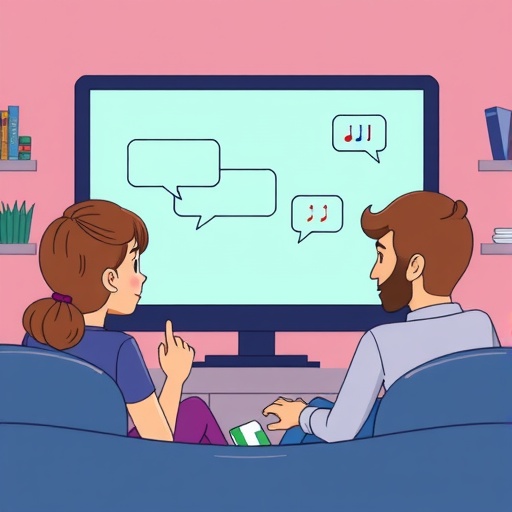
In an era increasingly dominated by digital screens, questions surrounding the impact of screen exposure on early childhood development have taken on heightened urgency. A groundbreaking study conducted by the University of Tartu offers a nuanced understanding of how screen time interacts with child-adult verbal engagement to influence early language acquisition. By analyzing comprehensive survey data from nearly 450 Estonian children aged 30 to 48 months, researchers elucidate the complex dynamics that underpin early language development in a digital age.
The premise that excessive screen time detrimentally affects children’s language abilities might appear self-evident. However, this research probes deeper, revealing that the quality and frequency of interactive communication between children and adults play a crucial, perhaps even overriding, role. Remarkably, children who engage in frequent, meaningful conversations with adults demonstrate stronger language skills even when they live in households with moderate parental screen use. This finding reframes the popular discourse around screen limits, emphasizing that what matters is not merely the quantity of screen usage but the rich linguistic environment that surrounds children.
Past research has established a threshold—approximately one hour per day—above which screen time may begin to adversely impact young children’s developmental outcomes. Alarmingly, most children in the 2-to-5 age bracket exceed this guideline, positioning early language acquisition as a vulnerable developmental frontier. Early language competence is widely recognized as foundational for subsequent academic achievement, social integration, and psychological well-being, thus underscoring the stakes involved in mediating digital consumption from a young age.
The methodology employed by the University of Tartu team involved standardized parental questionnaires that evaluated three prime dimensions of language ability: vocabulary breadth, grammatical understanding, and communicative complexity. In parallel, the study cataloged the frequency of child-adult face-to-face interactions alongside self-reported screen time for both parents and children. Such multidimensional data allowed for robust modeling of the associations between digital exposure, conversational interaction, and language outcomes.
Consistent patterns emerged from the statistical analyses: elevated screen time correlated with diminished language scores, signaling potential deprivation of interactive linguistic stimuli. Conversely, increased child-adult conversational engagement was independently linked to enhanced language performance, suggesting that active communication can counterbalance, or even override, some of the risks posed by screen saturation. These variables retained their significance when assessed jointly, highlighting their interrelated yet distinct contributions to early language development.
Intriguingly, the authors identified three distinct family behavioral archetypes that illustrate this complexity. The first, termed “Screen-Saturated, Somewhat Talkative Families,” was characterized by frequent screen use by both children and parents and relatively scant child-adult dialogue. Children in these households exhibited the weakest language outcomes. The second profile, “Low-Screen, Quiet Families,” aligned with minimal screen exposure but also reduced verbal interaction, culminating in unimproved language development relative to the screen-heavy cohort. The final group, “Parent-Screen, Talk-Rich Families,” exhibited moderate parental screen use combined with high levels of direct verbal engagement with children, resulting in the most favorable language acquisition metrics.
These insights caution against reductive public health messages focused solely on minimizing screen time without simultaneously promoting conversational richness. The data affirm that low screen exposure divorced from interactive context does not guarantee linguistic advantage. Instead, the replacement activities that fill the void left by screens—principally sustained, reciprocal exchanges between children and adults—are critical agents in nurturing language proficiency.
However, the research team advises caution in interpreting these findings, acknowledging that the study’s correlational design and reliance on parent-reported data cannot firmly establish causality. It remains plausible that children with poorer language skills may gravitate toward screens as a compensatory or preferred activity, complicating the directionality of associations. Nonetheless, the persisting links observed between conversational engagement, screen time, and language underscore an actionable target for intervention and parental guidance.
In discussing implications, the primary investigator, Jaan Tulviste, a Research Fellow in Developmental Psychology, underscores the importance of interactive dialogue as the cornerstone of early childhood language building. The study advocates for fostering environments rich in back-and-forth conversations, where children are active participants rather than passive recipients. Such engagement includes activities spanning storytelling, reading aloud, question-and-answer play, and shared problem-solving, each providing multidimensional linguistic input that screens often fail to replicate.
Additionally, the study adds a critical dimension to ongoing debates about digital media regulation in early childhood. It illuminates that simplistic metrics based solely on screen duration inadequately capture the complex interplay of environmental factors influencing developmental trajectories. This nuanced understanding may inform the design of educational programs, parenting workshops, and pediatric guidelines that emphasize qualitative aspects of child-rearing alongside quantitative limits on media exposure.
Ultimately, this research contributes a vital piece to the puzzle of child development in the digital age, suggesting that digital consumption cannot be viewed in isolation but rather examined through the lens of an ecosystem of social interaction. By highlighting the distinct yet interdependent roles of screen exposure and conversational engagement, it invites caregivers and policymakers alike to adopt more holistic strategies that prioritize enriching human connection as the bedrock of linguistic and cognitive growth.
The study titled “High screen time and low child-adult talk associated with poorer language development in early childhood” was published on April 8, 2026, in the esteemed Frontiers in Developmental Psychology journal. It challenges conventional wisdom by demonstrating that language acquisition is not merely compromised by screen usage per se, but more critically by the absence of interactive dialogue that provides essential language input. In this way, it reshapes understanding and offers a refined framework for supporting early developmental success amid evolving familial digital landscapes.
For families navigating the pervasive presence of screens, the takeaway is clear: fostering regular, meaningful verbal exchanges with young children must take precedence. Ensuring that digital time does not supplant conversational time may be the key to unlocking their full linguistic potential and, by extension, their lifelong learning trajectory and well-being.
Cite Scienmag News
Courtney Benton. (April 21, 2026). Low Screen Time Boosts Language Skills Only When Paired with Active Conversation. Scienmag. https://scienmag.com/low-screen-time-boosts-language-skills-only-when-paired-with-active-conversation/
Courtney Benton. "Low Screen Time Boosts Language Skills Only When Paired with Active Conversation." Scienmag, 21 April 2026, https://scienmag.com/low-screen-time-boosts-language-skills-only-when-paired-with-active-conversation/. Accessed 4 September 2026.
Courtney Benton. "Low Screen Time Boosts Language Skills Only When Paired with Active Conversation." Scienmag. April 21, 2026. https://scienmag.com/low-screen-time-boosts-language-skills-only-when-paired-with-active-conversation/


