


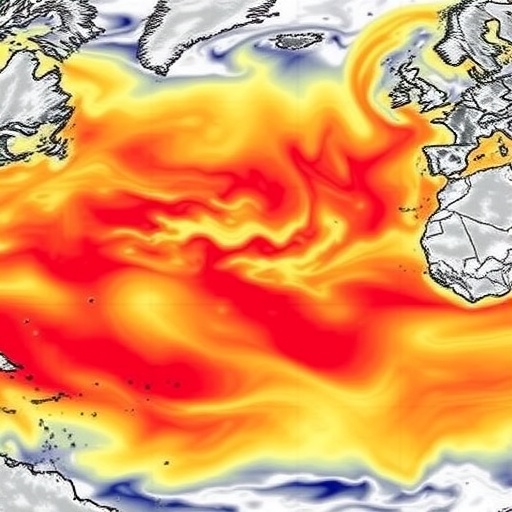
The Atlantic Meridional Overturning Circulation (AMOC), a critical conveyor belt of ocean currents in the Atlantic, has been widely documented to be weakening over the past century. This large-scale system plays a pivotal role in regulating global climate by distributing heat and salinity across vast oceanic expanses. However, its northern counterpart, known as the Nordic Overturning Circulation (NOC), which transports dense deep waters from the Atlantic past Iceland into the Nordic Seas before returning southward, has intriguingly shown remarkable stability. Recent computational simulations suggest that the NOC is not only stable but is projected to strengthen slightly in the face of ongoing global warming—a finding that challenges traditional assumptions about the coherence of these interlinked ocean systems.
The apparent paradox posed by a waning AMOC alongside a robust or even intensifying NOC has sparked considerable debate among oceanographers and climate scientists. Yet, novel research reveals that these seemingly contradictory trends may not be at odds but are instead dynamically connected through intricate physical mechanisms. Stefan Rahmstorf, a co-author at the Potsdam Institute for Climate Impact Research (PIK), emphasizes that the observed strengthening of the NOC is, counterintuitively, a direct consequence of the weakening AMOC. This counterintuitive relationship underscores the complexity of ocean circulatory interactions under the stresses imposed by anthropogenic climate change.
Delving into the physics, the research team led by Sasha Roewer utilized detailed climate model data alongside a simplified yet robust model framework of the Atlantic and Nordic Seas to uncover the density-driven processes entangling these ocean currents. The weakening of the AMOC diminishes the northward transport of salt-rich waters into the subpolar North Atlantic. This reduction in salinity causes a measurable decrease in water density in this region. Subsequently, the resulting enhanced density contrast between the subpolar North Atlantic and the more northern Nordic Seas intensifies the driving force behind the NOC, causing its apparent strengthening.
This density gradient mechanism provides a nuanced understanding of how the oceanic conveyor belt responds intricately to shifts in thermal and saline properties. It is not merely the circulation intensity that shifts, but the interplay of water mass transformation that dictates the overall overturning strength. The study posits that the NOC’s increased vigor is, paradoxically, emblematic of the growing fragility of the AMOC system, thereby reframing the narrative around ocean circulation changes in the context of global warming.
The model-based projections highlight that the NOC may continue to strengthen as long as deep convection processes in the Nordic Seas remain active. Deep convection, the process by which surface waters cool and sink to form dense deep water masses, is a critical driver of the overturning circulation. However, the simulations also warn of a precarious threshold: if global warming proceeds unabated, it could eventually shut down deep convection in the Nordic Seas. Such an event would remove the buoyancy-driven engine of the NOC, leading to the potential collapse of both the Nordic and Atlantic overturning circulations.
This potential shutdown carries profound implications for global climate dynamics. The AMOC is a key moderator of weather patterns, sea level, and regional climates, particularly in Europe and North America. A collapse in the AMOC, prompted by the cessation of Nordic deep convection, could trigger dramatic shifts in heat distribution, exacerbate sea-level rise on the eastern seaboard of the United States, and alter the frequency and intensity of extreme weather events across the Northern Hemisphere. Therefore, the strengthening of the NOC should be interpreted not as a reassuring stability but as a harbinger of deeper systemic vulnerabilities.
Indeed, the research reframes the interpretation of ocean observables used in climate monitoring. Traditionally, an invigorated Nordic overturning circulation might have been mistaken as a sign of oceanic resilience. Yet, the findings make it clear that this intensification is, in fact, symptomatic of underlying system stress. The NOC’s behavior acts like an amplifier of the weakening AMOC’s effects, combining to signal the proximity of a critical tipping point in the Atlantic’s thermohaline circulation.
Further computational simulations and climate modeling are needed to refine the predictions and better understand the spatiotemporal dynamics of these linked overturning circulations. Incorporating fine-resolution models that capture small-scale mixing, topographical influences between Greenland, Iceland, and Scotland, and feedbacks between ocean and atmosphere will enhance the certainty of future scenarios. Such advances will be essential for developing robust climate adaptation strategies aimed at mitigating the impacts stemming from a disrupted Atlantic overturning system.
These results also highlight the importance of sustained ocean observations in the North Atlantic and Nordic Seas. Better in-situ measurements of salinity, temperature, and convection rates are critical to validating model outputs and detecting early warning signs of shifts in overturning dynamics. Integrating satellite data with autonomous ocean floats and fixed moorings will contribute to a holistic understanding of the evolving ocean state under warming conditions.
Globally, these findings underscore the interconnectedness of ocean circulations and the intricate feedbacks that define Earth’s climate system. As anthropogenic emissions continue to warm the planet and redistribute oceanic densities, the complex dance between the AMOC and NOC unfolds with profound consequences. The recognition that a strengthening NOC portends an impending weakening and potential collapse of the AMOC challenges both scientific understanding and public perception, amplifying the urgency for climate action.
In conclusion, this cutting-edge research published in Ocean Science bridges a critical knowledge gap by elucidating the dynamic relationship between the AMOC and NOC. It provides a sobering outlook: the Nordic overturning’s strength is no safeguard but rather a sensitive indicator of deeper, potentially catastrophic changes beneath the ocean’s surface. Understanding these mechanisms alerts us to the fragility of the planetary systems that sustain modern civilization and underscores the imperative to curb global warming before tipping points are irrevocably crossed.
Cite Scienmag News
Bethany Barker. (April 20, 2026). New Study Reveals Nordic Seas Overturning Circulation Intensifies as Atlantic Meridional Overturning Circulation Weakens. Scienmag. https://scienmag.com/new-study-reveals-nordic-seas-overturning-circulation-intensifies-as-atlantic-meridional-overturning-circulation-weakens/
Bethany Barker. "New Study Reveals Nordic Seas Overturning Circulation Intensifies as Atlantic Meridional Overturning Circulation Weakens." Scienmag, 20 April 2026, https://scienmag.com/new-study-reveals-nordic-seas-overturning-circulation-intensifies-as-atlantic-meridional-overturning-circulation-weakens/. Accessed 3 September 2026.
Bethany Barker. "New Study Reveals Nordic Seas Overturning Circulation Intensifies as Atlantic Meridional Overturning Circulation Weakens." Scienmag. April 20, 2026. https://scienmag.com/new-study-reveals-nordic-seas-overturning-circulation-intensifies-as-atlantic-meridional-overturning-circulation-weakens/


