


In a groundbreaking advancement poised to reshape industrial carbon capture and utilization, researchers have unveiled a novel electrolyzer design that dramatically enhances carbon dioxide (CO2) conversion efficiency while avoiding the persistent pitfalls of salt precipitation and carbon loss. The breakthrough hinges on an innovative alkaline polymer layer-coated proton-exchange membrane (PEM) electrolyzer that, for the first time, effectively suppresses CO2 crossover and salt build-up by employing pure water as the feed. This development not only pushes the boundaries of CO2 electrolysis technology but also offers a viable pathway toward large-scale industrial application.
Electrochemical conversion of CO2 into valuable chemicals and fuels is widely regarded as an essential pillar in the global effort to mitigate climate change and achieve carbon neutrality. However, traditional CO2 electrolysis methods, especially those utilizing alkaline or neutral electrolytes, have suffered debilitating drawbacks that have significantly hampered industrial scalability. The key challenges include salt precipitation within the electrolyzer and the notorious crossover of carbonate ions through the membrane, leading to CO2 loss and decreased energy efficiency. Such issues have capped performance and durability, rendering many technological promises unrealizable on commercial scales.
The recently published study, led by a team of chemists and chemical engineers, addresses these challenges by methodically engineering an alkaline polymer layer to coat the proton-exchange membrane. This catalytic innovation is grounded in comprehensive finite element simulations that guided the synthesis of polymers with a high density of quaternary ammonium groups. These groups play a crucial role in generating an enriched environment of hydroxide ions (OH–) near the catalyst’s electric double layer, fundamentally altering the membrane interface’s ionic dynamics.
By incorporating these ammonium-functionalized polymers, the research team succeeded in modulating the local electric field at the catalyst surface, which in turn significantly enhances CO2 adsorption. This enhancement is pivotal: increased CO2 adsorption facilitates more efficient electrochemical reduction reactions. Concurrently, the enriched hydroxide ion concentration improves interfacial ionic conductivity, minimizing resistive losses that typically plague CO2 electrolyzers. Together, these effects contribute to a decisive leap forward in overall system performance.
Crucially, the use of pure water feed, as opposed to conventional alkaline electrolytes, eliminates the sources of salt that typically precipitate and clog electrolyzer components. Salt precipitation has long been a fundamental barrier to continuous operation, forcing frequent maintenance and operational downtime in industrial settings. The design introduced here circumvents this by ensuring that salt formation is minimized or completely prevented, dramatically extending device lifetime and operational stability.
The performance metrics of this alkaline polymer-coated PEM system are unprecedented. The electrolyzer achieved an impressive single-pass CO2 conversion rate of 62.4%, indicating that a substantial majority of the input CO2 is chemically transformed in a single transit through the electrolyzer. This figure far surpasses previous benchmarks for PEM-based CO2 reduction systems. Furthermore, the energy efficiency reached 39.0%, highlighting how the system converts electrical power into chemical energy with minimal losses.
Equally noteworthy is the electrolyzer’s CO2 utilization efficiency, which hovers around 80%. This means that of all the CO2 fed into the system, nearly four-fifths is effectively converted rather than being lost or wasted—an extraordinary feat that translates directly into reduced operational costs and improved sustainability metrics. The team reported stable operation at a current density of 200 mA cm–2 for an extended period of 260 hours. Such stability is vital for industrial-scale applications where uninterrupted, long-term functioning is non-negotiable.
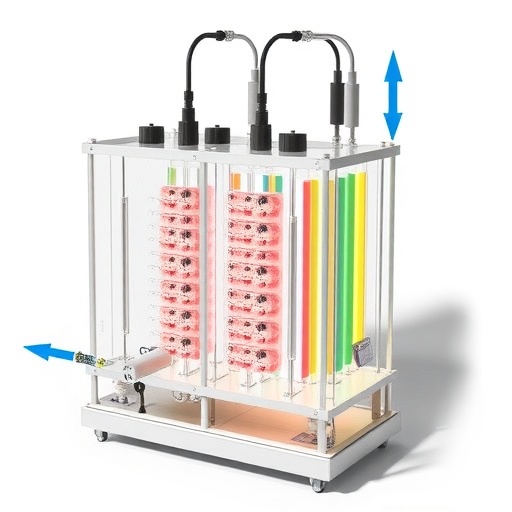
Beyond lab-scale demonstrations, scalability remains a critical hurdle for CO2 electrolyzers. The research group tackled this by developing a stack comprising six membrane electrode assemblies (MEAs), each with an active area of 100 cm². At a combined current of 70 A, this scaled-up system produced carbon monoxide (CO) at a maximum rate exceeding 2,000 ml per minute. This production rate is competitive with—and in some cases superior to—existing industrial CO2 reduction platforms, signaling the near-readiness of this technology for commercial deployment.
The implications of this work extend beyond improved electrolyzer performance to broader industrial and environmental impact. Efficient and scalable CO2 electrolysis technologies are central to closing the carbon loop, transforming waste CO2 into carbon-neutral or even carbon-negative chemical feedstocks. The alkaline polymer layer-coated PEM electrolyzer facilitates this vision by delivering practical solutions to enduring technical bottlenecks, thus accelerating the timeline for sustainable carbon conversion.
The innovative approach of employing a polymer layer enriched with quaternary ammonium groups appears to open new avenues for further material optimization. Fine-tuning polymer composition and layer thickness could potentially improve interfacial electric fields and ion transport properties even further. Additionally, integrating this electrolyzer design with renewable energy sources could yield fully green production chains for fuels and chemicals, propelling the clean energy transition.
Notably, this work bridges a significant knowledge gap in the understanding of interface electrochemistry at CO2 reduction catalysts. The modulation of the catalyst electric double layer by tailored polymer coatings offers a new conceptual framework for enhancing catalytic activity and selectivity. This insight is likely to inspire similar strategies across other electrochemical technologies, including water splitting and nitrogen fixation.
Furthermore, the success demonstrated with pure water feedstock points to potential advantages in simplifying system design and reducing operational complexity. Avoiding corrosive alkaline electrolytes not only mitigates material degradation but also improves safety and lowers maintenance burdens. These characteristics are particularly attractive for deployment in decentralized or modular CO2 conversion units.
The demonstration of continuous operation over 260 hours represents a significant leap toward meeting industrial durability requirements. Long operational lifetimes without degradation ensure that electrolyzers can be economically viable and competitive with traditional chemical synthesis routes. This aspect elevates the alkaline polymer layer-coated PEM electrolyzer from a laboratory curiosity to a genuine contender for real-world carbon management.
Finally, the system’s high current density operation at industrially relevant scales provides compelling evidence of its practical utility. Reaching 200 mA cm–2 and 70 A in stack configurations demonstrates that the technology transcends theoretical promise and can meet the rigorous demands of commercial applications. The team’s achievement establishes a new performance benchmark for CO2 electrolysis technologies worldwide.
In conclusion, this pioneering research marks a critical milestone in CO2 electrochemical conversion by overcoming fundamental challenges of salt precipitation, carbonate crossover, and low CO2 conversion efficiency. The combination of innovative polymer chemistry, membrane engineering, and practical scaling ushers in a new era for sustainable carbon utilization technologies. As industries seek viable solutions to the climate crisis, innovations like this alkaline polymer layer-coated PEM electrolyzer offer a hopeful blueprint for transforming captured CO2 into valuable resources—cleanly, efficiently, and at scale.
Cite Scienmag News
Sloane Callahan. (April 16, 2026). Co-electrolysis of CO2 and H2O in PEM Electrolyzer. Scienmag. https://scienmag.com/co-electrolysis-of-co2-and-h2o-in-pem-electrolyzer/
Sloane Callahan. "Co-electrolysis of CO2 and H2O in PEM Electrolyzer." Scienmag, 16 April 2026, https://scienmag.com/co-electrolysis-of-co2-and-h2o-in-pem-electrolyzer/. Accessed 3 September 2026.
Sloane Callahan. "Co-electrolysis of CO2 and H2O in PEM Electrolyzer." Scienmag. April 16, 2026. https://scienmag.com/co-electrolysis-of-co2-and-h2o-in-pem-electrolyzer/


