


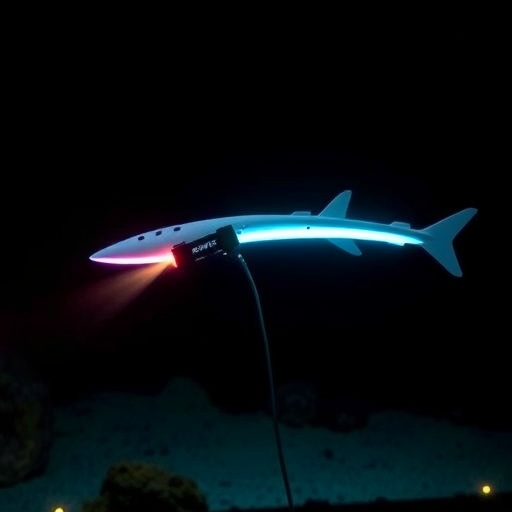
The black ghost knifefish, a mesmerizing inhabitant of freshwater ecosystems, has long fascinated biologists and engineers alike due to its seemingly effortless ability to navigate its environment with exceptional finesse. Unlike many aquatic creatures that rely on conventional tail fin propulsion, this enigmatic species employs an extraordinary mode of locomotion, using a wave-like motion generated along its elongated anal fin. Recent research has now illuminated the intricate biomechanical underpinnings behind this remarkable swimming style, revealing insights that transcend biology and could catalyze transformative advances in underwater robotics.
At the heart of the black ghost knifefish’s maneuverability lies its distinct fin morphology and kinematics. Researchers have conducted rigorous, systematic analyses to decode how the fin’s complex geometry synchronizes with its wave propagation to create nuanced thrust vectors. By mapping the kinematic patterns and correlating them with hydrodynamic forces, the study elucidates how the fish achieves stable hovering, precise backward swimming, and seamless transitions to forward motion. This multidisciplinary approach, utilizing high-speed videography, computational fluid dynamics, and morphological assessment, provides an unprecedented comprehensive database describing the fin’s mechanics in action.
What differentiates the black ghost knifefish from more typical swimmers is its ability to elastically deform its long anal fin in a traveling wave pattern that propagates along the fin’s length. This undulatory motion generates a force vector that can be deftly modulated to produce propulsion in multiple directions without the need for body flexion or caudal fin action. The result is an efficient, highly controllable mode of movement that allows the fish to maintain position against currents, glide with minimal disturbance to the surrounding water, and navigate confined or structurally complex environments with remarkable agility.
This adaptability is rooted in the fin’s distinctive morphology. Structurally, the fin consists of a series of closely spaced rays that serve as mechanical actuators embedded within a flexible membrane. These rays contract and relax in coordinated waves, creating the sinusoidal undulations integral to motion. By analyzing the frequency, amplitude, and wavelength of these waves across various behavioral contexts, the research team correlated specific kinematic profiles with propulsion efficiency and maneuvering capability. Notably, the fin’s ability to produce backward thrust enables the fish to retreat quickly without needing a cumbersome body turn, a trait uncommon among undulatory swimmers.
Beyond the biological fascination, these findings carry significant implications for biomimicry in robotic design. Traditional underwater vehicles often struggle with maneuverability in complex or cluttered environments, where conventional propellers and thrusters lack the finesse required for delicate navigation. By translating the black ghost knifefish’s fin mechanics into robotic prototypes, engineers aim to develop next-generation autonomous underwater vehicles capable of highly precise, energy-efficient propulsion. Such vehicles could revolutionize underwater exploration, environmental monitoring, and search-and-rescue operations, navigating tight spaces and irregular terrains with unprecedented dexterity.
The comprehensive kinematic database generated by the research is a key milestone in bridging biological inspiration and technological application. It provides a detailed reference framework delineating the relationships between fin waveform parameters—such as phase shifts and wave directionality—and resultant movement patterns. This resource empowers engineers to simulate and refine bio-inspired fin designs that replicate key features of the knifefish’s motion. Moreover, the database facilitates iterative testing to fine-tune robotic control algorithms, optimizing the balance between speed, stealth, and maneuverability.
Hydrodynamic analysis further complements morphological and kinematic data, offering insights into the fluid dynamic forces arising from fin motion. Using particle image velocimetry and computational flow models, the researchers visualized vortex formations and wake structures generated during propulsion. These flow patterns are crucial to understanding how thrust is generated and modulated. It was found that the traveling waves produce alternating jets of fluid that can be redirected almost instantaneously, enabling rapid changes in thrust direction and magnitude—a key factor in the knifefish’s agility.
Interestingly, the interplay between fin stiffness and flexibility significantly influences propulsion dynamics. The fin must be compliant enough to propagate undulatory waves efficiently yet sufficiently rigid to resist collapse under hydrodynamic loading. Material properties and internal ray actuation must be finely tuned to preserve this mechanical balance. Understanding this trade-off has prompted discussions around novel materials and soft robotics actuators that can mimic the knifefish fin’s structural properties, pushing the boundaries of current robotic actuation technologies.
The research also explored neuromuscular control strategies employed by the knifefish to orchestrate complex fin movements. Although not the primary focus, preliminary observations suggest a sophisticated motor control system enabling fine modulation of wave characteristics in response to environmental stimuli. This neural complexity hints at potential avenues for integrating adaptive control schemes in robotic systems, allowing real-time adjustments to fin motion based on sensor feedback. Such biomimetic control architectures could yield underwater vehicles that dynamically adapt to fluid conditions and obstacles.
This convergence of biology, fluid mechanics, materials science, and robotics exemplifies the power of interdisciplinary research. By unraveling the black ghost knifefish’s unique propulsion mechanism, the scientific community not only deepens its understanding of aquatic locomotion but also paves the way for innovative, practical technologies. Future developments inspired by this work may include bio-inspired robotic swimmers capable of stealthy, efficient movement in environments previously inaccessible to human-operated devices, from coral reefs to underwater archaeological sites.
The implications of the study extend beyond pure mechanics and robotics. By designing machines that operate harmoniously within complex underwater ecosystems, we may reduce environmental disturbance and enable new modes of aquatic monitoring. Leveraging the black ghost knifefish’s evolutionary optimized propulsion system could thus contribute to sustainable exploration practices. Furthermore, the principles uncovered may inspire design paradigms in other fields, such as aerospace or medical device engineering, where fluid-structure interactions govern performance.
In conclusion, the detailed investigation into the black ghost knifefish’s anal fin propulsion has unveiled a natural marvel of biomechanical innovation. Through meticulous characterization of fin morphology, kinematics, and hydrodynamics, the research bridges a critical gap between biological function and robotic application. The findings promise to revolutionize underwater vehicle design, unlocking capabilities for precision maneuvering in otherwise inhospitable environments. As this work continues to inspire new bio-inspired technologies, the black ghost knifefish stands as a testament to nature’s ingenuity and its boundless potential to inform human engineering.
News Publication Date: Not provided
Web References: Not provided
References: Not provided
Cite Scienmag News
Audrey Campbell. (April 14, 2026). Black Ghost Knifefish Sparks Innovation in Next-Generation Agile Underwater Robots. Scienmag. https://scienmag.com/black-ghost-knifefish-sparks-innovation-in-next-generation-agile-underwater-robots/
Audrey Campbell. "Black Ghost Knifefish Sparks Innovation in Next-Generation Agile Underwater Robots." Scienmag, 14 April 2026, https://scienmag.com/black-ghost-knifefish-sparks-innovation-in-next-generation-agile-underwater-robots/. Accessed 3 September 2026.
Audrey Campbell. "Black Ghost Knifefish Sparks Innovation in Next-Generation Agile Underwater Robots." Scienmag. April 14, 2026. https://scienmag.com/black-ghost-knifefish-sparks-innovation-in-next-generation-agile-underwater-robots/


