


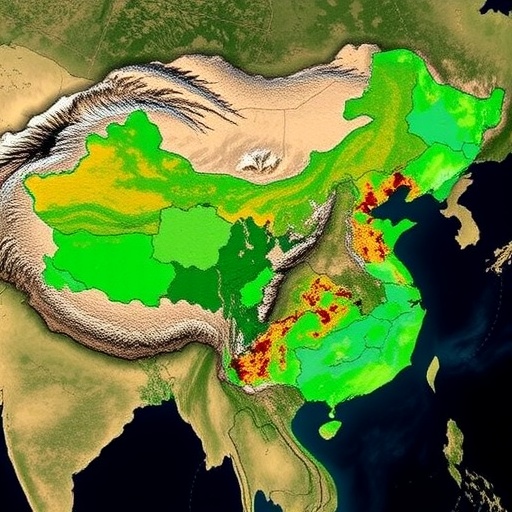
As the global community intensifies its efforts to combat climate change, innovative solutions that integrate renewable energy sources into existing infrastructure have become increasingly critical. A groundbreaking study led by Wu, H., Hu, X., Wang, X., and their colleagues suggests a transformative approach that could revolutionize China’s coal-powered energy sector by incorporating geospatial green ammonia co-firing. Published in Nature Communications (2026), this comprehensive research explores the potential to avoid an impending CO₂ emissions lock-in by strategically blending green ammonia with coal in thermal power plants throughout China’s vast energy landscape.
China, the world’s largest emitter of carbon dioxide, relies heavily on coal-fired power plants, which remain a major source of emissions contributing to global warming. The continuous investment in coal infrastructure risks locking in high levels of CO₂ emissions for decades. The idea of co-firing—burning two types of fuel simultaneously—has emerged as a promising solution to decarbonize power generation while maintaining grid stability. In this context, green ammonia, directly synthesized using renewable electricity and nitrogen from the air, offers an intriguing carbon-free fuel alternative with the capability to seamlessly blend into existing coal combustion processes.
The researchers adopt a geospatial perspective to analyze the feasibility and impact of green ammonia co-firing across China’s coal power fleet. Unlike previous studies that focused on technology in isolation or on small pilot projects, this study evaluates the spatial distribution of coal power plants alongside regional renewable energy potential to optimize the co-firing strategy. This approach accounts for the logistical and infrastructural nuances that determine the scalability and effectiveness of implementing green ammonia co-firing nationwide.
One of the central technical challenges addressed in this research is the production and supply chain optimization of green ammonia. The synthesis of ammonia traditionally involves energy-intensive processes that rely on fossil fuels, such as steam methane reforming. By contrast, “green” ammonia is produced using renewable energy sources — notably solar, wind, and hydroelectric power — to generate hydrogen through water electrolysis, followed by nitrogen fixation via the Haber-Bosch process powered by renewable electricity. This method dramatically reduces the carbon footprint of ammonia production, making it a suitable candidate for decarbonizing coal-fired power plants.
The co-firing technique proposed involves substituting a fraction of coal feedstock with green ammonia in power boilers, thereby reducing CO₂ emissions proportional to the ammonia ratio. Ammonia combustion emits nitrogen and water vapor but no carbon dioxide, making it an attractive adjunct fuel. However, ammonia’s combustion dynamics differ significantly from coal, requiring modifications in boiler design and operational parameters to maximize efficiency and maintain performance. Wu et al. meticulously analyze these thermodynamic and chemical engineering aspects, highlighting optimal blending ratios that balance emissions reduction with combustion stability and economic feasibility.
A further dimension of the study examines the geographical disparities in renewable energy generation potential across China. Regions such as Inner Mongolia and Xinjiang possess abundant solar and wind resources, making them prime candidates for green ammonia production facilities. Conversely, coal plants located closer to demand centers or industrial hubs may benefit more from ammonia transportation routes optimized to minimize energy losses and costs. The authors utilize advanced geospatial modeling, integrating meteorological data, grid infrastructure, and industrial layouts to determine the most effective deployment scenarios.
To quantify the environmental impact, the team employs life-cycle assessment (LCA) tools that capture emissions throughout ammonia production, transportation, storage, and combustion phases, alongside those from coal use. The results demonstrate that co-firing with green ammonia could reduce CO₂ emissions from coal plants by up to 40% without compromising power output or reliability. This reduction represents a significant stride toward China’s ambitious carbon neutrality goals, which aim for peak emissions by 2030 and net-zero by 2060.
Moreover, the economic analysis incorporated into the study considers current and projected costs of electrolyzers, renewable energy, ammonia catalysts, and retrofitting power stations. While green ammonia production currently faces higher capital and operational expenditures compared to fossil-derived fuels, the research highlights a foreseeable cost trajectory driven by technological advancements and economies of scale. Coupled with government incentives and carbon pricing mechanisms, green ammonia co-firing emerges as both an ecologically and economically viable pathway with near-term implementation potential.
The synergy between green ammonia and coal is underpinned not only by energy and environmental benefits but also by policy implications. China’s commitment to phase down coal dependence does not entail immediate plant closures, given the infrastructure footprint and energy demand. Instead, green ammonia co-firing provides a pragmatic transition technology that aligns with ongoing energy security concerns, grid stability demands, and industrial continuity, while significantly slashing greenhouse gas emissions.
Significantly, their proposed integrated co-firing strategy mitigates the risk of “carbon lock-in,” a phenomenon where existing fossil fuel infrastructures continue to operate at high emissions levels due to economic or technical constraints. By introducing green ammonia as a decarbonization lever that requires minimal disruption to existing power plants, the research delineates a pathway to avoid this lock-in, safeguarding China’s carbon reduction commitments against inertia and technical barriers.
An often-overlooked aspect thoroughly discussed is ammonia’s environmental safety and potential risks. The study evaluates storage, handling, and potential emissions of nitrogen oxides (NOx), which can form during combustion. Wu et al. provide a balanced assessment of mitigation technologies such as selective catalytic reduction (SCR) systems and advanced monitoring strategies, ensuring that co-firing does not introduce new environmental hazards while maximizing climate benefits.
Integration challenges related to ammonia supply chains are meticulously addressed. Green ammonia requires efficient distribution networks due to its corrosive nature and handling constraints. The team explores options for pipeline transport, rail, and localized production sites adjacent to coal plants to overcome logistical hurdles. They emphasize strategic infrastructure investments crucial for scaling co-firing efforts, presenting actionable roadmaps for government and industry stakeholders.
Technological development perspectives are also forecasted. The authors note ongoing research into “blue ammonia” — produced from natural gas with carbon capture and storage — and its complementary role in the energy transition. However, green ammonia’s ultimate potential, powered entirely by renewables, represents a truly sustainable and zero-carbon fuel option. The study therefore positions green ammonia co-firing within a broader context of hydrogen and ammonia energy future frameworks, underscoring its pivotal role in decarbonizing heavy industries and power sectors alike.
From a global viewpoint, this pioneering investigation not only advances carbon mitigation in China but also offers a replicable model for other coal-dependent economies grappling with emission reduction targets. The multi-dimensional geospatial and technical methodology establishes a benchmark for integrated energy transition analyses, highlighting how emerging fuel technologies can dovetail with existing infrastructure to accelerate decarbonization pathways.
In conclusion, Wu, Hu, Wang, and their team provide compelling evidence that geospatially optimized green ammonia co-firing within China’s coal power fleet is a scientifically viable, economically promising, and environmentally critical strategy. This approach bridges renewable energy deployment and legacy fossil fuel infrastructure aiming to circumvent carbon lock-in. It signals a transformative paradigm in the pathway from high-carbon coal dependence toward a sustainable, low-carbon energy future aligned with both national commitments and global climate goals.
Cite Scienmag News
Violet Maxwell. (April 13, 2026). Geospatial Green Ammonia Cuts CO2 in China’s Coal. Scienmag. https://scienmag.com/geospatial-green-ammonia-cuts-co2-in-chinas-coal/
Violet Maxwell. "Geospatial Green Ammonia Cuts CO2 in China’s Coal." Scienmag, 13 April 2026, https://scienmag.com/geospatial-green-ammonia-cuts-co2-in-chinas-coal/. Accessed 6 September 2026.
Violet Maxwell. "Geospatial Green Ammonia Cuts CO2 in China’s Coal." Scienmag. April 13, 2026. https://scienmag.com/geospatial-green-ammonia-cuts-co2-in-chinas-coal/


