


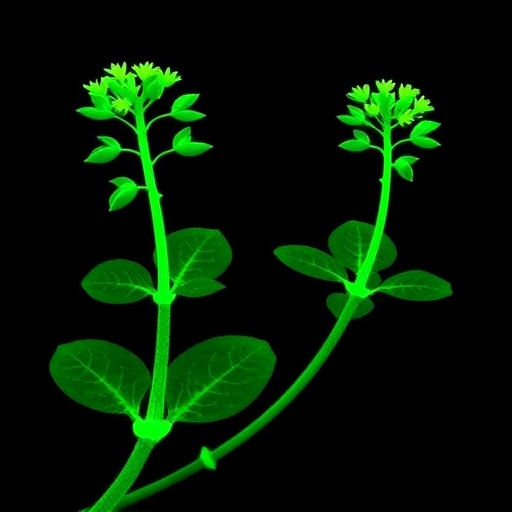
In a remarkable leap forward for plant developmental biology, researchers have successfully charted the entire lineage tree of cells from zygote to adult in the model organism Arabidopsis thaliana, revealing a fundamental organizational principle governing plant growth. This unprecedented achievement stems from the development of e-SMALT, an innovative cell lineage tracing system that integrates DNA barcoding with single-cell RNA sequencing to reconstruct the phylogeny of thousands of individual cells, shedding new light on the architecture of plant organogenesis.
Decoding the developmental history of an organism at single-cell resolution has long been a formidable challenge. Unlike animals, where lineage tracing tools have advanced considerably, accurately mapping the developmental trajectories of individual plant cells has remained elusive due to the complex, indeterminate growth patterns and cellular plasticity inherent to plants. The new approach devised by Xia, Liu, Wang, and colleagues surmounts these obstacles by leveraging a clever strategy of accumulating unique barcode mutations within a targeted 1-kb DNA sequence. Each cell acquires a distinctive mutation signature as it divides, effectively recording its developmental history in its genome.
The researchers applied this elegant method to two fully grown, three-month-old A. thaliana plants. Impressively, they found that each cell contained on average approximately 50 distinct barcoding mutations across the targeted sequence, providing an exceptionally rich dataset for reconstructing the cellular phylogeny. By analyzing these mutation patterns, they were able to reliably infer the lineage relationships among thousands of cells derived from various shoot branches, constructing a comprehensive, statistically robust cell phylogenetic tree.
One of the most striking revelations from this work is the discovery of a “three-cell rule” in plant shoot branch formation. According to this rule, every shoot branch, whether it is a primary, secondary, or tertiary branch, derives from exactly three founder cells. These founder cells represent three early-determined lineages, each contributing uniquely to the subsequent branch’s cellular population. Intriguingly, this rule also applies to discrete plant organs such as flowers and siliques, indicating that the three-cell origin is a pervasive feature of Arabidopsis development.
This finding fundamentally revises our understanding of how plants organize their stem cell pools and initiate branching. The repeated tri-cellular pattern provides a conceptual framework for interpreting the dynamics of plant stem cell maintenance and differentiation. It implies a level of developmental modularity and cellular coordination that was previously unappreciated in plant biology, with potential parallels to developmental mechanisms in animal systems, despite the evolutionary distance and distinct morphogenetic strategies.
Further integrating high-resolution single-cell RNA sequencing data, the team was able to assign molecular identities to the three founder cells of each branch. This molecular characterization revealed that these founder cells correspond to the three germ layers within the developing branch or organ. This breakthrough provides a new, single-cell resolution map of plant germ layers, significantly refining classical plant developmental models and highlighting subtle but crucial molecular distinctions among founder cell populations.
The broader implications of this study extend beyond Arabidopsis, as the three-cell rule may represent a generalized strategy employed by indeterminate plants to regulate organogenesis and stem cell dynamics. Unlike animals, where lineage hierarchies and developmental potentials are often rigid, plants appear to utilize a more flexible yet highly orchestrated approach, balancing stem cell pool size and organ production through constrained founder cell numbers. This insight opens avenues for exploring how plants optimize growth and adaptability under varying environmental conditions.
The e-SMALT system itself is a trailblazing technological advance. By integrating lineage barcoding with transcriptomic profiling, it serves as a powerful platform not only for charting developmental trajectories but also for uncovering gene expression patterns associated with different cell lineages. This dual capability provides a multidimensional view of plant development, allowing scientists to link cellular ancestry to functional states and identities.
Importantly, the high-throughput nature of e-SMALT enables large-scale lineage reconstruction at cellular resolution within complex, mature plants. This contrasts with earlier lineage tracing studies that were either limited to early embryonic stages or small cell populations. The unprecedented resolution and scale offered by this method provide a blueprint for future studies aiming to unravel the intricate choreography of plant development over the lifespan of the organism.
The study also highlights the robustness and stability of barcode mutation accumulation over development. The average of around 50 mutations per cell in the 1-kb barcode region underscores how mutation accumulation can serve as a reliable recording mechanism across many rounds of cell division. This ensures lineage information is preserved through complex developmental processes, providing a durable, retrievable record akin to a biological logbook.
By elucidating the cellular phylogeny of the entire shoot system, the authors provide a new reference framework for connecting developmental lineages with physiological and morphological traits. This will facilitate investigating how specific cells and their progeny contribute to plant form and function, as well as how developmental programs respond to environmental signals and stressors at the lineage level.
The implications of discovering a minimal set of founder cells governing branch formation also resonate with plant breeding and biotechnology. Understanding these lineage dynamics at single-cell resolution opens potential pathways for manipulating branch architecture, improving crop yields, or conferring resilience by targeted intervention at the founder cell level. It paves the way for rational engineering of plant development with unprecedented precision.
This pioneering work merges conceptual innovation with technical prowess, illustrating how leveraging evolutionary principles—such as phylogenetic tracing—enables profound insights into organismal development. The convergence of barcoding mutations and transcriptomics empowers a new era in plant biology where cell fate, lineage, and molecular identity can be dissected at the finest granularity, enriching our comprehension of life’s complexity in plants.
In conclusion, this groundbreaking research not only establishes a robust lineage tracing framework for plant developmental studies but also unveils a universal “three-cell rule” shaping branch and organ formation in Arabidopsis. The combination of detailed cell ancestry with gene expression profiling heralds transformative opportunities in developmental biology, agriculture, and biotechnology, making it a landmark advancement poised to inspire future science across kingdoms.
Cite Scienmag News
Juliet Wilcox. (April 13, 2026). Tracing Arabidopsis Development Reveals Three-Cell Branching Rule. Scienmag. https://scienmag.com/tracing-arabidopsis-development-reveals-three-cell-branching-rule/
Juliet Wilcox. "Tracing Arabidopsis Development Reveals Three-Cell Branching Rule." Scienmag, 13 April 2026, https://scienmag.com/tracing-arabidopsis-development-reveals-three-cell-branching-rule/. Accessed 6 September 2026.
Juliet Wilcox. "Tracing Arabidopsis Development Reveals Three-Cell Branching Rule." Scienmag. April 13, 2026. https://scienmag.com/tracing-arabidopsis-development-reveals-three-cell-branching-rule/


