


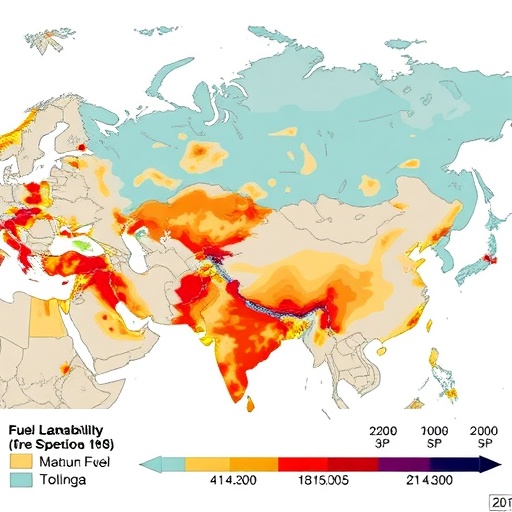
In the vast and ecologically complex drylands of Eurasia, fire has long served as both a natural phenomenon and a critical agent of ecosystem dynamics. Recent research led by Yu, Yang, and Lu, published in Nature Communications, delves into the intricate balance between fuel availability and flammability, two pivotal factors that dictate fire regimes across these expansive arid to semi-arid regions. This investigation challenges traditional paradigms by revealing how divergent controls emerge in seemingly similar landscapes, ultimately influencing the frequency, intensity, and impact of wildfires in ways that are vital for ecological understanding and management.
Fires in drylands are shaped by an interplay of climatic conditions, vegetation types, and soil properties, which collectively regulate the abundance and combustibility of fuel. The research focuses on Eurasian drylands, a biome spreading from the steppes of Eastern Europe through Central Asia to the fringes of the Gobi Desert. This area experiences a wide array of climatic gradients, with variations in precipitation, temperature, and seasonal patterns profoundly affecting vegetation structure and composition. Understanding fire dynamics here provides insights not only into local ecosystem processes but also global carbon cycles and biodiversity conservation.
One of the core findings of the study lies in the contrasting roles that fuel availability and flammability play across the vast Eurasian drylands. Fuel availability refers primarily to the quantity of burnable biomass, which depends on factors such as plant productivity, moisture levels, and soil nutrients. Flammability, on the other hand, relates to how easily this biomass ignites and sustains combustion, directly linked to its chemical and physical traits including moisture content, surface-area-to-volume ratio, and the presence of volatile organic compounds. The research team employs remote sensing data alongside ground-based ecological surveys to dissect these dynamics at both landscape and biome scales.
In regions dominated by sparse shrublands and grasslands, often found in the more arid zones of Eurasia, fuel availability tends to be the primary constraint on fire occurrence. Low biomass accumulation due to limited precipitation means that even when conditions become dry, there is insufficient fuel load to support widespread fires. Alternatively, in semi-arid and steppe ecosystems with greater vegetation cover, fuel load builds up sufficiently, making flammability a more critical determinant of fire regimes. Here, subtle variations in species composition and drought stress affect how readily vegetation burns, influencing fire spread and intensity.
Crucially, the research uncovers patterns indicating that climatic extremes, such as prolonged droughts followed by wet seasons, can lead to pulses of fuel accumulation that spike fire risk. However, the actual incidence of fire during these high-risk periods depends markedly on the flammability characteristics of the dominant species. This nuance underscores the importance of incorporating biome-specific fire controls into predictive models, moving beyond simplistic assumptions that equate dryness uniformly with fire risk.
From a methodological standpoint, the study leverages advances in satellite remote sensing technologies, including multispectral and hyperspectral imaging, to monitor vegetation dynamics and fire events over large temporal and spatial scales. These technologies allow for precise mapping of fuel loads and moisture conditions, providing unprecedented resolution in assessing fire potential across heterogeneous landscapes. Additionally, the incorporation of climate model projections provides a framework for understanding how future shifts in temperature and precipitation regimes may recalibrate these delicate fire controls.
The implications of this work extend far beyond academic interest, reaching into the realms of land management, wildfire mitigation, and policy formulation. Eurasian drylands are home to millions of inhabitants whose livelihoods depend on pastoralism, agriculture, and natural resource extraction, all of which are vulnerable to fire disturbances. By elucidating the divergent roles of fuel availability and flammability, this study equips stakeholders with targeted strategies to mitigate wildfire risks, such as managing vegetation to alter fuel loads or enhancing moisture retention to reduce flammability.
Moreover, the research highlights the necessity of regionalized fire management approaches. One-size-fits-all policies are likely insufficient given the spatial variability in fire controls documented. In parts of the Eurasian drylands where fuel is scarce, efforts may prioritize preserving biomass and preventing fuel accumulation hotspots. Conversely, in zones where flammability drives fire dynamics, strategies might center on understanding species-specific combustion traits and microclimatic influences to forecast and control fire outbreaks.
From an ecological perspective, understanding these divergent fire controls is pivotal for anticipating shifts in vegetation patterns and biodiversity outcomes under changing climates. Fire regimes influence plant community composition by selecting for fire-adapted species and determining succession pathways. Changes in fire frequency or intensity, if mismatched with the underlying controls of fuel and flammability, could trigger ecosystem degradation or unintended transformations, impacting carbon storage, soil health, and habitat availability.
The study further explores the feedback loops between fire and land surface processes. Fires alter albedo, soil nutrient levels, and hydrological cycles, which in turn affect vegetation regrowth and fuel composition. These feedbacks add layers of complexity to fire management and reinforce the need for integrative, multidisciplinary research approaches that meld ecology, climatology, and remote sensing.
Notably, the researchers emphasize the challenges posed by human activity in modulating fire regimes. Agricultural expansion, grazing pressure, and land-use changes modify vegetation structure and continuity, thereby influencing both fuel availability and flammability. Human ignition sources also introduce variability in fire occurrence, complicating the natural patterns the study aims to clarify. Recognizing these anthropogenic factors is essential for crafting effective fire control and land stewardship frameworks.
Looking ahead, the research sets a foundation for exploring how anticipated climate scenarios will impact fire regimes in Eurasian drylands. Projected increases in temperature and alterations in precipitation patterns suggest a potential intensification of fire risk, but how this risk manifests hinges on the balance between fuel build-up and changes in plant flammability traits. Ongoing monitoring and adaptive management will therefore be critical to mitigating adverse outcomes while preserving dryland ecosystem functions.
In conclusion, the groundbreaking work of Yu, Yang, Lu, and their colleagues underscores the intricate and sometimes counterintuitive relationships that govern fire behavior in Eurasian drylands. By distinguishing the relative influences of fuel availability and flammability, the study enhances predictive capabilities and informs more nuanced, landscape-specific fire management interventions. Such insights are not only scientifically compelling but also urgently needed as global change accelerates the frequency and severity of wildfires worldwide. This pioneering research exemplifies the critical intersection of ecological science, technology, and practical application in an era increasingly defined by environmental volatility.
Cite Scienmag News
Margaret Porter. (April 13, 2026). Fuel vs. Flammability: Fire Controls Differ Across Eurasia. Scienmag. https://scienmag.com/fuel-vs-flammability-fire-controls-differ-across-eurasia/
Margaret Porter. "Fuel vs. Flammability: Fire Controls Differ Across Eurasia." Scienmag, 13 April 2026, https://scienmag.com/fuel-vs-flammability-fire-controls-differ-across-eurasia/. Accessed 3 September 2026.
Margaret Porter. "Fuel vs. Flammability: Fire Controls Differ Across Eurasia." Scienmag. April 13, 2026. https://scienmag.com/fuel-vs-flammability-fire-controls-differ-across-eurasia/


