


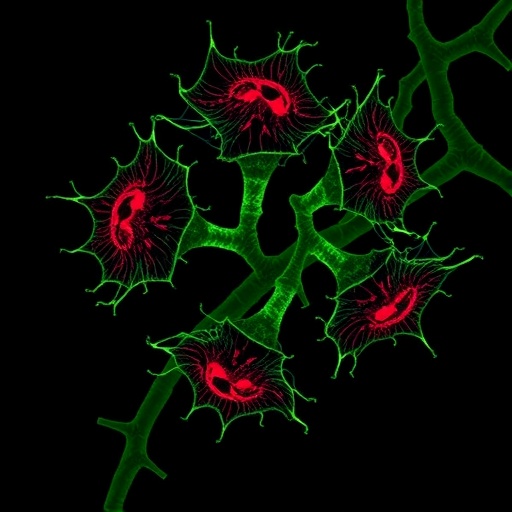
In a groundbreaking study published in the British Journal of Cancer, researchers have unveiled critical insights into the mechanisms driving tumour plasticity and lymphatic metastasis in triple-negative breast cancer (TNBC). This aggressive subtype of breast cancer, characterized by the absence of estrogen, progesterone receptors, and HER2 expression, continues to challenge clinicians due to its high likelihood of metastasis and limited targeted treatment options. The team led by Wang et al. elucidated the pivotal role of podoplanin, a glycoprotein increasingly recognized for its involvement in cancer progression, alongside the chemokine receptor CCR7, in orchestrating tumour adaptability and the spread of cancer cells via the lymphatic system.
Central to this study is podoplanin’s influence on tumour cell plasticity—a phenomenon enabling cancer cells to dynamically switch phenotypes, thereby enhancing their invasion and dissemination capabilities. Podoplanin expression was found to delineate a subpopulation of TNBC cells endowed with enhanced plastic traits, contributing to their aggressive behavior. Unlike previously held views that treated tumours as relatively static entities, this work emphasizes the flexibility within the tumour microenvironment, driven by intrinsic cellular programs modulated by podoplanin. Such plasticity is not mere cellular change but represents a complex, finely-tuned survival strategy enabling tumour cells to evade immune surveillance and resist therapeutic interventions.
Delving deeper into the molecular underpinnings, the researchers identified that podoplanin interacts extensively with the CCR7 signaling axis, a pathway traditionally known for its role in immune cell migration. CCR7’s aberrant activation in tumour cells was demonstrated to facilitate their directed migration toward lymphatic vessels, effectively hijacking the body’s lymphatic trafficking system to promote metastasis. The CCR7-ligand interaction essentially endows tumour cells with chemotactic abilities, guiding them to sentinel lymph nodes where they can establish secondary tumours. This discovery sheds new light on the metastatic cascade in TNBC, highlighting CCR7 as a potential molecular target for disrupting lymphatic dissemination.
Methodologically, the study employed advanced single-cell RNA sequencing combined with spatial transcriptomics to intricately map the heterogeneity within TNBC tumours. This high-resolution approach enabled the identification of distinct cellular subsets marked by podoplanin expression and revealed their spatial association with lymphatic vessels harboring CCR7 ligands. Such innovative techniques allowed the authors to go beyond bulk tumor analysis, providing unprecedented detail on cellular states and intercellular communication within the tumour microenvironment. These insights enhance our understanding of how tumour heterogeneity contributes to aggressive metastatic patterns seen in TNBC patients.
Notably, functional assays demonstrated that genetic silencing of podoplanin significantly impaired TNBC cell plasticity and their ability to engage CCR7-mediated chemotaxis. Mice models with podoplanin-depleted tumours exhibited markedly reduced lymph node metastasis, underscoring the therapeutic potential of targeting this axis. Moreover, the study found that disrupting the podoplanin-CCR7 interplay sensitized tumours to chemotherapy, suggesting combination strategies could potentially improve clinical outcomes. Such translational findings point toward a multi-faceted approach for tackling metastatic dissemination by simultaneously impairing tumour plasticity and directed migration.
The implications of these findings extend beyond the molecular level, underscoring the clinical urgency of addressing metastatic TNBC through novel therapeutic modalities. Given the paucity of effective targeted therapies for this breast cancer subtype, interventions directed at podoplanin and CCR7 may fill a critical gap. By curtailing both the phenotypic adaptability of tumour cells and their guided movement through the lymphatic system, future therapies could dramatically reduce metastatic burden, improving survival rates and patient quality of life. Importantly, these markers might serve as valuable prognostic indicators, enabling clinicians to stratify patients according to metastatic risk and tailor treatments accordingly.
Further analysis revealed that the tumour microenvironment’s composition plays a critical role in modulating podoplanin and CCR7 expression. Factors such as hypoxia and inflammatory cytokines were shown to upregulate podoplanin, thereby enhancing tumour plasticity under adverse microenvironmental conditions. These findings align with the increasingly appreciated concept that tumour progression is not solely determined by cancer cells themselves but is profoundly influenced by the surrounding stroma and immune infiltrates. Targeting the tumour niche alongside tumour-intrinsic pathways thus represents a comprehensive strategy to thwart metastatic evolution.
Intriguingly, the study also observed bidirectional signaling between podoplanin-expressing tumour cells and lymphatic endothelial cells. Podoplanin engagement appears to foster lymphangiogenesis, contributing to the expansion and remodeling of lymphatic networks within the tumour vicinity. This phenomenon not only facilitates tumour cell escape into the lymphatic system but may also create a permissive microenvironment that supports tumour growth and immune evasion. These insights provide a compelling rationale for the development of therapies aimed at normalizing lymphatic vasculature to inhibit metastasis.
From a broader perspective, the elucidation of podoplanin-defined tumour plasticity linked with CCR7-mediated lymphatic metastasis provides a compelling example of how cancer biology increasingly integrates cellular behavior, microenvironmental context, and molecular signaling. The study pioneers a paradigm shift, advocating a systems biology approach to understanding and targeting metastatic cancer. Such comprehensive insight is indispensable for confrontating the formidable challenges posed by TNBC’s heterogeneity and resilience, pointing toward more effective, personalized therapeutic interventions.
The authors also highlight that podoplanin’s role may transcend triple-negative breast cancer, given its expression in various other tumour types associated with poor prognosis. This suggests the presence of convergent pathways in tumour plasticity and lymphatic metastasis across malignancies. Future research is anticipated to explore whether similar mechanisms underlie metastatic behaviors in other aggressive cancers, potentially expanding the therapeutic reach of targeting podoplanin and CCR7. This cross-cancer applicability further amplifies the significance of this discovery within oncology.
Clinicians and researchers alike are poised to benefit from this study’s revelations, which provide not only a molecular framework but also practical targets for inhibiting metastasis. The study encourages the integration of podoplanin and CCR7 expression analyses into clinical diagnostics to improve metastasis prediction accuracy. Additionally, the potential for combining CCR7 antagonists with emerging immunotherapies holds promise, as disrupting tumour migration could enhance immune-mediated tumour clearance. These approaches reflect the ongoing evolution of cancer treatment toward mechanistically informed and multidimensional strategies.
In summary, Wang et al.’s compelling research uncovers the interconnected roles of podoplanin and CCR7 in shaping the highly plastic and metastatic phenotype of triple-negative breast cancer. By delineating the molecular and cellular processes underpinning lymphatic metastasis, their work opens new avenues for therapeutic intervention and prognostic assessment in a cancer subtype notorious for its aggressiveness. The study exemplifies cutting-edge cancer research, blending sophisticated molecular techniques with functional validation and clinical relevance, setting a new standard for future explorations of tumour biology.
As the oncology community digests these findings, the challenge will now shift to translating them into robust clinical applications. Drug development targeting podoplanin and CCR7 pathways will require careful optimization and safety profiling, yet the potential rewards—substantially mitigating metastatic burden in TNBC—are profound. Meanwhile, ongoing molecular characterization of patient tumours incorporating these markers could rapidly enhance personalized medicine approaches, tailoring interventions to curb tumour evolution and spread at their molecular roots.
Ultimately, this study represents a milestone in the quest to understand and combat metastasis—the principal cause of cancer-related mortality—particularly within the intractable landscape of triple-negative breast cancer. Through illuminating the role of tumour plasticity mediated by podoplanin and directed migration enabled by CCR7, it invites a critical reconsideration of metastatic processes and therapeutic targeting strategies. This breakthrough heralds a promising era where precision molecular interventions disrupt the deadly voyage of cancer cells from the primary tumour to distant sites, offering renewed hope for patients worldwide.
Cite Scienmag News
Nathaniel Bowman. (April 12, 2026). Podoplanin and CCR7 Drive Triple-Negative Breast Cancer Spread. Scienmag. https://scienmag.com/podoplanin-and-ccr7-drive-triple-negative-breast-cancer-spread/
Nathaniel Bowman. "Podoplanin and CCR7 Drive Triple-Negative Breast Cancer Spread." Scienmag, 12 April 2026, https://scienmag.com/podoplanin-and-ccr7-drive-triple-negative-breast-cancer-spread/. Accessed 3 September 2026.
Nathaniel Bowman. "Podoplanin and CCR7 Drive Triple-Negative Breast Cancer Spread." Scienmag. April 12, 2026. https://scienmag.com/podoplanin-and-ccr7-drive-triple-negative-breast-cancer-spread/


