


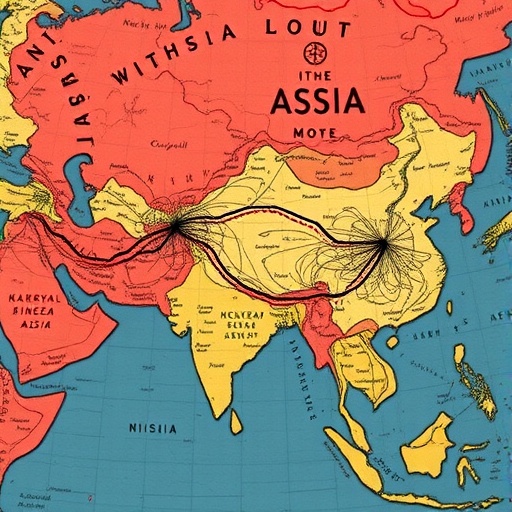
In the vast and climatically challenging expanse of the Inner Asian mountains, ancient communities engineered a remarkable sustenance strategy that allowed them to thrive from as early as 2900 BCE. Recent research sheds light on a sophisticated subsistence adaptation that combined dairy pastoralism with millet agriculture, unveiling a synergistic lifestyle that redefined resilience and innovation in one of the world’s most formidable environments.
This groundbreaking study reveals that the interplay between dairy production and millet cultivation was not merely coincidental but a deliberate, integrative economic and dietary system. The Inner Asian highlands, characterized by steep terrains, harsh weather conditions, and limited arable land, traditionally posed significant challenges to human habitation. Yet, this dual approach provided a stable, complementary resource base that diversified diets and bolstered nutritional intake across fluctuating seasonal cycles.
The research team employed an array of cutting-edge methodologies, including ancient protein residue analysis, isotopic dietary reconstruction, and archaeobotanical evidence, to decode the dietary patterns of these ancient populations. Proteomic techniques, specifically the analysis of milk proteins trapped in ceramic vessels, have been instrumental in identifying the presence and usage of dairy products. Simultaneously, microbotanical remains, such as charred millet grains and phytoliths, elucidated the role of millet as a robust cereal crop adapted to the mountain conditions.
Millet, a group of small-seeded grasses, exhibits remarkable drought tolerance and a short growing season, making it an ideal crop for marginal environments where more water-intensive cereals like wheat or barley would fail. Its cultivation in these highland areas demonstrates early agricultural innovation and dispersal patterns that challenge previous models restricted to lowland farming societies. The presence of interdisciplinary evidence points to an agricultural presence integrated intimately with pastoralist lifeways, suggesting complex social and economic interactions.
Dairy pastoralism, mainly centered around the domestication of ruminants such as sheep, goats, and cattle, provided a reliable source of fats, proteins, and essential nutrients like calcium and vitamin D. The ability to process and store milk in various forms—ranging from fresh milk to fermented products like cheese and yogurt—allowed for extended shelf life and dietary versatility. This was particularly crucial in mountain zones where growing seasons were short and food scarcity common during the harsh winters.
The crucial insight from this research is the recognition that combining millet farming and dairying created a synergistic system, wherein the limitations of one resource were offset by the strengths of the other. Millet’s carbohydrate-rich profile complemented the protein and fat sourced from dairy, generating a balanced diet capable of sustaining populations through environmental stressors. Moreover, the agricultural residues and animal husbandry remains co-located in archaeological sites suggest a deliberate spatial and economic integration rather than isolated or seasonal practices.
This subsistence strategy also implicates broader social and cultural dimensions. Pastoralism and agriculture, traditionally viewed as distinct economies, were interconnected in ways that likely influenced settlement patterns, social organization, and trade networks. The evidence points towards a mixed economy where communities engaged in cyclical mobility aligned with pastoral and agricultural calendars, optimizing resource use and landscape management. This model complicates earlier anthropological narratives that separated hunter-gatherers, farmers, and pastoralists into rigid categories.
Environmental analyses indicate that the region underwent significant climatic fluctuations throughout the Bronze Age, which would have placed additional pressures on food security. The synergy between dairy and millet not only exemplifies adaptive innovation but also hints at sophisticated ecological knowledge. These communities mastered the cycles of mountain ecology—timing sowing and grazing, managing water resources, and sustaining soil fertility—to ensure sustained productivity despite ecological constraints.
On a molecular level, the proteomic data reveal that milk from multiple species was exploited, showcasing a diversified pastoral herd composition. Such diversity would have minimized risk and maximized resource extraction from different ecological niches within the mountainous terrain. These findings lend strong support to a hypothesis of deliberate herd management strategies that optimized production according to altitude, season, and pasture availability.
Complementing the dietary data, the archaeobotanical record underscores millet’s critical role as a staple grain. The presence of distinct grain types and associated agricultural tools implies an established cultivation system and suggests local seed selection and agricultural knowledge transmission. This evidence collectively pushes back the timeline for high-altitude millet agriculture and calls for a reevaluation of prehistoric crop dispersal routes across Central and East Asia.
Notably, the study’s methodological advancements highlight the importance of combining bioarchaeological techniques with traditional excavation. By isolating ancient proteins from pottery and pairing isotopic studies of human and animal bones, researchers reconstructed a detailed and nuanced picture of diet and economy. Such integrative approaches set a new standard for archaeological investigations into ancient subsistence strategies.
The findings echo across disciplines from archaeology and anthropology to ecology and food science. They exemplify how human innovation can be tracked through biochemical signatures, revealing deep-time adaptations that resonate with modern efforts to develop sustainable, mixed farming systems. Understanding how ancient societies balanced dairy and millet production offers insights into resilience and food security relevant to today’s environmental challenges.
Furthermore, the study enriches the narrative of Inner Asia’s cultural history by highlighting the adaptive ingenuity of its early mountain inhabitants. It challenges the notion that high-altitude regions were only marginally exploited or held back by environmental limits. Instead, these landscapes were dynamic centers of innovation and cultural synthesis, capable of supporting complex economies that integrated agriculture and pastoralism.
The research also opens new avenues for studying ancient trade and cultural exchange, as millet and dairy practices may have spread through interconnected communities across Asia. The trans-regional diffusion of these subsistence strategies could have influenced neighboring regions, facilitating broader networks of economic and cultural interaction that shaped Eurasian prehistory.
In sum, the dairy-millet synergy discovered in the Inner Asian mountains from 2900 BCE represents a landmark example of early agro-pastoral innovation, underpinning long-term subsistence adaptation in a challenging environment. This research illustrates the power of interdisciplinary science to decode ancient lifeways and illuminate human resilience, offering lessons that echo far beyond prehistory.
Cite Scienmag News
Daisy Hatcher. (April 11, 2026). Dairy-Millet Synergy Enabled Inner Asia Survival Since 2900 BCE. Scienmag. https://scienmag.com/dairy-millet-synergy-enabled-inner-asia-survival-since-2900-bce/
Daisy Hatcher. "Dairy-Millet Synergy Enabled Inner Asia Survival Since 2900 BCE." Scienmag, 11 April 2026, https://scienmag.com/dairy-millet-synergy-enabled-inner-asia-survival-since-2900-bce/. Accessed 3 September 2026.
Daisy Hatcher. "Dairy-Millet Synergy Enabled Inner Asia Survival Since 2900 BCE." Scienmag. April 11, 2026. https://scienmag.com/dairy-millet-synergy-enabled-inner-asia-survival-since-2900-bce/


