


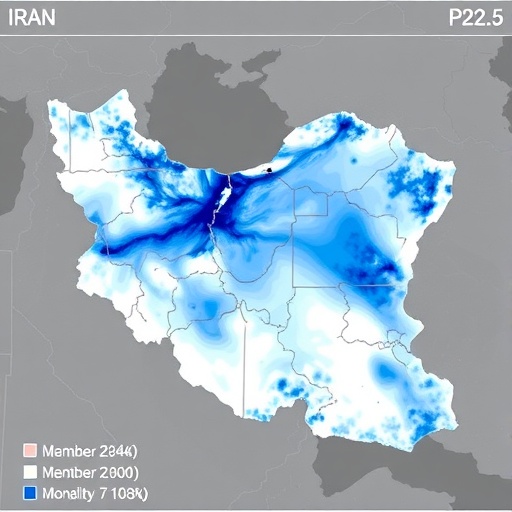
In a groundbreaking study that sheds critical light on the public health implications of urban air pollution, researchers have conducted a comprehensive time-series analysis focusing on the short-term impacts of fine particulate matter exposure on mortality in Mashhad, one of Iran’s most populous cities. This study, spanning from 2019 to 2024, zeroes in on daily fluctuations of PM2.5 levels—particulate matter with a diameter of less than 2.5 micrometers, notorious for its ability to penetrate deep into the respiratory tract—and their direct correlations with cause-specific mortality rates. This kind of granular analysis offers invaluable insights into how transient spikes in air pollution influence mortality, providing an empirical foundation for shaping public health policies in urban environments facing mounting air quality challenges.
Mashhad, with its dense population and rapid urbanization, represents a quintessential model city for investigating the real-time consequences of ambient air pollution. The city’s unique geographic and climatic conditions, combined with industrial activities and vehicular emissions, contribute to varying PM2.5 concentrations throughout the year. The researchers employed robust time-series statistical methodologies to parse out daily data from hospital records, meteorological databases, and air quality monitoring stations. This approach allowed them to capture the intricate temporal patterns between exposure and mortality with unprecedented resolution. Particularly, the analysis was designed to detect acute effects by focusing on short lag periods from the day of exposure to a few subsequent days, an essential focus given the fast physiological effects of inhaled particulates.
Fine particulate matter, specifically PM2.5, is recognized globally as a hazardous pollutant due to its capacity to traverse deep lung barriers and enter the bloodstream, inducing systemic inflammation and oxidative stress. Prior epidemiological studies have linked chronic exposure to increased risks for cardiovascular and respiratory diseases, yet fewer have elucidated the short-term temporal dynamics of such exposures. The present study uniquely contributes to this domain by identifying spikes in cause-specific mortality – especially examining subsets like cardiovascular, pulmonary, and cerebrovascular deaths – in direct temporal alignment with days registering elevated PM2.5 levels. This level of cause-specific granularity is crucial for understanding the biological pathways through which pollution exerts its deadly effects.
Statistical modeling in the study incorporated sophisticated adjustments for confounding variables such as temperature, humidity, day of the week, seasonal trends, and long-term mortality trends, which can otherwise obscure the true pollution-mortality relationship. The researchers applied distributed lag models to quantify how mortality risk evolves in the immediate aftermath of increased PM2.5 exposure. Their findings revealed statistically significant associations between PM2.5 levels and short-term mortality risk, with peak effects notably occurring within one to three days post-exposure. This temporal immediacy underscores the pressing urgency with which public health interventions must be deployed when air quality deteriorates.
Beyond validating existing global evidence, this study addresses a crucial regional gap by providing localized, context-specific data for Mashhad. Air pollution dynamics and population vulnerability can differ greatly between regions, influenced by factors such as prevalent pollutant sources, demographic structures, and healthcare infrastructure. By focusing on this Middle Eastern urban center, the study offers a culturally and environmentally relevant evidence base to inform local policymakers. The detailed cause-specific mortality analysis additionally aids hospitals and healthcare providers in anticipating periods of heightened patient risk and resource needs, possibly enabling preemptive measures to mitigate health outcomes during pollution episodes.
The implications of this research extend far beyond Mashhad’s city limits; they resonate on a global scale amid a world grappling with escalating urban air pollution linked to industrialization, motorization, and climate change drivers. Fine particulate matter is a ubiquitous threat in many megacities, and this study reinforces the message that even short-term exposure fluctuations have grave consequences for human health. By quantifying the immediate mortality risks attributable to daily PM2.5 variations, the research emphasizes the critical importance of real-time air quality monitoring and rapid-response public health advisory systems. These systems can provide vulnerable populations—such as the elderly and those with preexisting conditions—with timely warnings during periods of poor air quality.
Moreover, the study amplifies calls for stringent air quality standards and enforcement, highlighting the tangible life-or-death benefits accompanying reductions in PM2.5 emissions. It serves as a compelling scientific argument in favor of adopting cleaner energy technologies, improving urban planning to reduce traffic congestion, and implementing industrial emission controls. With climate change expected to exacerbate pollutant concentrations through altered weather patterns, understanding these short-term relationships becomes increasingly vital for adaptive public health strategies. The researchers suggest that integrating their findings into national environmental health frameworks could catalyze more effective pollution mitigation and health protection policies.
An integral aspect of the study’s methodological rigor lies in its use of high-resolution air quality data, captured continuously over five years, permitting a robust assessment of daily exposure variations. This continuous temporal coverage is essential for disentangling the acute health effects from long-term exposure outcomes more commonly documented. By deploying advanced time-series and distributed lag modeling techniques, the researchers successfully navigated the statistical challenges inherent in handling autocorrelated environmental data. This analytical precision ensures that the detected associations are both reliable and actionable, reducing the risk of spurious findings that could misinform decision-making.
The temporal dimension of this research highlights the hazards posed by peak pollution days often driven by meteorological phenomena, traffic surges, or industrial activity escalations. It advocates for targeted interventions on days demonstrating elevated PM2.5 levels, such as issuing health advisories, limiting outdoor activities for sensitive individuals, and even temporarily reducing traffic flows or industrial output. These tactical responses depend on the availability of predictive air quality models and public health communication networks, areas where investment and development are urgently needed. The study thus indirectly champions enhanced environmental surveillance infrastructure as a public health investment.
Given the variety of pollution sources in Mashhad, the study’s detailed cause-specific mortality assessment aids in pinpointing which health outcomes are most sensitive to PM2.5 elevation. Cardiovascular mortality demonstrated a particularly strong relationship with short-term exposure, consistent with biological evidence linking particulate matter inhalation to endothelial dysfunction, arrhythmias, and ischemic events. Respiratory mortality was also significantly elevated, reflecting the irritative and inflammatory effects of particulates compromising lung function. Less pronounced but notable increases in cerebrovascular mortality further affirm the systemic reach of airborne particulates. This nuanced understanding guides clinical practitioners and public health officials in prioritizing monitoring and intervention efforts.
Importantly, the research acknowledges limitations and calls for ongoing surveillance and expanded studies considering additional pollutants such as nitrogen dioxide, ozone, and sulfur dioxide, which often co-occur with PM2.5. The synergistic effects of multiple pollutants may compound health risks beyond what is observed considering PM2.5 alone. Furthermore, the authors advocate for integrating social determinants of health into future analyses, as factors like socioeconomic status, access to healthcare, and occupation may mediate pollution susceptibility. These insights point to a multidisciplinary approach combining environmental science, epidemiology, and social policy for comprehensive air pollution health impact assessments.
The societal relevance of this investigation cannot be overstated. Air pollution remains a major contributor to the global burden of disease, with millions of premature deaths annually attributed to fine particulate matter exposure. By delineating the proximate effects of daily PM2.5 exposure spikes, this research starkly illuminates the narrow margin between safety and harm that urban populations navigate daily. It underlines the urgency of collective action at governmental, community, and individual levels to reduce pollutant emissions and safeguard public health. The dissemination of such evidence through high-impact scientific publications catalyzes awareness and motivates coordinated efforts to combat this silent killer.
In conclusion, the multi-year, high-resolution dataset analyzed by Kermani, Farkhani, Joulaei, and colleagues provides an unprecedented window into the short-term mortality consequences of PM2.5 exposure in an urban Middle Eastern context. Their meticulous approach employing time-series analysis and cause-specific death classification offers compelling evidence of acute health risks directly linked to daily air quality fluctuations. This research stands as a clarion call for proactive air pollution management and enhanced public health preparedness capable of responding nimbly to the insidious threats posed by invisible, microscopic pollutants. The life-saving potentials of such informed intervention strategies are profound and demand immediate attention from all stakeholders invested in urban health resilience.
Cite Scienmag News
Russell Cooper. (April 11, 2026). Short-Term PM2.5 Exposure Links to Mortality in Iran. Scienmag. https://scienmag.com/short-term-pm2-5-exposure-links-to-mortality-in-iran/
Russell Cooper. "Short-Term PM2.5 Exposure Links to Mortality in Iran." Scienmag, 11 April 2026, https://scienmag.com/short-term-pm2-5-exposure-links-to-mortality-in-iran/. Accessed 4 September 2026.
Russell Cooper. "Short-Term PM2.5 Exposure Links to Mortality in Iran." Scienmag. April 11, 2026. https://scienmag.com/short-term-pm2-5-exposure-links-to-mortality-in-iran/


