


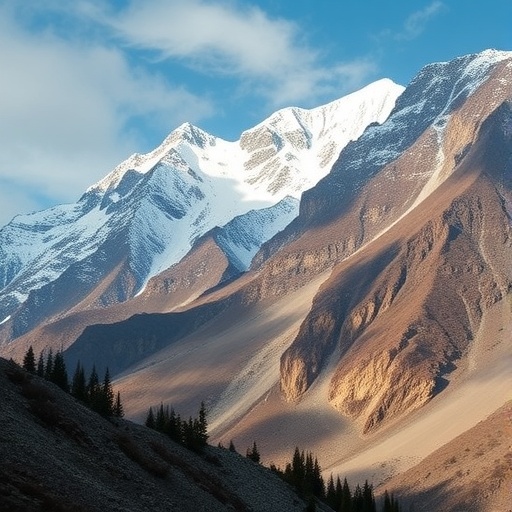
In a groundbreaking study recently published in the prestigious journal Science Advances, an international team of researchers has revealed startling insights into the dynamics behind fatal landslides in mountainous regions worldwide. Contrary to the common belief that landslides are predominantly governed by natural factors such as topography and precipitation, the research shows that human-induced changes to land cover and land use play a far more significant role in driving fatal landslide occurrences, especially in economically disadvantaged countries.
Landslides, recognized as some of the most devastating geophysical hazards on the planet, claim the lives of more than 4,500 people annually and incur damages exceeding $20 billion worldwide. Despite similar terrain and climatic parameters, the fatality rates due to landslides vary considerably between nations. This disparity inspired the researchers to probe deeper into the anthropogenic and environmental factors influencing landslide mortality. Their work addresses an urgent global concern heightened by the doubling of populations exposed to mountainous hazards since 1975, emphasizing the nexus between human transformation of landscapes and disaster risk escalation.
The scientific team, comprised of experts from the University of Vienna, Ankara University, Istanbul Technical University, Bursa Uludag University, and the GFZ Helmholtz Centre for Geosciences, meticulously analyzed empirical data spanning over six decades. They developed a comprehensive model integrating 60 years of land-use and land-cover change data alongside 45 years of population dynamics, thereby quantifying human influence through a novel metric termed Total Land-Use-Land-Cover Change (TLLC). This metric synthesizes spatial alterations ranging from deforestation to agricultural expansion and infrastructural developments, providing a holistic measure of anthropogenic landscape pressure.
By classifying mountainous regions across 46 countries according to their national income levels, the researchers identified a stark contrast: low-income countries exhibited a transformative alteration in land cover of approximately 50% within their mountainous terrains, whereas high-income nations altered only about 7%. Such discrepancies underscore the disproportionate impact of human intervention in resource-limited regions subjected to intensified demands for arable land, housing, and infrastructure. These transformations have profound implications on slope stability, hydrogeological processes, and sediment dynamics, all of which contribute cumulatively to landslide susceptibility.
The data corroborate the hypothesis that extensive land cover modification significantly exacerbates landslide fatality risks. For example, nations like Haiti, Sri Lanka, and El Salvador, where intense land-use changes have occurred, demonstrate heightened mortality rates. Conversely, affluent countries such as Switzerland, Japan, and Italy, despite their exposure to similar topographic and climatic hazards, maintain lower fatality tallies due to more conservative land management practices and robust infrastructure resilience. This dichotomy highlights the interplay between socio-economic conditions, environmental stewardship, and disaster outcomes.
At the core of this study lies a transformative notion: socioeconomic vulnerability is amplified by unsustainable land-use practices, which elevate the exposure and susceptibility of vulnerable populations to catastrophic landslides. The research reveals that in low-income countries, population pressures compel rapid clearing of fragile mountain ecosystems for subsistence farming, informal settlements, and basic infrastructure, often without adequate planning or regulatory oversight. These activities disrupt natural drainage patterns, increase soil erosion rates, and weaken slope integrity, heightening the probability of landslides with fatal consequences.
From a geotechnical engineering perspective, the physical destabilization caused by deforestation and land conversion alters critical parameters such as soil cohesion and hydrological conductivity. Removing forest cover eliminates root reinforcement, which plays a vital role in slope stability, thereby increasing the risk of mass movement during extreme rainfall events. Simultaneously, road construction exacerbates slope disturbance and alters natural drainage, while agricultural terracing without proper engineering controls can induce localized failure mechanisms. The compounded effect of these anthropogenic stressors accelerates the frequency and severity of landslides.
The study’s innovative methodology integrating remote sensing data, population statistics, and hazard modeling signifies an advancement in disaster risk science. By incorporating TLLC as a primary variable in their predictive models, the researchers provide a quantifiable link between human pressures and landslide mortality, shifting the paradigm from a purely natural hazard framework to one that prominently factors in human-environment interactions. This approach enables a more nuanced risk assessment tailored to socioeconomic contexts, thereby guiding targeted mitigation strategies.
Importantly, the findings advocate for sustainable land-use planning as an indispensable strategy for disaster risk reduction in mountainous regions of low and lower-middle-income countries. Maintaining minimal anthropogenic alteration of mountain ecosystems emerges as a crucial intervention to reduce fatalities from landslides. This includes enforcing land tenure policies that discourage unplanned deforestation, promoting agroforestry and soil conservation practices, and developing resilient infrastructure designed to withstand geomorphological hazards.
Moreover, the study draws attention to the role of governance and financial capacity in modulating landslide risk. High-income nations can deploy advanced early warning systems, invest in engineered slope stabilization, and regulate land development stringently, thereby mitigating vulnerability despite the omnipresent natural hazard. In contrast, economically constrained regions frequently lack the resources and institutional frameworks necessary to implement effective hazard management, further exacerbating the impact of human-induced environmental degradation.
The research also emphasizes the ethical dimension of environmental transformation and disaster vulnerability. Anthropogenic land changes disproportionately expose marginalized communities, who often have limited mobility and access to emergency services, to increased landslide risk. Addressing this disparity requires integrated policies that prioritize equity in disaster preparedness, enhance community-based risk reduction measures, and foster international cooperation to support sustainable mountain development.
In conclusion, this seminal study shifts the discourse around landslide fatalities from a focus solely on natural hazards to a comprehensive understanding rooted in human-environmental dynamics. By identifying land-use-land-cover change as a dominant determinant of fatal landslides, particularly in impoverished mountainous regions, it underscores the critical need for sustainable development practices underpinned by robust scientific data. The integration of socio-economic insights with geophysical data facilitates a strategic approach to reducing landslide mortality, potentially saving thousands of lives and mitigating economic losses worldwide.
This research not only enriches scientific knowledge but also carries profound implications for policymakers, urban planners, and disaster risk management practitioners. Harnessing the insights offered herein to develop tailored, context-sensitive interventions may transform how nations respond to landslide risks, ultimately fostering resilience in vulnerable mountain communities subjected to accelerating environmental and climatic changes.
News Publication Date:
8-Apr-2026
Web References:
https://dx.doi.org/10.1126/sciadv.aec2739
Cite Scienmag News
Violet Maxwell. (April 8, 2026). Human Land-Cover Changes Significantly Raise Global Mountain Landslide Deaths. Scienmag. https://scienmag.com/human-land-cover-changes-significantly-raise-global-mountain-landslide-deaths/
Violet Maxwell. "Human Land-Cover Changes Significantly Raise Global Mountain Landslide Deaths." Scienmag, 8 April 2026, https://scienmag.com/human-land-cover-changes-significantly-raise-global-mountain-landslide-deaths/. Accessed 3 September 2026.
Violet Maxwell. "Human Land-Cover Changes Significantly Raise Global Mountain Landslide Deaths." Scienmag. April 8, 2026. https://scienmag.com/human-land-cover-changes-significantly-raise-global-mountain-landslide-deaths/


