


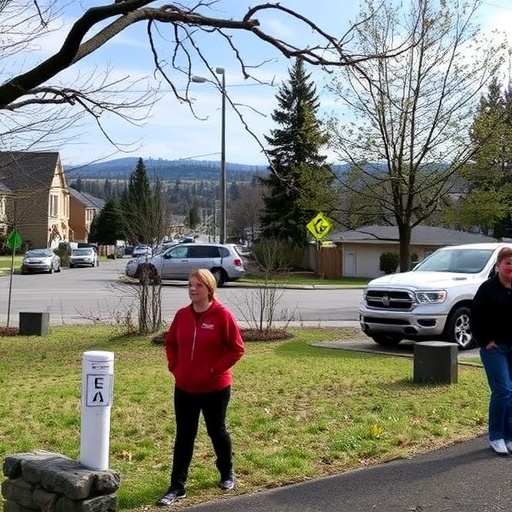
In a groundbreaking study released in April 2026, researchers have embarked on one of the most comprehensive community-engaged assessments of residential exposure to polycyclic aromatic hydrocarbons (PAHs) in West Eugene, Oregon. This investigation sheds new light on how everyday environments could harbor invisible toxic hazards that impact the health of local populations. The study, spearheaded by Germano, Tidwell, Jiang, and colleagues, combines rigorous scientific methodologies with active community participation, offering a novel paradigm in environmental epidemiology that prioritizes transparency and shared knowledge.
Polycyclic aromatic hydrocarbons, a class of organic compounds composed of multiple fused aromatic rings, have long been recognized for their pervasive presence in urban and industrial atmospheres. Originating predominantly from incomplete combustion of carbon-based fuels—such as vehicle emissions, residential heating, industrial processes, and tobacco smoke—PAHs are ubiquitous environmental pollutants. Their lipophilic nature facilitates bioaccumulation in human tissues, and many PAHs are classified as carcinogenic or mutagenic, posing significant risks to public health. Historically, quantifying residential exposure has been challenging due to spatial variability and the complex mixture of PAHs in ambient air.
The investigation used cutting-edge passive sampling technologies strategically deployed across numerous residential locations in West Eugene. These samplers enabled continuous collection of air samples over extended periods, capturing temporal fluctuations in PAH concentrations that traditional episodic sampling might overlook. By analyzing both gas-phase and particle-bound PAHs, the researchers obtained a comprehensive profile of exposure levels directly breathing zone-relevant for residents. This nuanced approach allowed the demarcation of exposure gradients within different neighborhoods, highlighting hotspots potentially linked to proximity to major roadways, industrial zones, and wood-burning activities.
What distinguishes this study is its commitment to community engagement throughout the research cycle. Local residents were involved not only as participants but as collaborators who helped identify key areas for sampling, interpret preliminary findings, and articulate concerns related to exposure sources. This participatory framework fosters trust and empowers communities, transforming them from passive subjects into advocates for environmental justice. Such collaboration also ensured that the scientific discourse was accessible, bridging the gap between technical research and real-world implications.
The findings resoundingly indicate that indoor and outdoor PAH concentrations in West Eugene homes vary considerably, influenced by factors such as building characteristics, cooking habits, ventilation, and proximity to traffic corridors. Seasonality played a notable role, with higher concentrations detected during colder months when wood-burning stoves and fireplaces are frequently used. These trends underscore the multifaceted nature of PAH exposure, where ambient sources interact dynamically with residential behaviors to shape individual risk profiles.
Beyond concentration measurements, the research team employed advanced chemical fingerprinting and source apportionment techniques to identify predominant PAH contributors. Their analyses implicated vehicle exhaust as a major contributor but also revealed significant input from residential wood combustion. This duality in source attribution highlights the complex challenges facing policymakers in crafting effective mitigation strategies. Addressing one source without accounting for others may fail to protect vulnerable populations adequately.
The health implications of chronic PAH exposure remain a pressing concern. Epidemiological evidence links long-term inhalation of PAHs with increased incidences of respiratory ailments, cardiovascular disease, and several types of cancer, including lung and bladder cancers. This study’s high-resolution exposure data provide a critical foundation for future health risk assessments tailored to localized conditions, enabling public health officials to prioritize interventions more strategically.
Importantly, the study’s integrative approach underscores the need to contextualize environmental exposures within socio-economic and demographic frameworks. West Eugene exhibits patterns of uneven environmental burdens, often aligning with communities of lower socio-economic status and limited access to healthcare resources. The researchers emphasize the ethical imperative to mitigate these disparities, advocating for policies that promote environmental equity alongside pollution reduction.
Technological advancements enabled the detection of PAHs at parts-per-trillion levels, surpassing sensitivity thresholds available in prior assessments. Coupling these analytical strengths with geospatial mapping techniques allowed the visualization of microenvironmental patterns of contamination. These visual tools serve crucial roles in communicating risks to stakeholders, informing urban planning decisions, and fostering community-led monitoring initiatives.
The team also explored behavioral adaptation potentials, such as optimizing ventilation practices or replacing wood-burning appliances with cleaner alternatives. By incorporating community input, the recommendations remain culturally and economically feasible, increasing the likelihood of successful adoption. This pragmatic orientation underscores the study’s broader vision: to catalyze actionable change informed by robust science and community wisdom.
In addressing the broader implications, the investigation situates its findings within global PAH research, highlighting parallels between West Eugene and other urban settings grappling with similar challenges. It advocates for expansion of community-based exposure assessments worldwide, leveraging participatory science as a tool for democratizing environmental health data.
Future directions stemming from this work aim to integrate biomonitoring and health outcome data to elucidate direct links between residential PAH exposure and adverse effects. Such interdisciplinary efforts will refine risk characterization and guide precision public health interventions. Collaborative networks spanning academia, government, and civil society will be indispensable for advancing this agenda.
In conclusion, this community-engaged research initiative marks a milestone in environmental exposure science. By weaving together sophisticated analytical techniques with grassroots participation, it not only illuminates pressing environmental health risks in West Eugene but also charts a path toward inclusive, evidence-based solutions. As urban populations continue to expand amidst evolving pollution landscapes, such integrative efforts become increasingly vital to safeguarding public well-being and fostering environmental justice.
Cite Scienmag News
Phoebe Ingram. (April 8, 2026). Community Study Uncovers PAH Exposure in West Eugene. Scienmag. https://scienmag.com/community-study-uncovers-pah-exposure-in-west-eugene/
Phoebe Ingram. "Community Study Uncovers PAH Exposure in West Eugene." Scienmag, 8 April 2026, https://scienmag.com/community-study-uncovers-pah-exposure-in-west-eugene/. Accessed 4 September 2026.
Phoebe Ingram. "Community Study Uncovers PAH Exposure in West Eugene." Scienmag. April 8, 2026. https://scienmag.com/community-study-uncovers-pah-exposure-in-west-eugene/


