


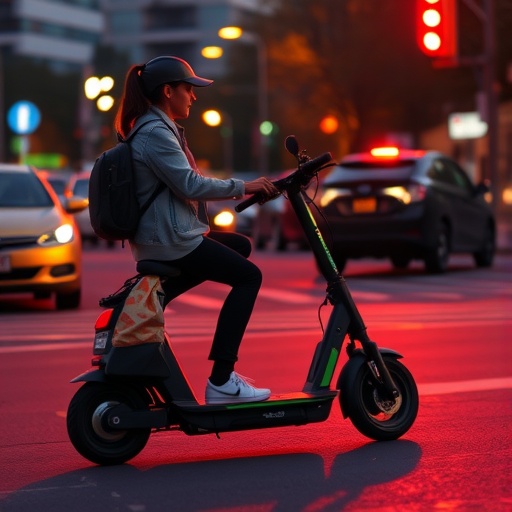
As electric scooters rapidly proliferate across urban landscapes, a parallel rise in injury rates among youth has emerged, sparking important public health concerns. A groundbreaking study led by experts at Johns Hopkins Children’s Center delves into national data, revealing critical insights about the demographics most affected by e-scooter incidents. The analysis not only highlights the prevalence of injuries among adolescent males but also uncovers significant racial and ethnic disparities in injury rates. These findings underscore the urgent need for targeted interventions and policy reforms to safeguard vulnerable populations.
The research, recently published in the peer-reviewed journal Injury, harnessed data spanning 2020 to 2024 from the National Electronic Injury Surveillance System (NEISS), a comprehensive database overseen by the U.S. Consumer Product Safety Commission. NEISS captures injury reports from a representative sample of emergency departments nationwide, providing a robust framework for epidemiological study. Within this period, pediatric injuries linked to e-scooters totaled 2,117 cases, with boys under 18 constituting over 70 percent of incidents. Notably, children aged 11 to 14 represented the largest proportion, accounting for 38.3 percent of these injuries, signifying a particularly at-risk developmental phase.
Detailed examination of injury mechanisms indicates that male adolescents exhibit a substantially higher propensity for both minor and major traumas, encompassing head injuries, traumatic brain injuries (TBI), fractures, and other musculoskeletal damage. Dr. Mary Beth Howard, a pediatric emergency medicine physician at Johns Hopkins, attributes this trend to a complex interplay of behavioral and social factors. Among these, increased risk-taking tendencies and the lower adoption rates of protective gear such as helmets are salient contributors. Furthermore, the relative immaturity of motor skills and decision-making faculties during early adolescence exacerbates vulnerability on roads and shared pathways.
Risk-taking behavior during early teenage years is often amplified by peer dynamics and social pressure, which may embolden adolescents to engage in hazardous riding practices. These psychosocial factors critically shape injury patterns and necessitate a multi-dimensional approach to prevention that extends beyond simple equipment mandates. The study’s evidence implicates this life stage as not only a period of physical and cognitive development but also a window during which targeted educational initiatives may yield significant safety benefits.
Perhaps most importantly, the research illuminates troubling racial and ethnic disparities in e-scooter injuries. Black and Hispanic children disproportionately bear the burden of these incidents, with injury rates of 16% and 15.7% respectively, exceeding their representation in comparable unintentional injury categories such as those involving bicycles, skateboards, and hoverboards. This disproportionate impact raises critical questions about environmental risk factors, access to safe recreational spaces, and socioeconomic determinants influencing injury risk profiles.
Despite the elevated incidence among Black and Hispanic youth, the study found no evidence of increased severity or hospitalization rates for these groups relative to others. The majority of injuries were classified as musculoskeletal or soft tissue damage – including fractures, dislocations, and abrasions. Internal organ injuries accounted for approximately 13% of cases, while head injuries such as concussions comprised a smaller fraction at 4%. This gradient of injury severity highlights the potential effectiveness of early intervention strategies aimed at reducing the occurrence of severe trauma.
Methodological constraints of the study include its reliance on emergency department data, which excludes injuries managed in urgent care centers or outpatient clinics. Consequently, the true scope of e-scooter-related pediatric injuries may be underestimated. Nevertheless, the comprehensive nature of the NEISS database ensures that these findings represent a critical step forward in understanding injury epidemiology in the context of the sustained rise in e-scooter use.
The Johns Hopkins research team advocates for integrative approaches to injury prevention that combine educational efforts, legislative action, and infrastructure improvements. They highlight the proven benefits of helmet use across all pediatric age groups, recommending mandatory helmet policies to substantially mitigate head injury risk. Importantly, they emphasize tailoring such policies to equitably reach all demographic subsets to address disparities.
In addition, the study points to traffic regulation strategies, such as speed limit enforcement on roads and pathways shared among pedestrians and cyclists, as effective measures for reducing injury severity. Dr. Howard references prior international research underscoring that specific speed restrictions for e-scooters correlate with significant decreases in both injury frequency and seriousness. Implementing such legislation at the local and national levels could yield measurable public health gains.
Environmental modifications also play a pivotal role in fostering safer e-scooter use. Designing dedicated lanes and protected recreational paths segregated from motor vehicle traffic would minimize exposure to common collision scenarios. This is especially critical in lower-income neighborhoods, where infrastructural deficits and limited access to safe play areas exacerbate susceptibility to injuries. Addressing these disparities requires coordinated urban planning and community engagement to create inclusive, safe environments.
The study’s authors, including Joanna Cohen and Laura Pritchett alongside Dr. Howard, call upon healthcare providers, policymakers, and community leaders to mobilize resources toward these multi-faceted prevention strategies. The emerging data presents a compelling case for prioritizing interventions targeting young adolescent males and racially marginalized groups, with the goal of reducing the considerable morbidity associated with e-scooter accidents.
Funded by the Johns Hopkins University School of Medicine, this research contributes essential knowledge to the broader discourse on urban transportation safety and child injury prevention. As e-scooter usage escalates globally, understanding population-specific risks and implementing evidence-based policies will be critical for mitigating injury rates and promoting healthier, safer communities.
News Publication Date: March 26, 2026
Web References:
- Johns Hopkins Children’s Center: https://www.hopkinsmedicine.org/johns-hopkins-childrens-center/
- National Electronic Injury Surveillance System: https://www.cpsc.gov/Research–Statistics/NEISS-Injury-Data
- Injury Journal: https://www.sciencedirect.com/science/article/pii/S0020138326001609?via%3Dihub
References: DOI: 10.1016/j.injury.2026.113175
Cite Scienmag News
Ophelia Keating. (April 7, 2026). Research Reveals Increasing Electric Scooter Injuries and Highlights Racial and Ethnic Disparities Among Victims. Scienmag. https://scienmag.com/research-reveals-increasing-electric-scooter-injuries-and-highlights-racial-and-ethnic-disparities-among-victims/
Ophelia Keating. "Research Reveals Increasing Electric Scooter Injuries and Highlights Racial and Ethnic Disparities Among Victims." Scienmag, 7 April 2026, https://scienmag.com/research-reveals-increasing-electric-scooter-injuries-and-highlights-racial-and-ethnic-disparities-among-victims/. Accessed 3 September 2026.
Ophelia Keating. "Research Reveals Increasing Electric Scooter Injuries and Highlights Racial and Ethnic Disparities Among Victims." Scienmag. April 7, 2026. https://scienmag.com/research-reveals-increasing-electric-scooter-injuries-and-highlights-racial-and-ethnic-disparities-among-victims/


