


Ecuador’s electricity grid faces unprecedented challenges amid climate unpredictability, especially following the severe 2023–2024 drought that crippled its hydro-dependent energy system. A groundbreaking study reveals that by leveraging the country’s flexible hydropower capabilities—particularly in the Complejo Paute region—and moderating reservoir management, Ecuador could significantly enhance its grid resilience and mitigate the socioeconomic fallout of similar future crises.
Historically, Ecuador’s power generation has been dominated by hydropower, an abundant and renewable resource given the country’s rich river systems. However, the 2023–2024 drought underscored the vulnerabilities inherent in relying heavily on hydropower. To fill the ensuing deficit, Ecuador had to ramp up electricity production from thermal plants powered by fossil fuels, resulting in a 33% generation increase from 2023 to 2024 and an alarming 90% rise compared to 2022. Despite these efforts, thermal capacity and fuel supply proved inadequate, culminating in frequent nationwide blackouts and an unprecedented leasing of a powership barge as an emergency solution.
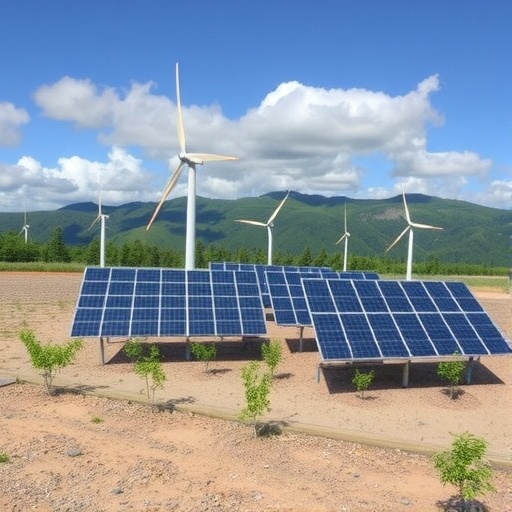
The study introduces a compelling paradigm shift by positioning variable renewable energies (VREs), such as solar and wind, as vital partners to hydroelectric systems rather than mere substitutes. Contrary to common assumptions that VREs possess low capacity credit and limited utility in addressing capacity shortages, the research demonstrates a novel “virtual” or “indirect” capacity credit within drought-affected systems. This credit emerges from synergistic interactions between hydropower flexibility and intermittent renewables, enabling VREs to bolster grid stability more effectively than previously anticipated, especially during periods of hydrological stress.
Focusing on the Complejo Paute hydropower complex, which holds the bulk of Ecuador’s flexible hydro capacity, the study illustrates how intelligent reservoir operation strategies, combined with the integration of VREs, could have more than halved the need for additional thermal peak capacity. This approach also dramatically curtails reliance on imported fossil fuels, maintaining a more consistent and reliable operation of the Paute River hydropower system throughout drought-induced low-flow episodes. The findings posit that strategic hybridization can smooth out the volatile output profiles characteristic of both hydropower and VREs, markedly improving overall system performance and economic efficiency.
While hydro–VRE hybridization emerges as a central resilience strategy, the research equally acknowledges alternative and complementary measures. Continual expansion of fossil-fuel-based generation remains on the table, albeit with notable environmental and economic trade-offs. Simultaneously, Ecuador’s efforts to diversify hydropower by developing new plants on the Pacific side—epitomized by the 254-MW Toachi Pilatón project inaugurated in early 2025—aim to harness Amazonian–Pacific hydrological complementarity. Although the 2024 drought disrupted this natural balance, spreading hydropower assets across different basins is envisioned to enhance reservoir management flexibility in normal years and increase drought resilience.
Transmission infrastructure is another pillar underpinning Ecuador’s energy security. The study underscores the synergistic potential of expanding interconnections with neighboring Colombia and Peru. Such interconnectors not only facilitate the export of excess VRE-generated electricity during periods of surplus but also broaden the system’s resource diversity and reliability. This networking approach synergizes with hydro–VRE hybridization rather than competes against it, promising new avenues for regional cooperation and mutual energy security.
Energy storage technologies, including batteries and pumped hydro storage, are recognized for their ability to augment daily balancing of supply and demand but fall short when tackling the protracted capacity deficits characteristic of multi-month drought events. Seasonal storage solutions, such as power-to-X technologies that convert surplus renewable power into green hydrogen for later combustion, hold theoretical promise. However, their high capital costs and layered infrastructure requirements make them a less feasible immediate option compared to direct VRE integration fortified by adept hydropower management.
Methodologically, the study leverages an innovative approach to capture the temporal intricacies of reservoir operation and hybrid system behavior. Unlike traditional long-term cost-optimization models, which often simplify reservoir dynamics or become computationally prohibitive over multi-year hourly simulations, this research offers granular insights into daily, seasonal, and interannual interactions shaping hydro–VRE synergy. Such precision allows for the nuanced identification of capacity credit mechanisms and system resilience benefits unique to drought-affected hydropower contexts.
Nonetheless, the authors caution that real-world reservoir management is far more complex than model-based optimal dispatch simulations can fully capture. Unexpected fluctuations in demand, sudden outages, transmission constraints, sedimentation concerns, and regulatory decisions introduce variability that may challenge the practical implementation of finely tuned hydro–VRE hybridization strategies. Additionally, evolving load profiles driven by economic growth and climate-change-induced shifts add layers of uncertainty regarding future system demands and renewable generation patterns.
Ecuador’s journey toward resilient power systems also confronts institutional and economic obstacles. Current subsidies favor hydropower and fossil fuels, dampening the competitive appeal of VRE investments. The absence of coherent policy frameworks and market mechanisms—for example, ancillary services markets that remunerate grid flexibility—further hinders VRE scalability and the incentivization of flexible hydropower operations aligned with renewable integration. Moreover, high capital costs for renewable projects, reportedly among the highest in Latin America, present significant barriers to attracting much-needed investment.
Looking ahead, the study highlights the pressing need for comprehensive policy reforms that align incentives with the technical and economic realities of a hydro–VRE hybridized grid. Lessons from neighboring countries, such as Colombia’s experience with reliability options that inadvertently encouraged less prudent reservoir operation, serve as cautionary tales. Robust regulatory design attentive to system complexity and aligned with resilience-building objectives will be essential.
The urgency of these reforms is underscored by the increasing frequency and intensity of climate extremes. Anthropogenic climate change amplified the likelihood of the 2023–2024 Amazon basin drought by a factor of 10 to 30, and projections indicate that similar extreme drought events will shift from once-in-a-century to once-in-three-decades occurrences in a 2°C warmer world. Given Ecuador’s hydro-reliance, safeguarding electricity supply against such climatic volatility remains an existential imperative, with broader implications for other hydro-dependent nations across Central and South America, Africa, and Asia.
Despite these challenges, Ecuador is not starting from zero in variable renewables deployment. It currently operates around 74 MW of wind capacity, a modest foundation compared to the gigawatt-scale expansions envisioned to realize full hydro–VRE synergy benefits. Achieving such scale will necessitate urgent and detailed assessments of VRE deployment feasibility, infrastructure requirements—including transmission in mountainous terrains—and integration strategies matched to Ecuador’s unique geographic and climatic context.
Ultimately, this research positions variable renewables not as mere supplements but as transformative partners to hydropower in Ecuador’s quest for a resilient and low-carbon electricity future. By unlocking the untapped potential of hydro–VRE hybridization, the country can forge a more secure, affordable, and sustainable energy system robust against the amplifying extremes of climate change. Integrative modeling efforts that weave reservoir management and renewable variability into holistic planning frameworks will be key to navigating this transition effectively.
In essence, Ecuador’s recent energy crisis acts as both a warning and an opportunity—a clarion call to reimagine power system design through innovative synergy rather than entrenched singular reliance. The lessons learned here may resonate widely, offering a blueprint for resilience in water-dependent energy systems confronting an uncertain climatic era worldwide.
Cite Scienmag News
Faith Mcneil. (April 7, 2026). Variable Renewables Strengthen Ecuador’s Drought-Resilient Power. Scienmag. https://scienmag.com/variable-renewables-strengthen-ecuadors-drought-resilient-power/
Faith Mcneil. "Variable Renewables Strengthen Ecuador’s Drought-Resilient Power." Scienmag, 7 April 2026, https://scienmag.com/variable-renewables-strengthen-ecuadors-drought-resilient-power/. Accessed 4 September 2026.
Faith Mcneil. "Variable Renewables Strengthen Ecuador’s Drought-Resilient Power." Scienmag. April 7, 2026. https://scienmag.com/variable-renewables-strengthen-ecuadors-drought-resilient-power/


