

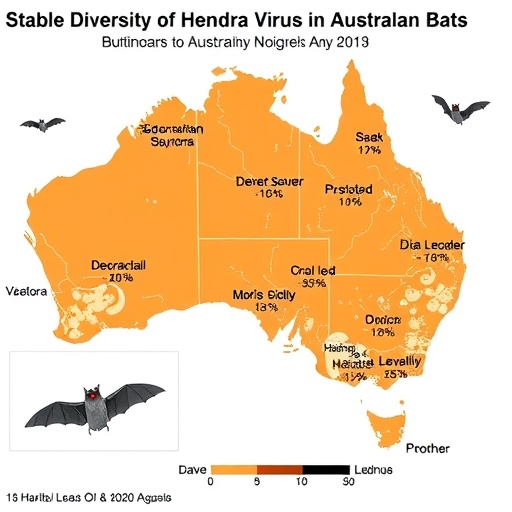
In a pivotal breakthrough published in Nature Microbiology, researchers have unveiled the intricate spatio-temporal dynamics of Hendra virus within Australia, presenting compelling evidence for the stable maintenance of diverse viral clades among Pteropus bat populations. This comprehensive study, led by Yinda et al., delves into the complexities underlying how this zoonotic virus persists and evolves within its natural reservoir, offering transformative insights into viral ecology with significant implications for public health preparedness.
Hendra virus, a member of the Henipavirus genus, is a highly pathogenic paramyxovirus primarily harbored by Pteropus bats, commonly referred to as flying foxes. Since its discovery in 1994, the virus has caused sporadic outbreaks in horses and humans, often resulting in severe respiratory or neurological diseases with high fatality rates. Understanding the maintenance and transmission dynamics of Hendra virus within reservoir hosts is crucial for predicting spillover events and minimizing cross-species infections.
The research team utilized an extensive dataset combining viral genome sequences collected across multiple years and geographic regions in Australia. By employing advanced phylogenetic and spatio-temporal analytical methods, they reconstructed the evolutionary trajectories and spatial dissemination patterns of various Hendra virus clades. Their findings reveal remarkable viral diversity maintained stably over time within distinct bat subpopulations, challenging prior assumptions that viral lineages are transient or frequently replaced.
Analysis demonstrates that multiple divergent clades of the virus coexist in Pteropus populations simultaneously rather than a single dominant lineage superseding others. This stable coexistence suggests a complex ecological equilibrium possibly shaped by bat population structure, virus-host coevolution, and environmental factors. Such viral heterogeneity enhances the adaptive potential of the virus, potentially affecting its transmissibility and virulence when spillover occurs.
The spatio-temporal mapping disclosed that viral clades exhibit regional clustering aligned with bat roosting sites, highlighting limited viral mixing between geographically isolated bat colonies. These findings emphasize that the structured social behavior and habitat preferences of Pteropus bats critically influence the local maintenance and dissemination of Hendra virus. Geographic barriers and environmental heterogeneity thus act as natural modulators of viral gene flow.
Interestingly, despite the spatial fragmentation, occasional long-distance virus dispersal events were identified, likely mediated by bat migration or overlapping foraging ranges. Such events contribute to genetic exchange and may facilitate the emergence of novel viral variants with unpredictable epidemiological characteristics. Understanding these dispersal dynamics is essential for modeling outbreak risks across broad landscapes.
The study also sheds light on temporal patterns, revealing seasonal fluctuations in virus prevalence corresponding with bat reproductive cycles and population density changes. Seasonal viral amplification likely results from increased contact rates among juvenile bats and immunological factors, promoting viral maintenance over time. These insights provide a scaffold for temporal risk assessments in spillover forecasts.
Furthermore, molecular clock analyses allowed estimation of the evolutionary rates of Hendra virus clades, confirming a relatively slow but steady accumulation of genetic changes. This stability contrasts with the rapid antigenic shifts observed in some RNA viruses and may reflect adaptation to the bat host environment, underscoring the intricate virus-host interplay preserving viral fitness without causing overt disease in the reservoir.
These findings have profound implications for disease surveillance and control strategies. By pinpointing key factors sustaining diverse viral populations in reservoir hosts, public health entities can refine monitoring efforts to high-risk periods and locations. Additionally, understanding viral diversity enables the development of more effective diagnostic tools and vaccines tailored to the circulating Hendra virus variants.
From an ecological perspective, the demonstrated stable coexistence of multiple clades highlights the importance of conserving bat habitats and maintaining natural population dynamics. Disruptions through habitat destruction or climate change could alter viral transmission patterns, potentially increasing spillover risks to humans and domestic animals. Thus, integrative approaches balancing ecological preservation and disease prevention are crucial.
The research underscores the utility of combining viral genomics, ecology, and epidemiology to unravel complex host-pathogen systems. By integrating cutting-edge sequencing technologies with environmental and behavioral data, scientists can gain unprecedented resolution into how zoonotic viruses persist and evolve, informing predictive models that are vital in the era of emerging infectious diseases.
Looking ahead, the authors advocate for expanded longitudinal sampling across broader geographic locales and additional bat species. Such efforts would capture greater viral diversity and illuminate interspecific transmission dynamics. Refining computational models to incorporate host immunity and environmental variables will further enhance predictive capacity and guide proactive public health interventions.
In summary, this landmark study elucidates the multifaceted mechanisms by which Hendra virus achieves stable maintenance of diverse genetic clades in Pteropus bat populations across Australia. It offers a paradigm shift in understanding the ecology of henipaviruses and underscores the interconnectedness of wildlife conservation and zoonotic disease emergence. These insights lay a robust foundation for mitigating future outbreaks of this enigmatic virus.
The work by Yinda and colleagues not only advances fundamental virology but also exemplifies the power of interdisciplinary research approaches in confronting global challenges posed by zoonoses. As human activities increasingly encroach on wildlife habitats, deciphering such pathogen dynamics becomes ever more urgent. This study stands as a testament to the critical need for collaborative efforts blending molecular biology, ecology, and epidemiology.
Through unraveling the evolutionary and ecological stability of diverse Hendra virus clades, this research opens novel avenues for targeted surveillance, risk assessment, and intervention strategies that can be adapted to other bat-borne pathogens worldwide. Ultimately, it enhances our collective capacity to protect both human health and biodiversity in an era defined by emerging infectious threats.


