


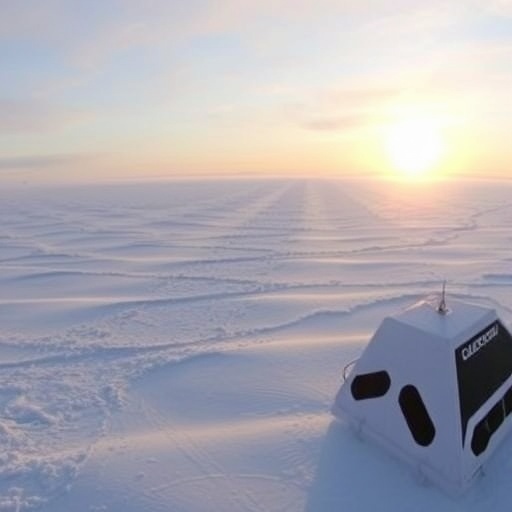
In the relentless expanse of the polar regions, where climate extremes challenge both life and scientific inquiry, researchers have unlocked a critical piece of the atmospheric chemistry puzzle: the elusive speciated forms of oxidized mercury. Mercury, a potent neurotoxin with global implications, has long been known to undergo complex atmospheric transformations, but capturing its speciation in real polar conditions was hitherto a monumental challenge. Now, a groundbreaking study published in Nature Communications has delivered the first direct observations of atmospheric oxidized mercury species in polar environments, promising to redefine our understanding of mercury cycling and its environmental impact in these fragile ecosystems.
Mercury’s journey through the atmosphere is marked by intricate chemical pathways, governed by oxidation and reduction reactions that determine its transport, deposition, and bioavailability. Traditionally, atmospheric mercury monitoring has focused on total oxidized mercury (Hg(II)) without resolving the individual molecular species that make up this pool. This limitation hindered precise modeling of mercury deposition patterns and its ecological consequences, particularly in the Arctic and Antarctic, where mercury sources and sinks exhibit unique dynamics influenced by extreme cold, seasonal light variations, and ice cover.
The pioneering work by Jokinen and colleagues utilizes advanced mass spectrometry techniques combined with carefully designed field campaigns in polar locations to differentiate between specific oxidized mercury species, such as HgCl2, HgBr2, and HgO. This methodological leap enables scientists to identify how each species behaves under polar atmospheric conditions, including their formation mechanisms, lifetimes, and reactivity with other atmospheric constituents like halogens and aerosols. The findings underscore the dominance of bromine-mediated oxidation pathways, a process highly efficient in polar springtime, that leads to elevated concentrations of reactive gaseous mercury (RGM).
Beyond merely cataloging species, the study reveals striking spatial and temporal variations in oxidized mercury speciation across polar seasons. During the sunlit months, the surge of bromine radicals generated from sea ice and snowpack instigates a rapid conversion of elemental mercury into more reactive oxidized forms, which then deposit onto snow and ice surfaces. This seasonal flux not only influences the immediate environmental exposure but also affects mercury’s global transport patterns, as deposited mercury can be remobilized into the atmosphere or enter the marine food web.
Importantly, the high-resolution observation data challenge previous assumptions embedded in atmospheric chemistry models, which often oversimplified mercury oxidation as a monolithic process. The specificity introduced by direct speciation measurements allows for refined kinetic parameters and reaction mechanisms to be integrated into predictive models, improving our ability to forecast mercury deposition trends and assess risks related to climate-driven changes in polar environments.
The implications extend far beyond fundamental atmospheric chemistry. Mercury contamination poses significant hazards to Arctic indigenous communities reliant on seafood, as mercury bioaccumulates in marine mammals and fish. Understanding the speciation and deposition patterns enhances risk assessments and informs policy decisions at local and international levels. Moreover, as polar regions warm disproportionately, changes in mercury cycling could exacerbate contamination issues, emphasizing the urgency of this research.
The technological advancements underpinning this study reflect a fusion of innovation and perseverance. Researchers engineered state-of-the-art ambient ionization mass spectrometers capable of operating under harsh polar conditions, maintaining sensitivity and specificity despite low mercury concentrations and the presence of interfering compounds. Field deployments involved coordinated measurements aboard icebreaker vessels and satellite-linked observation stations, integrating ground-truth data with remote sensing to paint a comprehensive picture of atmospheric mercury dynamics.
Furthermore, by characterizing the interplay between mercury species and halogen chemistry, the study highlights potential feedback mechanisms in polar atmospheric processes. The interaction of oxidized mercury with reactive bromine and chlorine species not only affects mercury’s fate but also links to broader phenomena such as ozone depletion and aerosol formation, positioning mercury chemistry at the nexus of multiple environmental concerns.
This nuanced understanding of oxidized mercury speciation in the poles challenges researchers to reconsider assumptions about global mercury cycling that influence everything from air quality management to climate change mitigation strategies. It prompts a re-evaluation of current regulatory frameworks and encourages increased monitoring in remote regions where data scarcity has long hindered effective governance.
Beyond the immediate scientific insights, the study serves as a testament to the power of interdisciplinary collaboration, merging atmospheric chemistry, environmental science, engineering, and Indigenous knowledge. By integrating diverse expertise, the researchers have opened new pathways for exploring biogeochemical cycles in some of the planet’s most unforgiving yet sensitive areas.
The revelations drawn from this study have already sparked a surge of interest within the atmospheric science community, with calls for expanded monitoring networks and development of next-generation analytical platforms capable of real-time speciation. Such efforts could transform how we track mercury pollution globally and enable timely interventions where human and ecological health are at greatest risk.
In summary, the direct observation and speciation of atmospheric oxidized mercury in polar areas represent a transformative milestone, bringing clarity to a complex environmental challenge. This work not only advances our chemical understanding but also lays the groundwork for informed environmental stewardship amid a rapidly changing Arctic and Antarctic landscape. As mercury continues its global journey, science now holds sharper tools to unravel its mysteries and safeguard vulnerable communities and ecosystems across the poles and beyond.
Cite Scienmag News
Russell Cooper. (April 7, 2026). Direct Observations of Oxidized Mercury in Polar Atmospheres. Scienmag. https://scienmag.com/direct-observations-of-oxidized-mercury-in-polar-atmospheres/
Russell Cooper. "Direct Observations of Oxidized Mercury in Polar Atmospheres." Scienmag, 7 April 2026, https://scienmag.com/direct-observations-of-oxidized-mercury-in-polar-atmospheres/. Accessed 3 September 2026.
Russell Cooper. "Direct Observations of Oxidized Mercury in Polar Atmospheres." Scienmag. April 7, 2026. https://scienmag.com/direct-observations-of-oxidized-mercury-in-polar-atmospheres/


