


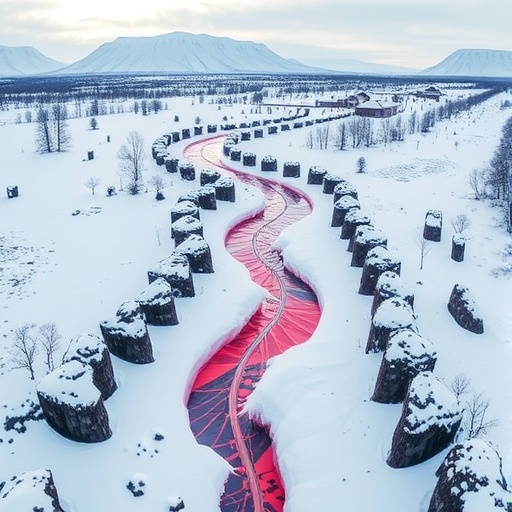
As the Arctic undergoes unprecedented warming, the thawing of permafrost—a once-frozen expanse of soil and sediment—has emerged as a critical driver of biochemical fluxes within northern ecosystems. Recent research has elucidated a previously underappreciated process whereby the thawing permafrost not only destabilizes landscapes but also facilitates the mobilization of iron from wetlands and sulfide-rich geological formations into Arctic rivers and streams. This cascade of iron fluxes, as unveiled in a pioneering study by Dial, Hanna, Sullivan, and colleagues, has profound implications for biogeochemical cycling, aquatic ecology, and even global climate feedbacks.
To understand the complexity of iron transport in these vulnerable environments, one must first appreciate the dual nature of permafrost regions. These areas frequently encompass extensive wetlands saturated with organic material, alongside underlying mineral substrates imbued with sulfide minerals, chiefly pyrite (FeS2). The intricate interplay between these components is modulated by temperature regimes that have historically preserved the stability of both organic carbon reserves and mineral structures. However, warming-induced permafrost thaw disrupts this balance, exposing sulfide-bearing rocks to oxygen and initiating chemical weathering processes that liberate iron ions into surrounding waters.
Key to this newly identified mechanism is the oxidation of sulfide minerals within thawed sediments, leading to the production of ferrous (Fe2+) and ferric (Fe3+) iron species. As oxygen penetrates the previously anoxic subsurface, pyrite undergoes oxidative dissolution, releasing iron ions that can complex with organic ligands originating from adjacent wetlands. These organo-iron complexes are more mobile and thus can be transported more readily through the hydrological network, entering rivers and streams that serve as conduits to the broader Arctic Ocean.
The research team employed a combination of field measurements, laboratory experiments, and geochemical modeling to quantify iron fluxes across permafrost-thaw gradients. Through meticulous sampling of porewater chemistry, sediment profiles, and fluvial discharge, they demonstrated that iron release corresponds closely with permafrost degradation fronts. Notably, elevated iron concentrations were detected downstream of regions where the active layer—the seasonally thawed surface—had deepened significantly, indicating enhanced mineral oxidation and mobilization in these zones.
Moreover, the iron mobilized through these processes is not mere inert particulate matter; it plays an outsized role in biogeochemical cycles. Iron acts as a critical micronutrient for microbial and phytoplankton communities, supporting primary productivity in nutrient-limited Arctic waters. In parallel, iron can influence the cycling of carbon and sulfur by serving as an electron acceptor in redox reactions that degrade organic matter or transform sulfur species. Thus, iron fluxes stemming from permafrost thaw can alter ecological dynamics both locally within aquatic ecosystems and broadly through feedbacks to global carbon budgets.
Interestingly, the study highlights the differential contributions of wetlands and sulfide-bearing rock sources to iron mobilization. Wetlands themselves, rich in organic carbon and microbial activity, can produce reduced iron species via microbial iron reduction under anaerobic conditions. Upon permafrost thaw, the reoxidation of these reduced iron pools leads to transient spikes of dissolved iron exported downstream. At the same time, weathering of sulfide rocks contributes a more sustained supply of iron, particularly when exposed to air and hydrological flowpaths altered by thaw-induced geomorphic changes.
The hydrology of Arctic watersheds also responds dynamically to thaw, modulating iron transport pathways. Enhanced groundwater flow, increased surface runoff, and the expansion of thermokarst features such as thaw slumps and taliks collectively reshape the channels through which iron is mobilized and discharged. These complex hydrological shifts can amplify the connectivity between terrestrial iron sources and aquatic systems, generating pulses of iron during the spring freshet and other high-flow events.
Beyond ecological and biogeochemical concerns, the increased flux of iron carries implications for Arctic water quality and fisheries. While iron is essential for biological productivity, excessive iron concentrations, especially bound to sulfate and organic ligands resulting from sulfide oxidation, may influence metal toxicity and bioavailability. Changes in water chemistry can affect the solubility and transport of co-occurring elements such as mercury, posing risks to indigenous communities reliant on fish as dietary staples.
Further exploration into the downstream effects of iron fluxes on Arctic marine environments reveals potential feedbacks to climate systems. Iron is often a limiting nutrient in polar oceans, constraining phytoplankton growth that drives carbon dioxide uptake via the biological pump. The export of terrestrial iron through rivers into coastal zones could stimulate these biological sinks, thereby modulating atmospheric CO2 levels. However, the net effect depends on complex interactions with other nutrient dynamics, light availability, and ocean chemistry.
Methodologically, the study stands out for its integrative approach combining high-resolution spatial data, advanced geochemical techniques, and robust process-based models. The authors adopted isotopic tracing to differentiate iron sources and utilized reactive transport models that incorporate both biotic and abiotic reactions governing iron speciation and mobility. Such interdisciplinary strategies are critical for untangling the multiple, overlapping pathways through which permafrost thaw impacts iron biogeochemistry.
This landmark research underscores the need to incorporate iron flux considerations into global permafrost carbon models and climate projections. Traditionally, models have emphasized greenhouse gas emissions from thawing permafrost, including CO2 and methane, but the role of mineral-derived nutrients like iron has been underrepresented. Accounting for iron mobilization could refine predictions of Arctic ecosystem responses and feedbacks to climate warming, especially as thaw-induced hydrological changes accelerate.
Moreover, the findings prompt urgent questions regarding the resilience and adaptation of Arctic freshwater and marine ecosystems. Understanding how iron-driven nutrient dynamics evolve under continued warming will be essential to manage fisheries, conserve biodiversity, and safeguard indigenous livelihoods. Collaborative efforts among scientists, policymakers, and local communities will be vital to address these complex challenges.
In conclusion, the thawing of Arctic permafrost initiates a cascade of geochemical reactions that profoundly reshape iron fluxes across wetland and rock domains. This mobilization of iron into aquatic systems represents a critical, yet previously underrecognized, pathway in the interconnected terrestrial-aquatic continuum of the frozen north. As the Arctic continues to warm at rates unmatched elsewhere, such processes may exert outsized influence on regional and global biogeochemistry, with ramifications extending far beyond the circumpolar north.
By revealing the chemical and hydrological mechanisms underpinning iron flux from thawing permafrost landscapes, the work of Dial and colleagues opens new frontiers in our understanding of Arctic environmental change. Their insights challenge researchers to integrate mineral nutrient transport into the broader framework of permafrost thaw impacts, thereby advancing a more holistic paradigm of Arctic ecosystem transformation amidst global climate disruption.
Cite Scienmag News
Violet Maxwell. (April 7, 2026). Permafrost Thaw Drives Arctic Iron Flow. Scienmag. https://scienmag.com/permafrost-thaw-drives-arctic-iron-flow/
Violet Maxwell. "Permafrost Thaw Drives Arctic Iron Flow." Scienmag, 7 April 2026, https://scienmag.com/permafrost-thaw-drives-arctic-iron-flow/. Accessed 4 September 2026.
Violet Maxwell. "Permafrost Thaw Drives Arctic Iron Flow." Scienmag. April 7, 2026. https://scienmag.com/permafrost-thaw-drives-arctic-iron-flow/


