


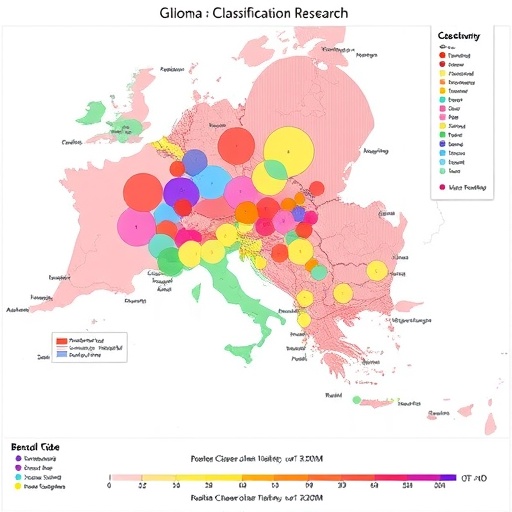
A groundbreaking bibliometric study has emerged from the collaborative efforts led by Kayode Ahmed of The University of Texas MD Anderson Cancer Center and Juan E. Núñez-Ríos from Universidad Panamericana, revealing a comprehensive mapping of glioma classification research. Published recently in Volume 17 of the journal Oncotarget, this insightful literature review harnesses advanced network analysis methodologies to decode the evolution and thematic focus of glioma classification studies from a multidimensional lens encompassing clinical, molecular, and social domains.
The research team employed a sophisticated bibliometric approach grounded in direct citation network analysis, involving an expansive dataset retrieved from the Web of Science. Comprising over 46,000 academic documents connected through more than 230,000 citation arcs, this network enabled the unraveling of pivotal scientific contributions and intellectual trajectories that have shaped the field over time. The use of main path analysis alongside key route and K-core methodologies assisted in isolating not only influential publications but also critical thematic clusters defining this research frontier.
One of the most significant outcomes of the study is the identification of DNA methylation profiling as a central pillar in the molecular classification models of gliomas. DNA methylation, an epigenetic modification influencing gene expression without altering the DNA sequence, has increasingly served as a biomarker facilitating higher-resolution subclassifications of glioma tumors. This molecular hallmark is now recognized for its diagnostic and prognostic prowess, driving personalized therapeutic strategies and refining the World Health Organization’s glioma classification framework.
Simultaneously, the bibliometric analysis underlines the critical role advanced neuroimaging technologies have played in the field. Enhanced imaging modalities, such as multiparametric MRI and PET scans, complement molecular profiling by providing spatial and functional tumor characterizations, thereby enabling more precise, non-invasive diagnostic pathways. This multidisciplinary integration of molecular data and imaging signatures encapsulates the progressive sophistication defining contemporary glioma research.
Intriguingly, despite the evident clinical and molecular advances, the review exposes a conspicuous paucity of studies incorporating social factors within glioma classification research. Social determinants of health—encompassing socioeconomic status, environmental exposures, and healthcare accessibility—remain underexplored in this domain. This thematic gap highlights a critical frontier for future research, suggesting that integrative models embedding socio-clinical contexts could substantially enrich patient stratification and outcome prediction frameworks.
The authors advocate that the analytical framework they applied transcends traditional bibliometric indicators like citation counts or h-indices, which often provide an incomplete picture of scientific development. Instead, their approach discerns the evolutionary logic and network architecture underlying the glioma research landscape, capturing complex interdependencies and thematic evolution with enhanced granularity. Such comprehensive mapping is invaluable for researchers and clinicians aiming to navigate this rapidly expanding knowledge ecosystem.
Moreover, the k-core analysis employed to examine densely interconnected subgraphs within the network offers a novel perspective on intellectual clusters—groups of publications that are tightly interlinked by shared themes or methodologies. This technique elucidates the core structure of glioma research, providing a clearer understanding of dominant scientific schools of thought and collaborative networks that sustain them.
By integrating multiple bibliometric techniques, the study not only reconstructs the historical progression and influential research nodes in glioma classification but also anticipates emerging trends. This foresight is crucial for funding agencies, policymaking bodies, and research institutions intending to prioritize areas with high translational potential and unmet clinical needs.
The study’s identification of molecular biomarkers such as DNA methylation profiling, alongside imaging advancements, reaffirms their synergistic impact in propelling precision oncology. Yet, the highlighted deficiency of social determinant considerations calls for interdisciplinary efforts that bridge molecular oncology with public health and social sciences, potentially opening new avenues for holistic patient care approaches.
Ahmed and Núñez-Ríos’ work represents a paradigm shift in how glioma classification research is analyzed and understood. By providing a multidimensional, data-driven narrative of this complex scientific arena, it encourages a more integrative research ethos—one that blends clinical insight, molecular innovation, and sociological awareness to ultimately improve glioma patient outcomes.
In conclusion, this bibliometric mapping underscores the imperative to embrace a broader research paradigm, inviting stakeholders to recognize the multifaceted nature of glioma classification. The promise lies in future models that harmonize molecular and imaging data with social determinants, ensuring that classification systems better reflect the diversity and complexity of real-world patient populations, thereby optimizing precision medicine strategies.
For scientists and clinicians alike, this study offers a clarion call: to harness network analytics not merely as retrospective tools but as proactive instruments shaping the trajectory of cancer research. The integration of big data bibliometrics with domain expertise stands to transform glioma research, fostering innovation that can ultimately translate into tangible clinical breakthroughs.
News Publication Date:
31-Mar-2026
Web References:
https://doi.org/10.18632/oncotarget.28851
References:
[62] Referenced within the figure caption in the original source.
Cite Scienmag News
Gavin Prescott. (April 6, 2026). Bibliometric Mapping Uncovers the Evolution of Glioma Classification Research. Scienmag. https://scienmag.com/bibliometric-mapping-uncovers-the-evolution-of-glioma-classification-research/
Gavin Prescott. "Bibliometric Mapping Uncovers the Evolution of Glioma Classification Research." Scienmag, 6 April 2026, https://scienmag.com/bibliometric-mapping-uncovers-the-evolution-of-glioma-classification-research/. Accessed 3 September 2026.
Gavin Prescott. "Bibliometric Mapping Uncovers the Evolution of Glioma Classification Research." Scienmag. April 6, 2026. https://scienmag.com/bibliometric-mapping-uncovers-the-evolution-of-glioma-classification-research/


