


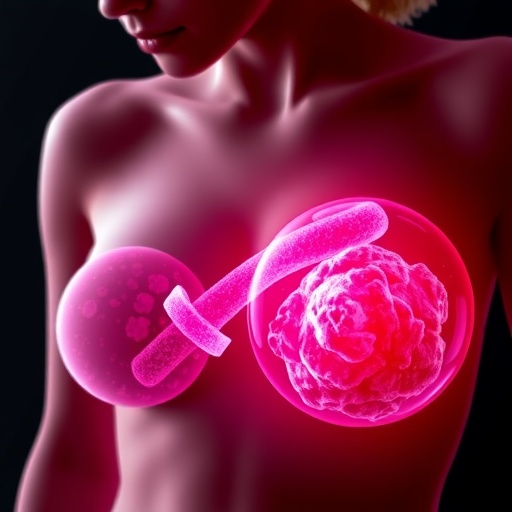
Recent research conducted by a team of Princeton University bioengineers has shed light on the complex relationship between diet and breast cancer progression, with a particular focus on how high-fat diets can exacerbate the invasive characteristics of triple-negative breast cancer (TNBC). This aggressive and therapeutically challenging form of breast cancer frequently evades traditional treatment modalities, underscoring the critical need for innovative research into its biological drivers. Utilizing advanced three-dimensional (3D) microfluidic tumor models that more faithfully recapitulate human tumor microenvironments, the investigators have demonstrated that dietary fats and cholesterol significantly alter tumor morphology, enhancing invasive behavior.
The method employed involved the culture of 3D tumor models fashioned from human-derived cells designed to mimic the architecture and complexity of in vivo tumors. By perfusing these tumor constructs with plasma-like fluids laden with various nutrients reflective of specific diets, the team was able to experimentally isolate the effects of distinct dietary components on tumor physiology. While diets rich in insulin, glycerol, and ketones produced negligible morphological changes relative to baseline conditions, exposure to fatty acids and cholesterol induced the formation of hollow, branching tumor extensions. These invasive tendrils are hallmark features of highly metastatic cancers that infiltrate surrounding tissues and facilitate systemic dissemination.
A critical molecular finding centers on the upregulation of matrix metalloproteinase 1 (MMP1), a proteolytic enzyme known for its role in remodeling the extracellular matrix by degrading collagen. Elevated MMP1 levels correlated tightly with the structural remodeling observed in the high-fat diet tumors, suggesting a mechanistic link between dietary lipids and tumor invasiveness. Although causality remains to be definitively established, this association posits MMP1 as a promising therapeutic target for interventions aimed at mitigating fat-induced cancer progression. Future research designed to inhibit MMP1 activity within the context of high-fat systemic environments may yield transformative insights.
Intriguingly, the study also evaluates the impact of ketogenic diets—characterized by high fat but low carbohydrate intake—on breast tumor growth, a nutritional strategy often posited as cancer-protective. Contrary to expectations, the ketogenic nutrient milieu did not confer observable protective effects on the TNBC models. This anomaly highlights the complexity of tumor metabolism and raises the possibility that the putative benefits of ketogenic diets may be contingent upon interactions with other cells or systemic factors absent in the current model system. The heterogeneity of tumors further complicates this paradigm, emphasizing the limitations inherent in model simplification.
The use of 3D microfluidic tumor models represents an elegant balance between biological fidelity and experimental control. Traditional two-dimensional cell cultures offer limited physiological relevance, growing on stiff substrates and lacking multicellular context. Conversely, animal models introduce systemic and environmental complexity that can obscure precise mechanistic elucidation. By integrating physical geometry, matrix stiffness, and physiologically relevant nutrient composition, the microfluidic systems recapitulate key aspects of the tumor niche, enabling interrogation of diet-tumor interactions under controlled yet biologically meaningful conditions.
The observation that tumors exposed to high-fat conditions undergo spatial reorganization—where tumor cells migrate from the core to periphery before invading outward—speaks to the adaptive remodeling capacity of cancer cells under metabolic stress or stimuli. This spatial invasion process, underpinned by molecular shifts such as MMP1 upregulation, typifies the transition from localized disease to invasive carcinomatosis. Understanding the signaling pathways and feedback loops governing this plasticity may reveal intervention points to prevent metastatic spread.
Moreover, the findings suggest that dietary fats do not necessarily accelerate tumor size expansion directly but rather induce qualitative changes in tumor architecture that enhance metastatic potential. This decoupling of growth rate and invasion underscores the multifaceted influence of metabolism on cancer pathogenesis. It suggests that clinical strategies addressing cancer aggressiveness must consider not only tumor proliferation but also the microenvironmental changes that enable metastasis.
This work also contributes to a growing consensus that diet composition exerts profound effects on cancer biology, potentially impacting patient prognosis. By connecting high-fat consumption to gene expression alterations and phenotypic invasiveness, the study advances the understanding of how environmental exposures intersect with tumor biology. It opens avenues for dietary interventions to complement molecular therapies, augmenting the arsenal against aggressive cancers like TNBC.
The research team acknowledges the limitations of their model system, which, while sophisticated, excludes many in vivo complexities such as immune system interactions and stromal cell influences. Tumor heterogeneity and patient variability remain formidable challenges, reinforcing the necessity for diverse model systems and integrative approaches to fully unravel diet-cancer dynamics.
Overall, this pioneering study highlights the detrimental role that dietary fats can play in promoting a more invasive breast cancer phenotype, signaling crucial implications for patients and clinicians alike. It underscores the importance of metabolic context in cancer progression and encourages further explorations into the molecular underpinnings of diet-induced tumor invasiveness. Moving forward, exploiting targets like MMP1 and refining dietary guidelines may inform personalized cancer management strategies aimed at halting metastatic evolution.
News Publication Date: 3-Mar-2026
Web References:
http://doi.org/10.1063/5.0291646
References:
Kohram M et al., “Fat promotes growth and invasion in a 3D microfluidic tumor model of triple-negative breast cancer,” APL Bioengineering, March 3, 2026.
Cite Scienmag News
Nathaniel Bowman. (April 6, 2026). New Findings Reveal How Fat Fuels Tumor Growth in Aggressive Breast Cancer. Scienmag. https://scienmag.com/new-findings-reveal-how-fat-fuels-tumor-growth-in-aggressive-breast-cancer/
Nathaniel Bowman. "New Findings Reveal How Fat Fuels Tumor Growth in Aggressive Breast Cancer." Scienmag, 6 April 2026, https://scienmag.com/new-findings-reveal-how-fat-fuels-tumor-growth-in-aggressive-breast-cancer/. Accessed 4 September 2026.
Nathaniel Bowman. "New Findings Reveal How Fat Fuels Tumor Growth in Aggressive Breast Cancer." Scienmag. April 6, 2026. https://scienmag.com/new-findings-reveal-how-fat-fuels-tumor-growth-in-aggressive-breast-cancer/


