


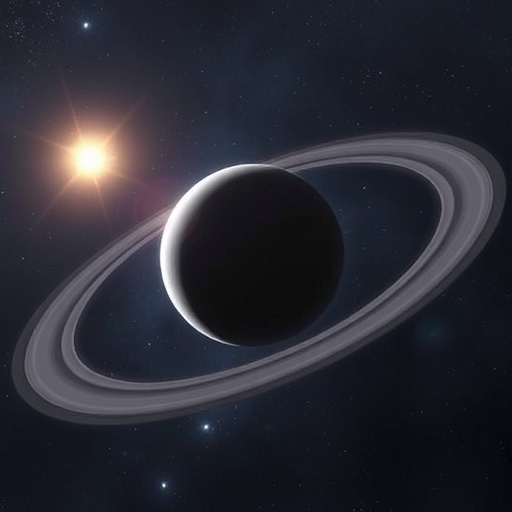
In a groundbreaking study using the unparalleled observational power of the James Webb Space Telescope (JWST), astronomers have unveiled astonishing new details about the exoplanet TOI-5205 b, a giant planet orbiting a diminutive, cool red dwarf star. This Jupiter-sized planet, which has long been considered an astronomical oddity—sometimes labeled “forbidden” due to its unusual characteristics—has now revealed an atmosphere with significantly lower heavy element content than its host star. This revelation challenges prevailing theories about planet formation and the chemical evolution of gas giants, especially those forming in the complex environs around M dwarf stars.
TOI-5205 b orbits a small star roughly four times the size of Jupiter, with a mass about 40 percent that of our Sun. Despite its relatively small host star, TOI-5205 b blocks an extraordinary six percent of the star’s light during transit events, which makes it a highly favorable candidate for detailed spectroscopic study. Using transit spectroscopy, researchers analyzed starlight filtered through the planet’s atmosphere to decode the chemical makeup and gain insights into its formation history and atmospheric processes. These spectroscopic observations provide a direct window into exoplanetary atmospheres—a frontier that has expanded dramatically with JWST’s advanced instruments.
Planets form within the protoplanetary disks of gas and dust that encircle newborn stars. It is well accepted in astrophysics that giant planets emerge from these disks in the early stages of star formation, accreting large amounts of gas and heavy elements from their surroundings. However, the discovery of gas giants like TOI-5205 b orbiting close to cool, low-mass M dwarf stars raises compelling questions about the efficiency and mechanisms of giant planet formation, migration, and chemical differentiation around such stars. This particular system poses a unique puzzle due to the planet’s considerable mass relative to its host star.
The study, published in The Astronomical Journal, represents a collaboration led by NASA’s Goddard Space Flight Center’s Caleb Cañas alongside Carnegie Science’s Shubham Kanodia, and forms part of the ambitious “Red Dwarfs and the Seven Giants” JWST Cycle 2 program. This initiative is specifically designed to investigate the so-called “GEMS” planets—giant exoplanets orbiting M dwarf stars—whose formation and evolutionary histories remain largely enigmatic. The TOI-5205 b observations mark a pioneering step in characterizing these extreme worlds.
Initial identification of TOI-5205 b came from NASA’s Transiting Exoplanet Survey Satellite (TESS), with confirmation and subsequent JWST observations spearheaded by Kanodia and colleagues. Their concerted effort involved capturing the planet’s transit events across different wavelengths, allowing them to apply transmission spectroscopy techniques that dissect the atmospheric signatures imprinted on starlight. This approach revealed a surprisingly metal-poor atmosphere—a finding that defied expectations based on comparisons to giant planets within our own Solar System such as Jupiter.
Detailed analysis uncovered that the planet’s atmosphere contains significantly lower abundances of heavier elements relative to hydrogen than its host star’s composition. This low metallicity atmosphere is unprecedented among gas giants studied thus far and contradicts standard planet formation models predicting enrichment of heavy elements in giant planet atmospheres due to core accretion and gas accumulation processes. Moreover, JWST spectra showed notable presence of methane (CH₄) and hydrogen sulfide (H₂S), offering additional clues to the chemical pathways shaping this exotic atmosphere.
To better understand these surprising results, researchers from the University of Zurich, including Simon Muller and Ravit Helled, employed sophisticated planetary interior models. Their computations suggest that although the planetary atmosphere is metal-poor, the overall composition of TOI-5205 b—including its interior—is approximately 100 times richer in heavy elements. This dichotomy implies that during its formation, heavy elements migrated toward the planet’s core or inner layers, decoupling from the atmosphere. Such heavy-element sequestration may indicate inhibited mixing between the planet’s interior and atmospheric layers, shedding light on complex evolutionary processes previously unexplored in such systems.
Kanodia emphasized the implication of these findings: the evident disparity between interior metallicity and atmospheric metal content signals that planets like TOI-5205 b possess atmospheres dominated by carbon-rich, oxygen-poor chemistry. This altered elemental balance contrasts with giant planets like Jupiter, which exhibit enhanced atmospheric metallicities consistent with their host stars and solar system formation models. Such atmospheric compositions challenge existing theoretical frameworks and invite new explorations into chemical dynamics and planetary differentiation influenced by host star properties and protoplanetary disk environments.
Additionally, the study painstakingly addressed the confounding influence of starspots on the host star, which can distort transit spectroscopy data. TOI-5205’s star exhibits significant spot activity, causing brightening effects at certain wavelengths that could mask or mimic atmospheric features. Carnegie astronomers Nicole Wallack and Shubham Kanodia developed corrective methodologies to eliminate the influence of stellar magnetic activity on the data. This refinement enhances the reliability of the atmospheric characterizations and sets a new standard for future JWST observations of planets orbiting magnetically active stars.
The GEMS survey team comprises a broad international coalition of astronomers, including specialists from institutions like Johns Hopkins University, University of Maryland, Caltech, University of St. Andrews, University of Amsterdam, and Penn State University. This transdisciplinary collaboration integrates observational astronomy, theoretical modeling, and data analysis techniques to decode the multiplicity of physical processes shaping giant exoplanets around red dwarfs—a stellar population comprising a significant fraction of the Milky Way’s stars but largely unexplored in giant planet context.
These observations and subsequent analyses herald a new era in exoplanetary science, unveiling how planetary formation physics can diverge remarkably depending on the host star’s characteristics and environment. As JWST continues to provide unprecedented spectroscopic sensitivity, astronomers anticipate uncovering further examples of metal-poor giant atmospheres and anomalous chemical signatures, offering deep insight into the diversity of planetary systems and their evolutionary trajectories. The implications extend to refining core accretion theories, migration models, and the chemical evolution of planets orbiting different types of stars, reshaping our understanding of planet formation in the cosmos.
This remarkable study underscores the transformational impact of JWST’s capabilities in transcending previous observational limitations and delivering the detailed characterization required to probe planetary atmospheres directly. By revealing the intriguing chemical fingerprint of TOI-5205 b, it opens new frontiers in exoplanetary research and ignites fresh theoretical challenges. Continued observations of similar systems promise to expand our knowledge of the profound mechanisms governing planetary emergence, chemical evolution, and atmospheric dynamics on worlds beyond our Solar System.
Web References:
https://iopscience.iop.org/article/10.3847/1538-3881/ae4976
References:
Cañas, C., Kanodia, S., et al. (2024). GEMS JWST: Transmission Spectroscopy of TOI-5205b Reveals Significant Stellar Contamination and a Metal-poor Atmosphere. The Astronomical Journal. DOI: 10.3847/1538-3881/ae4976
Keywords
TOI-5205 b, exoplanet atmosphere, JWST, transmission spectroscopy, giant exoplanets, M dwarf stars, metal-poor atmosphere, planet formation, stellar contamination, methane, hydrogen sulfide, planetary interiors, protoplanetary disks
Cite Scienmag News
Grant Pearson. (April 3, 2026). How Was This Formed? Giant Planet Orbiting a Tiny Star Raises Questions. Scienmag. https://scienmag.com/how-was-this-formed-giant-planet-orbiting-a-tiny-star-raises-questions/
Grant Pearson. "How Was This Formed? Giant Planet Orbiting a Tiny Star Raises Questions." Scienmag, 3 April 2026, https://scienmag.com/how-was-this-formed-giant-planet-orbiting-a-tiny-star-raises-questions/. Accessed 5 September 2026.
Grant Pearson. "How Was This Formed? Giant Planet Orbiting a Tiny Star Raises Questions." Scienmag. April 3, 2026. https://scienmag.com/how-was-this-formed-giant-planet-orbiting-a-tiny-star-raises-questions/


