


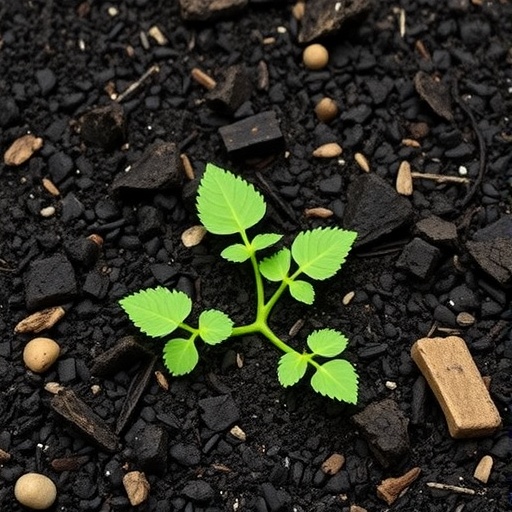
A groundbreaking study has unveiled crucial insights into the behavior of biochar when subjected to increasing soil salinity—a pervasive issue that threatens global agricultural productivity. Biochar, a carbon-dense byproduct of biomass pyrolysis, is widely celebrated for its dual capacity to enhance soil fertility and sequester atmospheric carbon, making it a linchpin in sustainable farming and climate mitigation strategies. However, the long-term fate of biochar in salt-affected soils, which are rapidly expanding due to factors such as climate change and intensive irrigation, has remained a scientific mystery—until now.
This new research delineates how elevated soil salinity fundamentally alters the chemical and microbial dynamics involved in the aging process of biochar. Whereas the conventional understanding posits biochar as an evolving substrate that gradually transforms via oxidation and microbial interactions, the findings suggest that high salinity environments substantially retard these chemical aging processes. Notably, biochar residues in such soils exhibit enhanced preservation of aromatic carbon structures and lower degrees of oxidation compared to those in low-salinity conditions.
The methodologies employed were rigorous and meticulous, involving the collection of soil samples across a gradient of salinity levels followed by controlled laboratory simulations of wet-dry cycles to mimic approximately eight years of natural aging. These simulations provided a unique window into the progressive modifications in biochar’s physicochemical properties over time. Through advanced spectroscopic and molecular analyses, the study illuminated the nuanced interplay between soil salinity and biochar stability.
One of the pivotal mechanisms identified underpinning this slowed aging process is the significant suppression of microbial colonization, especially among fungal communities. Fungi are known to be key agents in breaking down carbonaceous materials due to their enzymatic capabilities. However, the osmotic stress induced by high salt concentrations creates an inhospitable environment for these microbes, dramatically reducing their diversity and activity within the biochar matrix. Bacterial populations, while somewhat more resilient, also experienced structural shifts that further inhibited the biodegradation pathways typically observed in biochar.
Adding complexity to this phenomenon is the accumulation of mineral salts on the biochar surface. These salts form a protective coating that acts as a physical barrier, impeding oxidative reactions that ordinarily contribute to biochar’s chemical transformation. The mineralogical composition of this layer and its interaction with organic functional groups on biochar represent promising avenues for future research, potentially unlocking new strategies to tailor biochar characteristics for specific environmental conditions.
The microbial impoverishment driven by salinity not only influences biochar degradation but also reverberates through soil ecological functions. Microorganisms are central to nutrient cycling, organic matter decomposition, and soil structure development. Thus, diminished microbial activity around biochar could curtail its ability to promote soil health and ecosystem services. This introduces a challenging trade-off: while biochar persists longer and retains more carbon under saline stress, its benefits for sustaining biological processes in soil may be compromised.
Quantitatively, the study revealed that total carbon loss from biochar during aging was about 20 percent on average, but this degradation was significantly attenuated in soils with high salinity. This finding is indicative of the enhanced recalcitrance of biochar carbon under such conditions, conferring potential advantages for carbon sequestration goals aimed at mitigating climate change. However, this slow decomposition also underscores the need to balance carbon storage with maintenance of soil biological vitality.
The broader implications of this research extend into practical domains. As soil salinization intensifies globally—driven by unsustainable agricultural practices and changing climate regimes—understanding how biochar interacts with these altered environments is critical for optimizing its application. The nuanced insights afford opportunities to engineer biochar amendments tailored to saline soils, potentially improving crop resilience, nutrient use efficiency, and carbon retention.
Despite these advances, the study’s authors caution that their experimental framework, while robust, does not encapsulate all the complexities of field conditions. Notably absent were the influences of temperature fluctuations, photodegradation from UV exposure, and biotic interactions beyond fungi and bacteria. Future investigations must incorporate these variables along with longitudinal monitoring of microbial community dynamics and direct tracing of carbon transformation pathways to fully elucidate biochar’s ecological role in saline soils.
This research thus represents a monumental step toward unraveling the intricate processes governing biochar aging in challenging environments. By marrying chemical analyses with microbiological assessments, it unveils how salinity undermines the biological functionality of biochar while simultaneously fostering its chemical persistence. Ultimately, these insights are vital for guiding sustainable land management policies and carbon management frameworks in the face of escalating soil degradation worldwide.
As the global agricultural landscape grapples with the twin pressures of environmental change and food security demands, biochar emerges not just as a soil amendment but as a strategic tool for resilience. This study empowers scientists, agronomists, and policymakers to harness biochar’s full potential, especially in the increasingly vast tracts of salt-affected lands. Through informed application and continued research, biochar could pave the way for revitalized, sustainable agricultural ecosystems that contribute meaningfully to climate mitigation efforts.
News Publication Date: 9 March 2026.
Web References: Biochar Journal – DOI: 10.1007/s42773-026-00589-w
References: Wang, R., Li, H., Cui, N. et al. Increased soil salinization slows biochar aging and limits microbial colonization. Biochar 8, 72 (2026).
Keywords
Biochar, soil salinity, microbial colonization, soil chemistry, carbon sequestration, fungi, soil aging, environmental remediation, soil microbiology, biochar stability, carbon cycling, soil fertility
Cite Scienmag News
Beatrice Stafford. (April 2, 2026). Study Finds Salty Soils Slow Biochar Aging but Hinder Beneficial Microbes. Scienmag. https://scienmag.com/study-finds-salty-soils-slow-biochar-aging-but-hinder-beneficial-microbes/
Beatrice Stafford. "Study Finds Salty Soils Slow Biochar Aging but Hinder Beneficial Microbes." Scienmag, 2 April 2026, https://scienmag.com/study-finds-salty-soils-slow-biochar-aging-but-hinder-beneficial-microbes/. Accessed 4 September 2026.
Beatrice Stafford. "Study Finds Salty Soils Slow Biochar Aging but Hinder Beneficial Microbes." Scienmag. April 2, 2026. https://scienmag.com/study-finds-salty-soils-slow-biochar-aging-but-hinder-beneficial-microbes/


