


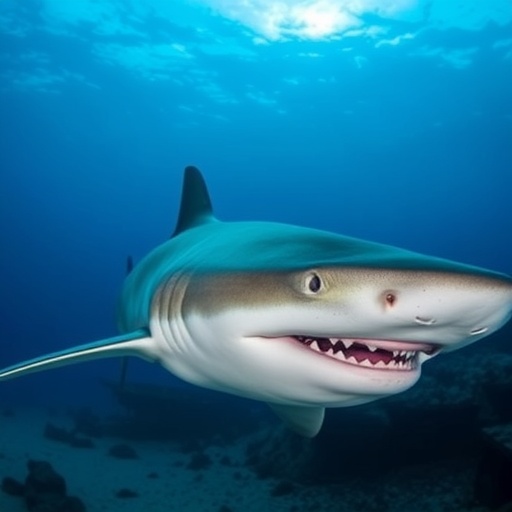
In the vast, ever-changing tapestry of the world’s oceans, predators must often adjust their hunting strategies based on unpredictable environmental factors. One crucial element influencing marine life is temperature — a force that shapes metabolic rates, behaviors, and survival strategies across countless species. However, great hammerhead sharks (Sphyrna mokarran), amongst the ocean’s apex hunters, exhibit a remarkable physiological trait that allows them to defy these common temperature constraints with a phenomenon termed a “thermal hustle.” This adaptive ability enables them to sustain peak hunting performance across a broad spectrum of ocean temperatures, a breakthrough finding recently unveiled by scientists from Florida International University (FIU).
Traditionally, ectothermic marine predators rely heavily on environmental temperatures to regulate their activity levels. As temperatures deviate from their optimal range, these organisms typically experience metabolic slowdowns, impaired motor function, and reduced hunting efficiency. Contrasting sharply with this established biological doctrine, great hammerheads demonstrate the capacity to maintain relatively stable and high levels of performance even when ocean temperatures fluctuate significantly, spanning the cooler conditions of winter to the warmer summer months. This adaptability challenges conventional assumptions and opens new dialogues on marine predator resilience in the face of climate variability.
This exceptional thermal performance was quantified through advanced biologging technology, a method involving the attachment of data-rich tags to individual sharks. These devices recorded multifaceted parameters including movement patterns, acceleration rates, depth profiles, and ambient water temperatures. Analyzing data from nine great hammerhead sharks tracked in the subtropical waters of Florida and the Bahamas, researchers constructed what is known scientifically as a “thermal performance curve.” This curve represents the relationship between temperature and the physiological and behavioral capabilities of the sharks, outlining their peak performance zones as well as declines outside that optimum.
The curve revealed that great hammerheads possess a thermal pinnacle near 84.7 degrees Fahrenheit (approximately 29.3 degrees Celsius), at which they achieve optimal swimming speed, hunting agility, and metabolic efficiency. Beyond conventional expectations, the sharks’ performance tapering rate — the speed at which their capabilities drop off at suboptimal temperatures — remained impressively low. This means that these predators can effectively engage fast prey species year-round. Fast-moving blacktip sharks are typical prey during colder periods, while swift tarpon and barracuda become prime targets during warmer months, showcasing the hammerheads’ flexibility across different ecological seasons.
Yannis Papastamatiou, an associate professor of biological sciences and a key contributor to the research, highlighted the significance of these findings in a warming ocean context. He suggests that this thermal tolerance might afford great hammerheads an evolutionary advantage, possibly allowing them to withstand climate-induced habitat shifts better than less thermally flexible marine species. This resilience could prove pivotal as ocean temperatures rise amid global climate change, potentially shaping the future distribution and survival of these predators.
Moreover, the study delved into historical catch data and satellite tagging information to contextualize thermal preferences in natural settings. Despite their physiological capacity to endure wide temperature ranges, great hammerheads were predominantly observed inhabiting waters close to their identified thermal optimum. This pattern suggests that while thermal flexibility exists, ecological, behavioral, or prey availability factors may regulate the sharks’ habitat selection more than temperature alone — an insight that complicates predictions based solely on thermal tolerance.
The concept of a thermal performance curve is not new in physiological ecology, frequently used to predict species’ responses to climate change. However, the great hammerhead’s comparatively flat decline curve intimates that temperature alone cannot comprehensively explain shifts in distribution for highly mobile marine predators. Given their capacity to traverse thousands of miles, hammerheads may employ a multifaceted strategy integrating thermal preferences with prey availability, reproductive needs, and human-induced pressures such as fishing intensity.
Importantly, this research intersects with conservation challenges. Great hammerhead sharks, despite their impressive thermoregulatory abilities, have endured severe population reductions over recent decades and currently hold a critically endangered status as assessed by the International Union for Conservation of Nature (IUCN). Understanding their unique physiological adaptability provides vital clues for conservation planning, especially in forecasting potential range expansions or contractions that could increase encounters with fisheries and escalate anthropogenic threats.
The interdisciplinary collaboration underpinning this study brought together expertise from institutions such as the Georgia Aquarium and the Mote Marine Laboratory, illustrating the integrative nature of contemporary marine biology research. Employing cutting-edge tagging technologies alongside comprehensive ecological data analyses, these teams have generated a richer, more nuanced understanding of how climatic variables mediate predator behavior in our oceans.
As the global climate crisis accelerates, deciphering the complex interactions between marine species and their changing environments becomes an imperative scientific endeavor. The great hammerhead shark’s “thermal hustle” exemplifies an adaptive marvel that may redefine ecosystem dynamics under environmental stressors. However, it simultaneously serves as a cautionary tale about the limits of resilience — physiological or otherwise — amid escalating human pressures and planetary changes.
Further investigations are necessary to explore the molecular and genetic mechanisms supporting this thermal flexibility. Additionally, expanding biologging efforts across different geographic regions and shark populations will allow researchers to assess variability in thermal adaptability. Such insights will not only enhance ecological models but also refine conservation strategies aimed at safeguarding these enigmatic predators and maintaining the delicate balance of marine ecosystems.
The FIU-led study provides a compelling example of how integrating technological innovation with classical ecological theory can push the frontiers of understanding marine life. It also underscores the complexity of biological responses to climate change, portraying an organism that is at once remarkably adaptable and perilously vulnerable, navigating the shifting waters of survival in a world transformed by humanity.
News Publication Date: 31-Mar-2026
Web References:
Journal of Experimental Biology Article
Cite Scienmag News
Violet Maxwell. (March 31, 2026). How Great Hammerhead Sharks Outsmart Ocean Temperature Swings: Insights from FIU Researchers. Scienmag. https://scienmag.com/how-great-hammerhead-sharks-outsmart-ocean-temperature-swings-insights-from-fiu-researchers/
Violet Maxwell. "How Great Hammerhead Sharks Outsmart Ocean Temperature Swings: Insights from FIU Researchers." Scienmag, 31 March 2026, https://scienmag.com/how-great-hammerhead-sharks-outsmart-ocean-temperature-swings-insights-from-fiu-researchers/. Accessed 4 September 2026.
Violet Maxwell. "How Great Hammerhead Sharks Outsmart Ocean Temperature Swings: Insights from FIU Researchers." Scienmag. March 31, 2026. https://scienmag.com/how-great-hammerhead-sharks-outsmart-ocean-temperature-swings-insights-from-fiu-researchers/


