


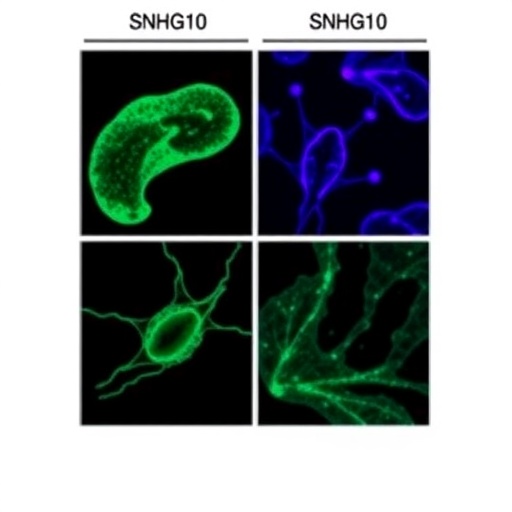
In a groundbreaking new study published in Cell Death Discovery, researchers uncover a pivotal molecular mechanism driving pancreatic ductal adenocarcinoma (PDAC) progression and chemotherapy resistance. This malignancy, notorious for its dismal prognosis and limited therapeutic options, is now linked to the lncRNA SNHG10, which orchestrates tumorigenesis via a complex signaling network involving EGFR, AKT, ERK, mTOR pathways, and the miR-150-5p/VEGF-A axis. This novel insight not only deepens our understanding of PDAC biology but also sheds light on why gemcitabine, a frontline chemotherapeutic agent, often fails, paving the way for innovative treatment strategies.
Pancreatic ductal adenocarcinoma remains one of the deadliest cancers worldwide, largely due to its aggressive nature and intrinsic resistance to chemotherapy. The molecular underpinnings of such drug resistance and malignant proliferation have long eluded scientists, thwarting efforts to improve patient outcomes. However, the emerging role of long non-coding RNAs (lncRNAs) in cancer biology has cast new light on intricate regulatory circuits. SNHG10, a small nucleolar RNA host gene, has now been implicated as a master regulator in PDAC, promoting both tumor growth and undermining gemcitabine efficacy.
At the heart of this discovery lies the epidermal growth factor receptor (EGFR) signaling cascade, a well-established contributor to cancer progression. The study reveals that SNHG10 upregulates EGFR activity, thereby igniting downstream signaling pathways including AKT, ERK, and mTOR. These molecules collectively orchestrate cell survival, proliferation, and metabolism, effectively creating an environment conducive to tumorigenesis. This hyperactivation enhances cellular resilience against chemotherapy-induced apoptosis, explaining PDAC’s notorious drug resistance.
Intriguingly, SNHG10 also modulates a microRNA axis involving miR-150-5p and its target vascular endothelial growth factor A (VEGF-A), a critical player in angiogenesis. The downregulation of miR-150-5p mediated by SNHG10 results in the upregulation of VEGF-A, stimulating the formation of new blood vessels. Such neovascularization not only nurtures the tumor microenvironment but also facilitates metastasis and tumor persistence, further complicating therapeutic interventions.
The study employed comprehensive molecular profiling methods, including RNA interference and gain-of-function experiments, to dissect SNHG10’s functional role. This multi-pronged approach confirmed SNHG10’s capacity to enhance PDAC cell proliferation, migration, and resistance to gemcitabine-induced cytotoxicity. Moreover, mechanistic experiments uncovered that SNHG10 directly interacts with key signaling proteins, establishing itself as an indispensable molecular hub within malignant pancreatic cells.
One of the most striking findings is the identification of SNHG10 as a therapeutic target to overcome gemcitabine resistance. By silencing SNHG10 in PDAC cell lines, researchers observed restored sensitivity to gemcitabine, indicating that SNHG10’s blockade might potentiate chemotherapy effectiveness. This opens a promising therapeutic avenue where combination treatments targeting SNHG10 could significantly improve patient response rates and survival outcomes.
Understanding the crosstalk between SNHG10 and the EGFR/AKT/ERK/mTOR axis also reveals potential biomarkers for early diagnosis and prognosis. Elevated levels of SNHG10 correlated with more aggressive disease phenotypes and poorer patient prognosis, suggesting its utility as a molecular indicator to stratify patients for personalized therapies. This biomarker potential could be revolutionary in clinical settings where treatment resistance remains a formidable hurdle.
From a translational perspective, this discovery encourages the development of novel lncRNA-targeted therapies, which have remained largely unexplored in PDAC. Traditionally, drug development has focused on proteins and enzymes, but lncRNAs like SNHG10 represent an untapped frontier with high specificity and regulatory control. Antisense oligonucleotides, CRISPR-Cas systems, and small molecule inhibitors targeting SNHG10 could soon enter the therapeutic landscape, tailored to circumvent current chemotherapy failures.
This study also challenges the long-held view that cancer progression is solely driven by oncogenes and tumor suppressors encoded by protein-coding genes. Instead, it highlights the central role of non-coding RNAs in shaping the tumor microenvironment and drug resistance, expanding the paradigm of molecular oncology. The integration of lncRNA biology into cancer research frameworks promises to accelerate the discovery of hitherto unrecognized molecular targets.
Further implications extend to the tumor microenvironment, where SNHG10-mediated VEGF-A upregulation enhances not only angiogenesis but also immune evasion. Angiogenic factors contribute to immunosuppressive niches within tumors, suggesting that SNHG10 may indirectly influence immunotherapeutic responses. Consequently, SNHG10-targeted interventions might synergize with immune checkpoint inhibitors, offering combinatorial therapeutic benefit.
The researchers underscore the importance of system-wide analyses to unravel SNHG10’s multifaceted roles. Integrative genomics and proteomics approaches are crucial for delineating the downstream effectors and feedback loops sustaining the oncogenic circuitry. Ultimately, this holistic understanding is essential for developing robust, long-lasting therapies that can effectively disrupt PDAC progression and chemoresistance.
As a future direction, in vivo studies validating SNHG10 inhibition’s therapeutic efficacy in animal models are imperative. Such preclinical data will solidify its candidacy as a drug target and facilitate clinical translation. Additionally, investigating SNHG10 expression across different PDAC patient cohorts will clarify its prognostic and predictive value, tailoring patient management strategies.
In conclusion, this landmark research spotlights SNHG10 as a central molecular orchestrator in pancreatic cancer, potentiating tumorigenesis and chemotherapy resistance via EGFR/AKT/ERK/mTOR and miR-150-5p/VEGF-A axes. This dual regulatory role underscores a sophisticated oncogenic network that could be exploited for innovative therapies. With PDAC’s grim prognosis, these findings are not merely academic but represent a beacon of hope, offering tangible pathways toward improved diagnostic and therapeutic modalities.
Unlocking the therapeutic potential of SNHG10 signals a paradigm shift in pancreatic cancer treatment. By targeting this lncRNA, the scientific community edges closer to overcoming the formidable barriers of tumor aggressiveness and chemoresistance. The intersection of molecular biology, translational research, and clinical application delineates a hopeful path to transforming the outlook for PDAC patients worldwide.
Cite Scienmag News
Nathaniel Bowman. (March 31, 2026). SNHG10 Drives Pancreatic Cancer Growth and Drug Resistance. Scienmag. https://scienmag.com/snhg10-drives-pancreatic-cancer-growth-and-drug-resistance/
Nathaniel Bowman. "SNHG10 Drives Pancreatic Cancer Growth and Drug Resistance." Scienmag, 31 March 2026, https://scienmag.com/snhg10-drives-pancreatic-cancer-growth-and-drug-resistance/. Accessed 4 September 2026.
Nathaniel Bowman. "SNHG10 Drives Pancreatic Cancer Growth and Drug Resistance." Scienmag. March 31, 2026. https://scienmag.com/snhg10-drives-pancreatic-cancer-growth-and-drug-resistance/


