


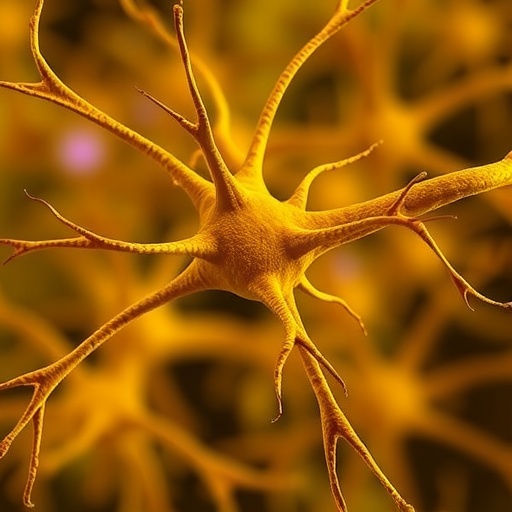
In a groundbreaking study published in Nature Neuroscience, researchers have uncovered a sophisticated mechanism within the brain’s ventral CA1 region that intricately balances memory acquisition and extinction through the dual action of neuropeptide Y (NPY)-expressing interneurons. This discovery by Wu, Gu, Kong, and colleagues sheds new light on how memories—particularly fear-associated ones—are not only formed but also strategically destabilized to enable behavioral adaptation, revealing novel layers of complexity in the orchestration of memory dynamics.
The permanence of memory has long fascinated neuroscientists, who recognize that engrams—the physical substrates of memories—are formed by the recruitment of excitatory principal neurons. However, the role of inhibitory neurons in modulating these memory traces, particularly the nature of their participation in determining whether a memory becomes stable or remains malleable, has remained elusive. This fresh investigation explores how a specific subset of GABAergic interneurons expressing NPY modulates this critical balance, revealing mechanisms that toggle memory states during fear extinction learning in mice.
Central to this process is the ventral CA1 (vCA1) hippocampal area, a brain locus renowned for its crucial involvement in emotional memory processing and fear response regulation. The authors introduce compelling evidence demonstrating that NPY+ GABAergic interneurons in the vCA1 enact a twofold inhibitory strategy: a rapid GABA-dependent suppression facilitating the acquisition phase of memory, and a more prolonged, slower inhibition mediated through the release of NPY itself, which progressively promotes memory extinction.
The study’s experimental approach combined cutting-edge calcium imaging techniques with behavioral analyses in male mice subjected to well-established paradigms of cued fear conditioning and extinction. As extinction learning advanced and the mice transitioned from a ‘fear-on’ to a ‘fear-off’ state, the researchers documented a pronounced ramping up in both calcium signals within the NPY+ interneurons and local NPY release. This correlation underpins the critical role of these interneurons not simply as passive modulators but as active agents that pivot the brain’s circuitry to favor memory flexibility.
Intriguingly, the slow-acting peptidergic inhibition through NPY is selectively funneled through two nonoverlapping populations of principal neurons distinguished by their expression of neuropeptide Y receptors 1 and 2 (NPY1R and NPY2R, respectively). This segregation underlies a sophisticated gating mechanism in which NPY1R-expressing cells dominate regulation during the early, rapid extinction stage, while the NPY2R-expressing neurons orchestrate later-stage slower modulation, effectively managing memory stability.
The distinction between the roles of these receptor-expressing neuron groups not only challenges prior models that treated inhibitory regulation as homogeneous but also opens new avenues to understand how memory dynamics can be precisely tuned on temporal scales. This spatial and functional stratification achieves a delicate balance: facilitating initial forgetting or suppression of fear memories while eventually consolidating the extinction process, thereby preventing inappropriate or excessive erasure of learned information.
At the molecular level, NPY acts as a neuromodulator released by the interneurons in addition to classical fast neurotransmitters such as GABA. This dual-functionality highlights the remarkable versatility of inhibitory neurons in modulating synaptic transmission. Whereas GABA provides immediate, phasic inhibition to shape neuronal firing patterns during memory formation, the neuropeptide exerts a modulatory influence that unfolds over longer timescales, adjusting network excitability to promote memory adaptation and emotional resilience.
This discovery of temporally distinct inhibitory processes driven by the same cell type amplifies understanding of how neurochemical signaling coordinates complex behavioral states. The NPY system’s capacity to slant the network balance suggests a finely engineered feedback loop where interneurons dynamically adjust the emotional valence of memories, potentially defending against maladaptive persistence of fear responses seen in anxiety disorders and PTSD.
The implications of these findings extend beyond basic neuroscience and carry translational potential. By manipulating NPY signaling pathways or receptor-specific targets within the hippocampus, novel therapeutic strategies could be devised to selectively enhance extinction learning—critical in clinical contexts where pathological fear memories undermine mental health. Importantly, the ability to differentially modulate early versus late extinction phases could allow refined interventions designed to recalibrate memory stability with precision.
Furthermore, this research resonates with broader themes in neurobiology regarding how peptidergic systems co-opt excitatory ensembles to regulate cognition and behavior. The dual inhibitory role of NPY+ interneurons exemplifies how the brain achieves a balance between plasticity and stability—essentially deciding when a memory becomes fixed versus when it remains open to updating and modification.
Another notable aspect is the innovative use of genetically encoded calcium indicators to track activity within interneuron subpopulations during live behavior. This methodological advance not only corroborates causality but enables the dissection of neural circuit dynamics at unprecedented resolution, strengthening links between specific cellular phenotypes and complex behavioral outcomes.
While this study focused on cued fear extinction in male mice, its implications potentially extend to other forms of learning and memory across sexes and species. Given the conserved nature of NPY and its receptors, similar inhibitory mechanisms might be involved in diverse cognitive processes and neuropsychiatric conditions, broadening the scope of future research.
This work also prompts reconsideration of inhibitory neuron classification schemes, suggesting that peptidergic content and receptor-specific signaling pathways define specialized subtypes beyond traditional markers. NPY+ interneurons emerge as critical nodes that interface fast synaptic inhibition with slower neuropeptide modulation, a duality that may exemplify how the brain fine-tunes circuit function to balance behavioral flexibility with memory integrity.
In conclusion, Wu et al. present compelling evidence that a subtype-specific population of NPY-expressing interneurons in the ventral CA1 hippocampus orchestrates the mechanisms of memory lability and stability through temporally distinct inhibitory pathways. This discovery not only advances understanding of fear memory processing but also provides a conceptual framework for unraveling how neural circuits integrate fast neurotransmitter and slow neuromodulator signaling to shape behavior adaptively.
As future investigations further decode these peptidergic inhibitory dynamics, the potential for targeted modulation of memory processes opens exciting prospects for treating fear-related psychopathologies and enhancing cognitive adaptability. This landmark study redefines how memory traces are sculpted by interneuron subtypes, highlighting the nuanced interplay of neuropeptides and classical neurotransmitters in orchestrating the brain’s most fundamental functions.
Cite Scienmag News
Ophelia Keating. (March 31, 2026). Neuropeptide Y Tunes Neurons for Memory Stability. Scienmag. https://scienmag.com/neuropeptide-y-tunes-neurons-for-memory-stability/
Ophelia Keating. "Neuropeptide Y Tunes Neurons for Memory Stability." Scienmag, 31 March 2026, https://scienmag.com/neuropeptide-y-tunes-neurons-for-memory-stability/. Accessed 4 September 2026.
Ophelia Keating. "Neuropeptide Y Tunes Neurons for Memory Stability." Scienmag. March 31, 2026. https://scienmag.com/neuropeptide-y-tunes-neurons-for-memory-stability/


