


Almost 2,000 years ago, Pliny the Younger wrote letters describing a shaking ground as Vesuvius erupted. Now, a collaborative study led by researchers from the Istituto Nazionale di Geofisica e Vulcanologia (INGV) and Pompeii Archaeological Park has shed light on the effects of seismicity associated with the 79CE eruption.
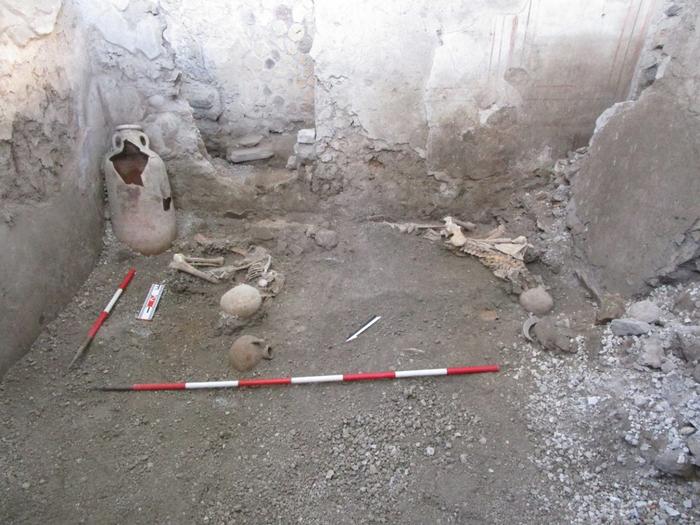
Credit: Image: Pompeii Archaeological Park.
Almost 2,000 years ago, Pliny the Younger wrote letters describing a shaking ground as Vesuvius erupted. Now, a collaborative study led by researchers from the Istituto Nazionale di Geofisica e Vulcanologia (INGV) and Pompeii Archaeological Park has shed light on the effects of seismicity associated with the 79CE eruption.
The study is the first to tackle the complex task of reporting on the effects of co-occurring earthquakes. This is tricky due to the possibility of volcanic and seismic effects happening concurrently or in quick succession, meaning volcanic effects can overshadow effects caused by earthquakes and vice versa.
“These complexities are like a jigsaw puzzle in which all the pieces must fit together to unravel the complete picture,” said Dr Domenico Sparice, a volcanologist at INGV-Osservatorio Vesuviano and first author of the Frontiers in Earth Science study. “We proved that seismicity during the eruption played a significant role in the destruction of Pompeii and, possibly, influenced the choices of the Pompeiians who faced an inevitable death.”
Clues to a deadly collapse
“Correctly recognizing the cause-effect relationship is essential to reconstruct the interplay between volcanic and seismic phenomena, and their effects on buildings and humans,” added co-author Dr Fabrizio Galadini, a geologist and senior researcher at INGV.
During excavations in the ‘Casa dei Pittori al Lavoro’, the researchers noticed something off about the collapsed buildings. “We found peculiar characteristics that were inconsistent with the effects of volcanic phenomena described in the volcanological literature devoted to Pompeii. There had to be a different explanation,” said co-author Dr Mauro Di Vito, a volcanologist and director of INGV-Osservatorio Vesuviano.
When the researchers found two skeletons with severe fracture and trauma injuries, they were even more motivated to figure out the reason.
Painters at work
The eruption caught Pompeiians in the midst of daily life. For about 18 hours, pumice lapilli – small rock and ash particles– fell on the city, causing people to seek shelter. When the eruption paused, inhabitants who’d survived may have thought themselves safe – until strong earthquakes started.
“The people who did not flee their shelters were possibly overwhelmed by earthquake-induced collapses of already overburdened buildings. This was the fate of the two individuals we recovered,” said co-author Dr Valeria Amoretti, an anthropologist who heads the Applied Research Laboratory of Pompeii Archaeological Park.
The researchers found two male skeletons, both around 50 years of age. Their positioning suggests that ‘individual 1’ was suddenly crushed by the collapse of a large wall fragment, resulting in severe traumas causing immediate death. ‘Individual 2’, however, may have been aware of the danger and tried to protect himself with a round wooden object of which the researchers found faint traces in the volcanic deposits.
There are several hints that these individuals did not die from inhaling ash or extreme heat, such as their positioning on the pumice lapilli, rather than under it. This suggests both survived to first phase of the eruption and then were overwhelmed by collapsing walls during the temporary decline of the eruptive phenomena and before the arrival of the pyroclastic currents, the researchers said.
Difficult choices
While not everybody could make it into temporary safety, the numbers of victims recovered in the ash deposits makes people fleeing to the outside a plausible, albeit hopeless, scenario, the researchers said. There are no reliable estimations about how many people died from volcanic-related causes or due to damage caused by earthquakes.
“New insight into the destruction of Pompeii gets us very close to the experience of the people who lived here 2,000 years ago. The choices they made as well as the dynamics of the events, which remain a focus of our research, decided over life and death in the last hours of the city’s existence,” concluded co-author Dr Gabriel Zuchtriegel, director of the Pompeii Archaeological Park.
Journal
Frontiers in Earth Science
Method of Research
Experimental study
Subject of Research
Not applicable
Article Title
A novel view of the destruction of Pompeii during the 79 CE eruption of Vesuvius: syn-eruptive earthquakes as an additional cause of building collapse and deaths
Article Publication Date
18-Jul-2024
COI Statement
The authors declare that the research was conducted in the absence of any commercial or financial relationships that could be construed as a potential conflict of interest.
Cite Scienmag News
Violet Maxwell. (July 18, 2024). Pompeii skeleton discovery shows another natural disaster may have made Vesuvius eruption even more deadly. Scienmag. https://scienmag.com/pompeii-skeleton-discovery-shows-another-natural-disaster-may-have-made-vesuvius-eruption-even-more-deadly/
Violet Maxwell. "Pompeii skeleton discovery shows another natural disaster may have made Vesuvius eruption even more deadly." Scienmag, 18 July 2024, https://scienmag.com/pompeii-skeleton-discovery-shows-another-natural-disaster-may-have-made-vesuvius-eruption-even-more-deadly/. Accessed 24 November 2026.
Violet Maxwell. "Pompeii skeleton discovery shows another natural disaster may have made Vesuvius eruption even more deadly." Scienmag. July 18, 2024. https://scienmag.com/pompeii-skeleton-discovery-shows-another-natural-disaster-may-have-made-vesuvius-eruption-even-more-deadly/




