


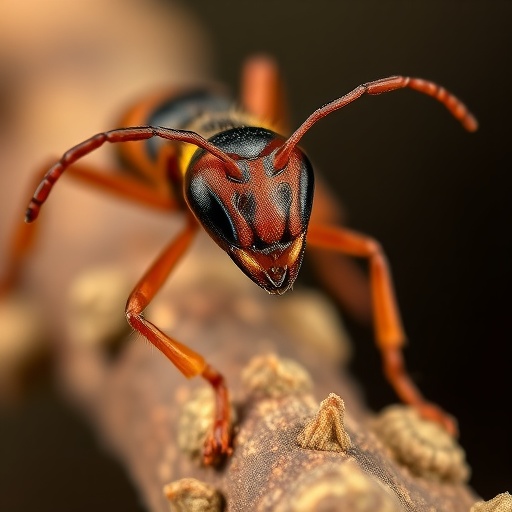
In an ambitious leap forward in entomological science, a recent study by Moyneur, Giloni, and Choe has unveiled the profound influence of vapor-phase (S)-methoprene on the cuticular hydrocarbons of the Argentine ant (Linepithema humile). Published in Scientific Reports in 2026, this research opens new pathways for understanding chemical communication disruption in invasive ant species, with implications that ripple across ecology, pest management, and evolutionary biology. The Argentine ant, notorious for its aggressive displacement of native species and widespread infestation, employs cuticular hydrocarbons as critical mediators of social cohesion and colony identity. The revelation that (S)-methoprene, a juvenile hormone analog commonly used as an insect growth regulator, can induce significant biochemical modifications in these hydrocarbons suggests a novel mechanism for behavioral interference that could revolutionize species control.
Cuticular hydrocarbons serve as a chemical signature on the exoskeleton of ants, facilitating recognition, hierarchy establishment, and cooperative interaction within colonies. The researchers embarked on a meticulous investigation, exposing Argentine ants to vapor-phase (S)-methoprene under controlled conditions and employing gas chromatography–mass spectrometry (GC-MS) to decode the alterations in hydrocarbon profiles. The study’s experimental design meticulously measured not only qualitative shifts in hydrocarbon composition but also quantitative changes in peak abundances, revealing nuanced modulations previously undocumented in the context of juvenile hormone analog exposure. Such changes hint at a profound disruption of the Argentine ant’s sophisticated chemical language, potentially fragmenting colony integrity and social functionality.
Biochemically, the interaction between (S)-methoprene and cuticular hydrocarbon synthesis pathways appears to implicate enzymatic cascades involved in fatty acid elongation and modification processes integral to hydrocarbon production. The study postulates that vapor-phase (S)-methoprene could interfere at multiple stages, from gene expression regulation of key enzymes like elongases and desaturases, to post-synthetic modifications such as methyl branching. This interference not only alters the hydrocarbon profile’s structural complexity but also impacts the functional efficacy of chemical signals essential for nestmate recognition. The implications suggest a vulnerability in the Argentine ant’s communication system exploitable by tailored chemical interventions.
Intriguingly, the deployment of (S)-methoprene in vapor form introduces a delivery modality that penetrates natural barriers efficiently, enabling systemic exposure without direct contact. This characteristic contrasts with traditional contact-based applications, offering a promising avenue for widespread area treatments where physical application is impractical. Vapor-phase dynamics also raise questions about persistence, diffusion gradients, and environmental interactions, all essential parameters for translating laboratory findings into applicable pest control strategies. The subtle balance between effective dose and ecological safety forms a critical axis for future research prompted by this study.
Behavioral assays conducted alongside chemical analyses corroborated the functional consequences of altered hydrocarbon profiles. Ants subjected to vapor-phase (S)-methoprene exhibited notable disruptions in social behaviors such as grooming, trophallaxis, and aggression towards non-nestmates. These behavioral aberrations mirror the hydrocarbon profile disturbances noted, underscoring the chemical basis of social cohesion in Argentine ants. The findings carry profound implications: by chemically incapacitating the ants’ communication network, colony formation and maintenance could be compromised, potentially diminishing invasive populations’ ability to establish and sustain dominance over ecosystems.
The study’s methodology extended beyond observational analytics to include molecular investigations probing gene expression changes linked to hydrocarbon biosynthesis. Utilizing quantitative PCR techniques, the authors identified differential expression patterns of genes encoding hydrocarbon synthesis enzymes in response to (S)-methoprene vapor exposure. This facet illuminates the pathway from chemical exposure to phenotypic outcome, suggesting that juvenile hormone analogs exert regulatory control at the transcriptional level—an insight that broadens our understanding of insect endocrine disruption and its cascading biological effects. The integration of molecular and chemical ecology methods showcases the multifaceted approach necessary for advancing pest control science.
In the context of pest management, the implications of these findings are profound. Argentine ants are among the most pervasive invasive species globally, posing ecological and economic threats in diverse environments, from agricultural landscapes to urban settings. The ability to disrupt their chemical communication systems through vapor-phase hormone analogs offers a strategic tool potentially surpassing conventional insecticides in specificity and sustainability. This targeted approach could reduce collateral damage to non-target species, a critical consideration in ecological stewardship. Moreover, the vapor-phase application mode affords flexibility in deployment, enhancing practicality for wide-scale management efforts.
From an evolutionary standpoint, the study prompts reflection on the plasticity and vulnerability of insect chemical communication systems. The observed susceptibility of cuticular hydrocarbon profiles to hormonal analog-induced modification suggests evolutionary trade-offs between social stability and environmental adaptability. Given that cuticular hydrocarbons also confer protection against desiccation and pathogens, their alteration could impose fitness costs beyond social disruption, which could in turn influence selective pressures shaping ant populations. Such dynamics offer fertile ground for further investigation into how anthropogenic chemicals might inadvertently drive evolutionary trajectories in social insects.
The ecological ramifications extend beyond individual colonies, as the Argentine ant’s invasive success often leads to cascading impacts on native biodiversity and habitat structure. By undermining the colony’s chemical cohesion, vapor-phase (S)-methoprene applications could attenuate invasive pressure, providing a biochemically elegant method for ecological restoration. This approach contrasts sharply with broad-spectrum pesticides that risk collateral damage to native fauna, thereby aligning pest management strategies more closely with conservation goals. The study thus bridges chemical ecology with practical ecosystem management, emphasizing the translational potential of fundamental research.
Importantly, the research addresses the biochemical specificity of (S)-methoprene, noting stereochemical considerations in its efficacy and interaction with insect hormone receptors. The use of the (S)-enantiomer reflects a strategic choice, given that enantiomeric forms can exhibit markedly different biological activities. This precision underscores the importance of stereoselectivity in designing effective pest control agents and hints at the molecular complexity underpinning hormone analog interactions. Future investigations could expand on this by evaluating the relative impacts of different stereoisomers on hydrocarbon modulation and social behavior, potentially refining the arsenal of chemical tools available.
The technical innovations featured in this study, including advancements in vapor delivery systems and sensitive analytical platforms, exemplify the synergistic integration of technology and biology. The ability to generate precise vapor-phase concentrations and monitor subtle chemical changes with high resolution demonstrates an impressive command over experimental variables—a prerequisite for dissecting complex biological phenomena. This level of control paves the way for deeper mechanistic studies, including explorations into dose-response relationships, temporal dynamics of hydrocarbon changes, and recovery potential following exposure cessation.
Looking forward, the findings raise several compelling research directions. A key question revolves around the long-term effects of vapor-phase (S)-methoprene exposure on colony viability and reproductive success. Longitudinal studies could elucidate whether hydrocarbon disruptions are transient or lead to sustained colony destabilization. Additionally, expanding the approach to other invasive or socially complex insect species may reveal generalizable principles or species-specific vulnerabilities. This broader application could reposition juvenile hormone analogs as core components in integrated pest management frameworks, blending ecological insight with chemical innovation.
Moreover, ethical considerations emerge concerning the environmental spread of hormone analog vapors. Comprehensive ecological risk assessments will be essential to ensure non-target organisms and broader ecosystems remain unharmed. The study’s initial success sets the stage for interdisciplinary collaboration among entomologists, chemists, ecologists, and regulatory bodies to refine application protocols, monitor environmental residues, and fine-tune delivery methods. This convergence of expertise will be vital for responsibly harnessing the promising benefits illuminated by these findings.
In conclusion, Moyneur, Giloni, and Choe’s 2026 exploration into the modulation of Argentine ant cuticular hydrocarbons via vapor-phase (S)-methoprene marks a significant milestone in chemical ecology and pest management science. By exposing a critical biochemical vulnerability within a globally invasive species’ social architecture, this work charts a course toward more selective, sustainable, and ecologically informed control strategies. The marriage of high-resolution chemical analysis, behavioral assays, and molecular biology showcases a compelling model for interdisciplinary research that not only deepens scientific understanding but also holds tangible promise for addressing pressing environmental and agricultural challenges.
Cite Scienmag News
Gavin Prescott. (March 28, 2026). Vapor-Phase (S)-Methoprene Changes Argentine Ant Hydrocarbons. Scienmag. https://scienmag.com/vapor-phase-s-methoprene-changes-argentine-ant-hydrocarbons/
Gavin Prescott. "Vapor-Phase (S)-Methoprene Changes Argentine Ant Hydrocarbons." Scienmag, 28 March 2026, https://scienmag.com/vapor-phase-s-methoprene-changes-argentine-ant-hydrocarbons/. Accessed 3 September 2026.
Gavin Prescott. "Vapor-Phase (S)-Methoprene Changes Argentine Ant Hydrocarbons." Scienmag. March 28, 2026. https://scienmag.com/vapor-phase-s-methoprene-changes-argentine-ant-hydrocarbons/


