


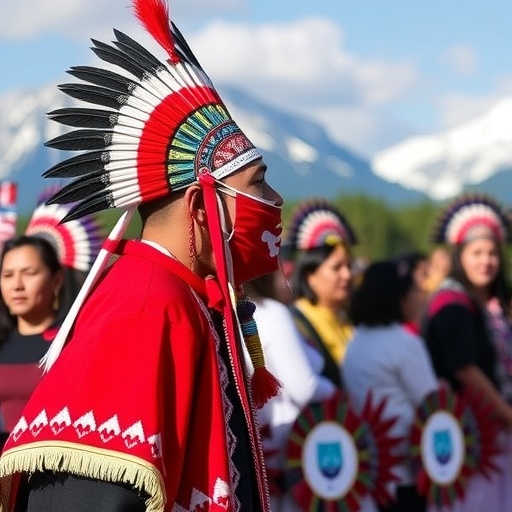
In a groundbreaking exploration of the intersection between Indigenous sovereignty and cutting-edge biotechnological advancements, recent research by Kolopenuk and Smith probes the intricate challenges facing the Canadian Precision Health Initiative. This ambitious national program seeks to harness genetic and environmental data to revolutionize personalized medicine across Canada’s diverse populations. However, the study published in Nature Communications critically examines the limits that Indigenous sovereignty imposes on the scope and implementation of the Initiative, raising urgent ethical, political, and scientific questions.
At the heart of the analysis is the recognition that Indigenous communities are not merely passive data sources but active sovereign entities with distinct legal, cultural, and ethical paradigms governing health research. These paradigms challenge the dominant frameworks of biomedical research that prioritize broad population-scale data aggregation and centralized control. The authors interrogate how the Precision Health Initiative’s strategies may inadvertently marginalize Indigenous voices and potentially violate longstanding treaties and Indigenous governance protocols, complicating efforts toward inclusivity in precision medicine.
Precision health signifies a monumental shift from generalized medical treatments toward interventions tailored to an individual’s genetic profile, environment, and lifestyle. Its promise hinges on vast datasets representing diverse genetic lineages and environmental contexts. Canada’s Indigenous populations, with their unique genetic heritage and distinct social determinants of health, stand to gain significantly from this medical revolution. Yet the history of scientific colonialism and ethical breaches in research involving Indigenous peoples casts a long shadow over participation in such initiatives.
The study details how Indigenous sovereignty asserts control over biological materials, data, and research processes, demanding consent procedures that incorporate community standards far beyond individual autonomy. These demands underscore the incommensurability between Western informed consent models and Indigenous notions of collective rights and responsibilities. For instance, Indigenous laws may require consent not only from individuals but also from community governing bodies, which complicates the data collection logistics for large-scale health projects driven by federal mandates.
Moreover, the Canadian Precision Health Initiative’s data infrastructure is designed around centralized biobanks and extensive genetic databases aimed at maximizing representativeness and analytic power. Yet this model risks disempowering Indigenous governance, as data stored in centralized repositories may be inaccessible or used without community oversight. The research critiques the lack of mechanisms ensuring community-directed data stewardship, which is pivotal for honoring Indigenous sovereignty and fostering trust essential for collaboration.
Another critical focus of the paper is the scientific challenge of integrating Indigenous biological knowledge and social determinants of health into precision medicine frameworks. The authors argue that precision health must evolve beyond mere genomic data to incorporate culturally grounded understandings of health, environmental stewardship, and intergenerational wellbeing. This integration requires developing research methodologies that respect Indigenous epistemologies and prioritize reciprocal benefits—concepts often at odds with conventional biomedical paradigms.
Technical aspects of the Initiative’s genomic sequencing protocols are also examined through the lens of Indigenous data sovereignty. The study highlights the complexities of representing Indigenous genetic diversity accurately without essentializing or homogenizing distinct populations. Genetic admixture, population structure, and historical displacement pose analytical hurdles that demand collaborative interpretation with Indigenous researchers and knowledge holders to avoid misclassification or stigmatization.
The legal framework surrounding Indigenous data in Canada adds yet another layer of complexity. Ongoing treaty rights, land claims, and governance statutes necessitate negotiations and agreements tailored to each community’s unique political and cultural context. The authors express concern that the Initiative, while federally driven, may insufficiently accommodate these diverse legal realities, risking legal conflicts and undermining the program’s ethical foundation.
Importantly, the paper advocates for the co-creation of research protocols, including data governance, intellectual property rights, and benefit-sharing mechanisms. Indigenous partnerships must extend beyond token consultation to genuine collaboration, ensuring that health innovations do not exacerbate existing inequities but rather advance Indigenous health sovereignty. This calls for a paradigm shift wherein Indigenous peoples lead Precision Health research priorities and custodianship.
From a technological standpoint, the Initiative’s reliance on machine learning algorithms to analyze large genomic datasets must be transparent and culturally sensitive. The authors warn against “black-box” models opaque to Indigenous stakeholders, emphasizing the need for explainability in algorithmic decisions to facilitate trust and accountability. Simultaneously, data privacy protections must align with Indigenous community standards, which may diverge from national legal norms focusing on individual protections.
The research also foregrounds the potential for biotechnological advancements to reinforce Indigenous health resilience when properly contextualized within community-driven frameworks. For instance, precision health tools tailored for Indigenous populations could improve management of chronic diseases prevalent in these communities. However, realizing such potential requires dismantling structural barriers rooted in historical marginalization and present-day governance mismatches.
Education and capacity-building initiatives form a key recommendation to empower Indigenous researchers, healthcare providers, and community members to engage meaningfully with precision health technologies. Integrating Indigenous knowledge systems with genomic sciences necessitates cross-disciplinary training and the creation of Indigenous-led research centers. Such empowerment is essential to decolonize the health research landscape and reorient it toward justice and equity.
The implications of the study extend beyond Canada, offering crucial lessons for global health initiatives integrating precision medicine with Indigenous sovereignty worldwide. It highlights the risks of universalizing biomedical models while ignoring cultural specificity and sovereign rights. Policymakers, scientists, and Indigenous leaders internationally can draw from this work to craft ethical, inclusive, and effective precision health programs.
Kolopenuk and Smith ultimately call for a reimagining of the Canadian Precision Health Initiative—not as a top-down project but as a federated, rights-based endeavor respectful of Indigenous sovereignty, cultural diversity, and scientific integrity. They caution that failure to do so risks replicating colonial harms and losing valuable knowledge essential for the next generation of health innovations.
This research reinvigorates dialogue on how emerging biotechnologies intersect with Indigenous rights amid accelerating scientific progress. It challenges the scientific community to embrace humility, cultural humility, and shared governance as prerequisites for breakthroughs in health that are both innovative and just. The Canadian Precision Health Initiative thus stands at a crossroads—poised to redefine the future of medicine or, if mishandled, perpetuate historic injustices.
In conclusion, the study underscores that precision health is not solely a scientific enterprise but also a profoundly political and ethical one. Its success depends on genuine partnerships with Indigenous nations, respect for their sovereignty, and a commitment to co-creating health futures that honor both modern science and ancestral wisdom. Only through such integrative approaches can precision health achieve its transformative promise, delivering equitable and culturally resonant health outcomes across Canada’s complex social tapestry.
Cite Scienmag News
Juliet Wilcox. (March 26, 2026). Indigenous Sovereignty Challenges Canadian Precision Health Limits. Scienmag. https://scienmag.com/indigenous-sovereignty-challenges-canadian-precision-health-limits/
Juliet Wilcox. "Indigenous Sovereignty Challenges Canadian Precision Health Limits." Scienmag, 26 March 2026, https://scienmag.com/indigenous-sovereignty-challenges-canadian-precision-health-limits/. Accessed 3 September 2026.
Juliet Wilcox. "Indigenous Sovereignty Challenges Canadian Precision Health Limits." Scienmag. March 26, 2026. https://scienmag.com/indigenous-sovereignty-challenges-canadian-precision-health-limits/


