


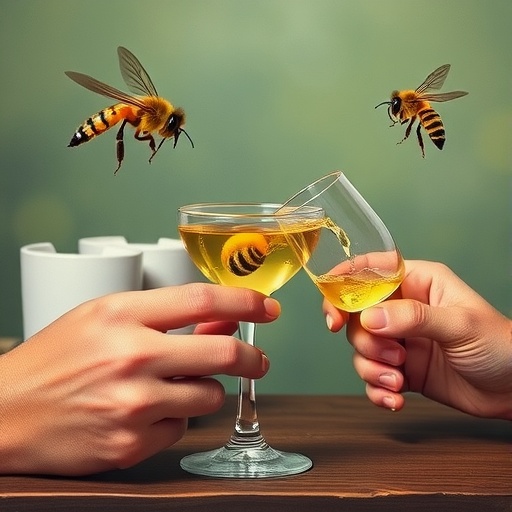
In a groundbreaking study published in Royal Society Open Science, researchers from the University of California, Berkeley, have uncovered a fascinating and previously overlooked aspect of nectar consumption among nectarivorous animals: the presence of low-level ethanol in floral nectar. This discovery sheds new light on the complex chemical interactions within ecosystems and raises intriguing questions about the evolutionary adaptations of animals that consume these nectar sources. The implications stretch beyond simple dietary observations, hinting at profound physiological and behavioral adaptations linked to chronic exposure to dietary ethanol.
The study conducted a comprehensive survey across 29 different flowering plant species, revealing that 26 of these contained detectable traces of ethanol in their nectar. Though most levels were extremely low—attributable to yeast fermentation of sugars—the findings challenged prior assumptions that nectar was ethanol-free. One sample notably contained 0.056% ethanol by weight, approximately one-tenth proof, a concentration that represents a significant source of ethanol considering some animals’ reliance on nectar as their primary caloric intake.
Hummingbirds, such as the Anna’s hummingbird (Calypte anna), consume between 50% and 150% of their body weight in nectar daily, potentially ingesting ethanol in quantities equivalent to a human consuming a standard alcoholic drink per day when normalized to body mass. This high-volume consumption highlights an intriguing biological balance; the birds seem to tolerate low levels of ethanol without exhibiting any obvious inebriation. Unlike humans, who metabolize alcohol more slowly, these tiny birds possess a rapid metabolic rate that may prevent the accumulation of alcohol in their bloodstream.
This phenomenon presents intriguing questions about the biochemical and neurological effects of ethanol on nectarivorous species. Some compounds found in nectar, such as nicotine and caffeine, are known to influence pollinator behavior and physiology, suggesting that ethanol might play a comparable role. The possibility emerges that ethanol may serve as a subtle biochemical signal or modulator affecting feeding choices or even providing some unrecognized adaptive advantage.
Research team member Aleksey Maro, a doctoral student at UC Berkeley, highlighted the unknowns regarding ethanol’s impact beyond intoxication-like effects. “We don’t fully understand the signaling or appetitive properties that alcohol might have in these animals,” Maro explained. “There could be nuanced roles for ethanol analogous to the complex effects it has in humans, even if those effects don’t manifest as intoxication.” Robert Dudley, a professor of integrative biology, suggested potential evolutionary benefits tied to ethanol metabolism linked to foraging biology, hypothesizing that speedy ethanol combustion likely minimizes detrimental impacts while possibly influencing behavior in ways not yet understood.
Past experiments by the UC Berkeley team have illustrated that Anna’s hummingbirds do not readily consume nectar with ethanol concentrations above 1%. They actively avoid feeders with 2% ethanol, implying a natural upper threshold for ethanol tolerance. This selective acceptance points to a finely tuned evolutionary adaptation that balances caloric and biochemical needs, avoiding excessive ethanol intake that might be harmful.
Further biochemical analyses have shown that feathers of nectarivorous birds contain ethyl glucuronide, a metabolic byproduct of ethanol, indicating that these animals effectively metabolize the alcohol ingested through their diet. This discovery parallels metabolic pathways found in mammals, suggesting convergent evolutionary solutions to managing ethanol exposure—opening a new frontier in comparative physiology and evolutionary biology.
Complementing the laboratory and field analyses, researchers estimated the daily ethanol intake for multiple nectarivorous species, including hummingbirds and sunbirds, which occupy similar ecological niches on different continents. The data showed comparable consumption ratios across these avian species, positioning the pen-tailed tree shrew as an outlier with remarkably high ethanol intake from dietary sources. This comparative approach broadens understanding of dietary ethanol’s ecological prevalence and suggests widespread evolutionary pressures to develop tolerance and metabolic handling mechanisms.
Ironically, artificial nectar feeders, commonly used by hummingbird enthusiasts, may expose birds to higher ethanol concentrations due to sugar fermentation than naturally fermented floral nectar. This finding introduces novel considerations for both ecological studies and practical avian feeding strategies, emphasizing the importance of understanding human impacts on animal behaviors and physiology.
This research is part of a larger, extensive NSF-funded project focusing on the genetics and physiological adaptations of hummingbirds and sunbirds. By integrating genetic data with ecological and biochemical analyses, scientists aim to unravel how these birds have evolved to thrive on sugary and often fermented nectar within their diverse environments.
The widespread presence of dietary ethanol across numerous flowering plant species and the evident physiological adaptations in their nectar-feeding consumers call for a paradigm shift in how biologists view the ecological and evolutionary roles of ethanol. This chemical, far from being a mere metabolic byproduct, may have served as a persistent selective pressure shaping animal biology across evolutionary timescales.
In sum, the discoveries reported by Maro, Corl, Dudley, and their colleagues highlight ethanol’s surprising ubiquity in floral nectar and its potential as a bioactive compound influencing animal behavior and physiology. This aligns with a broader biological narrative emphasizing the adaptability of organisms to persistent yet subtle environmental chemical cues. The study underscores the need for further multidisciplinary research into chronic ethanol exposure’s ecological and evolutionary implications, potentially altering paradigms across several biological disciplines.
News Publication Date: 24-Mar-2026
Cite Scienmag News
Gavin Prescott. (March 25, 2026). Birds and Bees Do It Too… Sip Alcohol, That’s What Science Says. Scienmag. https://scienmag.com/birds-and-bees-do-it-too-sip-alcohol-thats-what-science-says/
Gavin Prescott. "Birds and Bees Do It Too… Sip Alcohol, That’s What Science Says." Scienmag, 25 March 2026, https://scienmag.com/birds-and-bees-do-it-too-sip-alcohol-thats-what-science-says/. Accessed 4 September 2026.
Gavin Prescott. "Birds and Bees Do It Too… Sip Alcohol, That’s What Science Says." Scienmag. March 25, 2026. https://scienmag.com/birds-and-bees-do-it-too-sip-alcohol-thats-what-science-says/


