


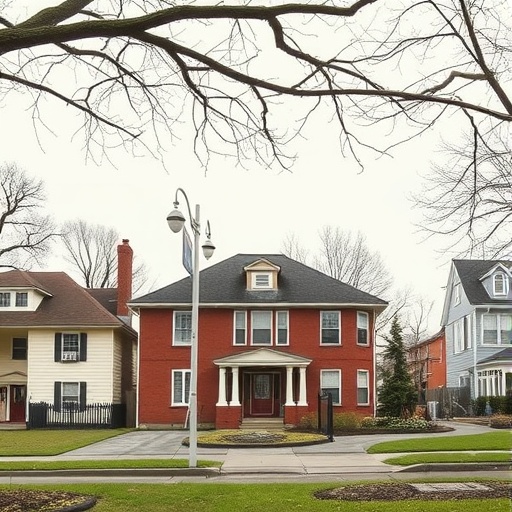
Two groundbreaking studies emerging from Boston University School of Public Health have unearthed a disturbing link between historic redlining practices and current fertility challenges faced by residents in predominantly marginalized neighborhoods. These studies illuminate how a racist mortgage lending policy initiated nearly a century ago continues to cast a long shadow on reproductive health, disproportionately affecting Black communities and other people of color.
Redlining was a federal policy implemented between the 1930s and 1968 by the Home Owners’ Loan Corporation (HOLC), which created residential security maps to guide mortgage lenders. These maps assigned risk grades to neighborhoods, often discriminating based on racial composition rather than objective financial metrics. A and B grades signified favorable lending environments, while C and especially D grades—referred to as “hazardous” or effectively “redlined” areas—were systematically denied fair access to housing loans and investment. This led to entrenched disinvestment, resulting in enduring socioeconomic disparities.
The two studies, published in the prestigious American Journal of Epidemiology and Epidemiology, use sophisticated epidemiological methods to explore the association between residence in historically redlined neighborhoods and fecundability—the probability of conceiving in a given menstrual cycle. By linking current residential data with historic HOLC maps, researchers quantified how deeply structural racism through housing policy continues to impact biological health outcomes.
The first study analyzed over 1,900 participants from the Pregnancy Study Online (PRESTO), a large web-based preconception cohort spanning 37 states. Employing probability models, the researchers demonstrated a significant 14% reduction in per-cycle conception probability among individuals living in neighborhoods previously graded as hazardous (D) compared to those in neighborhoods with more favorable ratings (A or B). This association was notably exacerbated in individuals with less education and lower household income, underscoring how intersecting social determinants amplify health disparities.
Complementing these findings, the second study focused on more than 600 Black women enrolled in Boston University’s Black Women’s Health Study, the largest ongoing epidemiological study dedicated to Black women’s health in the US. Here, living in redlined neighborhoods correlated with a 9% to 18% reduction in fecundability, based on neighborhoods classified as C or D. This attests to the pervasive influence of historic structural inequities on reproductive potential even decades later.
This body of work challenges the prevailing notion that individual factors—such as education level, income, health behaviors, or medical conditions—solely drive fertility outcomes. Instead, it places redlining and its enduring spatial and social ramifications at the heart of racial and ethnic disparities observed in reproductive health statistics. Structural racism, indeed, perpetuates biological disadvantages through chronic exposure to adverse social and environmental conditions.
Mechanistically, neighborhoods that endured redlining suffer from a confluence of environmental degradation and resource deprivation. These areas typically harbor higher levels of air pollution, fewer green spaces, and limited access to quality healthcare and economic opportunities. Such chronic environmental stressors not only impact physical health at a cellular level—through pathways like inflammation and hormonal dysregulation—but also impose psychological stress that impairs reproductive physiology.
The researchers emphasize the concept of “double jeopardy” faced by residents of historic redlined neighborhoods: compounded discrimination and environmental harm converge to produce health outcomes far worse than either factor alone. The chronic neglect of neighborhood infrastructure and social services entrenches cycles of disadvantage, making reproductive challenges yet another symptom of systemic inequity.
An encouraging insight from the studies points to education and current neighborhood socioeconomic status as potential buffers. Individuals attaining higher education or residing in currently affluent neighborhoods displayed reduced susceptibility to infertility, suggesting that investment in social mobility and community development could partially mitigate these entrenched disparities.
These revelations underscore the urgent necessity to reevaluate public health strategies. Addressing fertility disparities demands interventions beyond individual behavioral change, necessitating policies aimed at rectifying historic disinvestment and systematic discrimination. Investment in housing, environmental cleanup, and equitable access to healthcare and economic opportunities are vital components in dismantling the legacy of redlining.
The homeownership gap starkly reflects these inequities—while nearly 76% of White families own their homes, only about 46% of Black families do, perpetuating wealth and asset disparities that trace back to restrictive lending policies. Without comprehensive policy reforms, the biological and social inequities unveiled by these studies will endure.
In light of these meticulous epidemiological findings, the researchers advocate for long-term, systemic solutions such as reinvesting in neglected neighborhoods and creating equitable mortgage lending opportunities for historically marginalized groups. Such public health and social justice initiatives hold promise to reduce reproductive health disparities and improve life trajectories across generations.
Beyond its specific focus on fertility, this research powerfully spotlights the persistent influence of structural racism on population health, urging scientists, policymakers, and society to confront the lasting damage wrought by historically discriminatory lending practices. As fertility challenges continue to affect millions, understanding these roots is vital for crafting effective, just interventions.
News Publication Date: March 25, 2026
Web References:
- American Journal of Epidemiology: https://academic.oup.com/aje/advance-article-abstract/doi/10.1093/aje/kwaf237/8364954
- Epidemiology: https://journals.lww.com/epidem/abstract/2026/03000/historical_neighborhood_redlining_and_fertility_in.13.aspx
- Historical Redlining Maps: https://dsl.richmond.edu/panorama/redlining/
- Pregnancy Study Online (PRESTO): https://sites.bu.edu/presto/
- Black Women’s Health Study: https://www.bu.edu/bwhs/
References:
- Lovett, S. et al. (2026). A preconception cohort study of historical mortgage lending discrimination and present-day fecundability. American Journal of Epidemiology. DOI: 10.1093/aje/kwaf237
- Willis, M. et al. (2026). Historical neighborhood redlining and fertility outcomes. Epidemiology.
Cite Scienmag News
Phoebe Ingram. (March 25, 2026). Residing in Historically Redlined Neighborhoods May Lower Fertility Rates. Scienmag. https://scienmag.com/residing-in-historically-redlined-neighborhoods-may-lower-fertility-rates/
Phoebe Ingram. "Residing in Historically Redlined Neighborhoods May Lower Fertility Rates." Scienmag, 25 March 2026, https://scienmag.com/residing-in-historically-redlined-neighborhoods-may-lower-fertility-rates/. Accessed 4 September 2026.
Phoebe Ingram. "Residing in Historically Redlined Neighborhoods May Lower Fertility Rates." Scienmag. March 25, 2026. https://scienmag.com/residing-in-historically-redlined-neighborhoods-may-lower-fertility-rates/


