


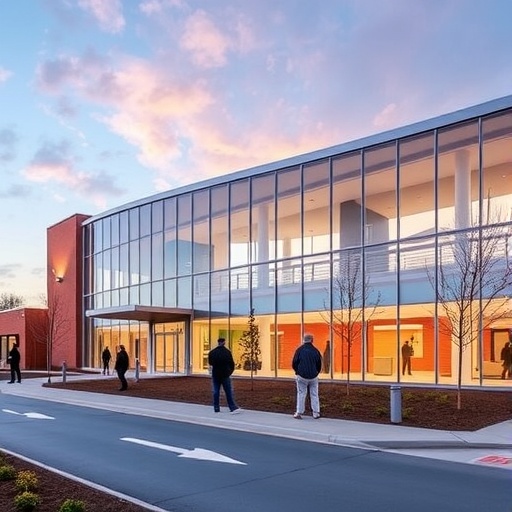
In a transformative leap poised to redefine the future of biomedical research, Gladstone Institutes has secured an extensive new laboratory space in San Francisco’s Mission Bay district. The sprawling 105,000 square feet of cutting-edge facilities at 1450 Owens Street will house approximately 300 scientists across 20 state-of-the-art laboratories, setting the stage for pioneering medical discoveries slated to begin occupancy in early 2027. This ambitious expansion reflects Gladstone’s commitment to harnessing emerging technologies and multidisciplinary approaches to accelerate the genesis of innovative therapeutics and cures.
Situated just a stone’s throw from Gladstone’s current headquarters, the new space integrates seamlessly into the burgeoning Mission Bay biotech ecosystem, a vibrant hub recognized globally for its concentration of scientific innovation. The lease agreement with Alexandria Real Estate Equities, Inc., a major player in life sciences real estate, provides Gladstone with not only state-of-the-art infrastructure but also the option to acquire portions of the premises in the future. This strategic move secures a stable environment conducive to long-term scientific endeavors, ensuring the institute’s capacity for growth and adaptability.
Deepak Srivastava, MD, president of Gladstone Institutes, emphasizes that this expansion arrives at a pivotal moment for science and medicine. The fusion of revolutionary technological advances and exponentially increasing computational power is reshaping paradigms that once accepted many diseases as inevitabilities. “We stand at the dawn of an era where prevention and cure are within tangible reach,” Srivastava remarked, highlighting the facility as instrumental in realizing this vision by providing scientists access to unparalleled research environments.
The backdrop of this expansion is Gladstone’s ambitious five-year, $350 million capital campaign named Gladstone NOW, which ignited in September 2024. This philanthropic endeavor channels resources toward scaling research capacity, nurturing high-risk, high-reward projects, and building computational infrastructure that leverages artificial intelligence (AI) to unravel complex biomedical questions. The synergy of AI with experimental science is anticipated to revolutionize drug discovery pipelines and expedite clinical translation, dramatically shrinking the gap between laboratory breakthroughs and patient care.
Gladstone’s existing facility at 1650 Owens Street, a 200,000-square-foot cornerstone of the Mission Bay life sciences community since 2004, has served as a launchpad for notable growth. Over nearly two decades, Gladstone has expanded its scholarly breadth, establishing institutes such as the Gladstone Institute of Data Science and Biotechnology in 2018 under Katie Pollard, PhD, and the Gladstone-UCSF Institute of Genomic Immunology in 2020 led by Alex Marson, MD, PhD. These institutes exemplify the institute’s focus on integrating computational biology and immunogenomics, offering fertile ground for discovery in complex disease biology.
Katie Pollard underscores the transformative impact of AI on biomedical research, emphasizing how machine learning algorithms have reshaped approaches to genome analysis, drug design, and predictive modeling for clinical trials. “The confluence of AI and biotechnology heralds a future of more effective, cost-efficient therapies,” she asserted, expressing anticipation for the enhanced capabilities that the new labs will afford researchers to forge novel biotechnologies.
Meanwhile, Alex Marson’s leadership in immunology is poised to deepen with access to the enhanced laboratory environment. Advances in DNA sequencing, CRISPR gene editing, and synthetic biology are enabling unprecedented manipulation of immune cells. This empowers researchers to engineer bespoke immunotherapies aimed at combating cancer, autoimmune diseases, and persistent infections with greater precision and efficacy. Marson notes that while progress has been steady, the expansion will enable his team to advance from measured steps to rapid strides in therapeutic development.
As the data science and genomic immunology units transition into the 1450 Owens Street facility, the original 1650 Owens Street building will free up critical space. This repercussion facilitates necessary expansion for Gladstone’s other institutes, which focus on cardiovascular, neurological, and infectious diseases—fields where the institute continues to push boundaries in translational medicine. Moreover, plans remain flexible with the potential to augment existing infrastructure further while retaining the institute’s roots firmly within Mission Bay’s dynamic biotech landscape.
This deliberate spatial and strategic planning underscores Gladstone’s vision to nurture an interwoven scientific community where computational biology, immunology, and disease-specific research coalesce. The fusion of these disciplines, supported by bespoke laboratory infrastructure and enhanced computational resources, aims to catalyze the development of transformative therapies. This integrated approach is considered critical for tackling the formidable challenge of more than 10,000 diseases that currently elude effective treatment.
Joel S. Marcus, executive chairman and founder of Alexandria Real Estate Equities, expressed enthusiasm about Gladstone’s continued presence and growth, describing the institution as a prolific engine of biomedical innovation. He noted, “Our nearly two-decade partnership reflects a shared commitment to advancing life sciences,” illustrating how the relationship between research institutions and real estate developers is instrumental in fostering a thriving ecosystem that enables rapid scientific progress.
Looking forward, Gladstone’s expansion plans position it among the elite of the Bay Area’s biotech infrastructure, a “crown jewel” in a region synonymous with scientific excellence. Srivastava highlighted aspirations for the new facility to not only accommodate existing operations but also serve as a magnet for recruiting global scientific talent. The institute’s enhanced capabilities and collaborative environment will be pivotal in accelerating breakthroughs that can revolutionize health care paradigms worldwide.
Since its inception in 1979, Gladstone Institutes has been dedicated to visionary science designed to overcome the most pressing medical challenges. Its model emphasizes disruptive approaches, high-impact science, and attraction of exceptional minds to catalyze breakthrough discoveries. The new facility at 1450 Owens Street represents a bold extension of this mission, supporting an era defined by technological sophistication, interdisciplinary synergy, and a relentless pursuit of cures for diseases long deemed intractable.
By integrating advanced laboratory infrastructure with next-generation computational power and innovative biotechnologies, Gladstone stands ready to redefine the landscape of biomedical research. This investment in the future not only reflects a scientific imperative but also promises profound societal benefits as discoveries in genetics, immunology, and drug development translate from bench to bedside with unprecedented speed and precision.
News Publication Date: 2024.
Web References:
Keywords
Gladstone Institutes, biomedical research, laboratory expansion, Mission Bay, artificial intelligence, computational biology, immunotherapy, genomic immunology, CRISPR, drug discovery, translational medicine, biotech infrastructure.
Cite Scienmag News
Grant Pearson. (March 25, 2026). Gladstone Institutes Unveils 105,000 Sq Ft Expansion to Advance Scientific Research. Scienmag. https://scienmag.com/gladstone-institutes-unveils-105000-sq-ft-expansion-to-advance-scientific-research/
Grant Pearson. "Gladstone Institutes Unveils 105,000 Sq Ft Expansion to Advance Scientific Research." Scienmag, 25 March 2026, https://scienmag.com/gladstone-institutes-unveils-105000-sq-ft-expansion-to-advance-scientific-research/. Accessed 4 September 2026.
Grant Pearson. "Gladstone Institutes Unveils 105,000 Sq Ft Expansion to Advance Scientific Research." Scienmag. March 25, 2026. https://scienmag.com/gladstone-institutes-unveils-105000-sq-ft-expansion-to-advance-scientific-research/


