


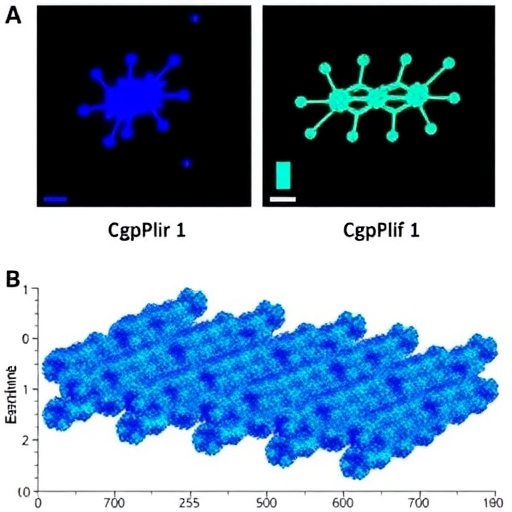
In a breakthrough that could redefine the landscape of optoelectronic devices, researchers have unveiled an innovative approach to the synthesis of blue-emitting perovskite nanocrystals, specifically CsPb(Br₁₋ₓClₓ)₃, by integrating halide exchange with simultaneous defect passivation through dopamine hydrochloride treatment. This pioneering study not only promises advancements in display technology but also addresses longstanding challenges in stability and luminescence efficiency that have hindered the practical application of blue perovskite materials.
Perovskite nanocrystals, particularly those based on lead halide compositions, have captivated scientific and technological communities due to their tunable emission spectra, high quantum yields, and solution processability. However, achieving efficient and stable blue emission has remained notoriously difficult. Conventional synthesis methods often result in nanocrystals with suboptimal photoluminescence quantum yields and rapid degradation under ambient conditions, predominantly because of halide ion migration and surface defects acting as nonradiative recombination centers.
The research group, led by Kim, D., Park, J.S., and Yim, S.Y., embarked on an ambitious quest to overcome these obstacles by focusing on a dual strategy: the rational halide exchange between bromide and chloride ions in the CsPb(Br₁₋ₓClₓ)₃ lattice and the concurrent passivation of surface defects utilizing dopamine hydrochloride. This approach capitalizes on the multifaceted chemical nature of dopamine hydrochloride, which interacts with the perovskite surface at the molecular level, effectively suppressing trap states and stabilizing the lattice structure.
Halide exchange, a technique where bromide ions in the perovskite crystal are partially replaced by chloride ions, shifts the emission wavelength towards the blue spectrum, which is essential for full-color display applications and high-resolution lighting. Nevertheless, this substitution introduces lattice strain and exacerbates defect formation, generating surface traps that quench luminescence. The simultaneous application of dopamine hydrochloride averts these complications by forming a protective molecular layer rich in catechol and amine functional groups that coordinate with lead ions and halides, resulting in reduced surface defects and enhanced photostability.
Characterization techniques such as photoluminescence spectroscopy revealed a remarkable increase in quantum yield and a narrow full width at half maximum (FWHM), signifying superior color purity. Furthermore, accelerated aging tests under continuous illumination demonstrated a pronounced enhancement in operational lifetime compared to unpassivated counterparts. These findings suggest that the incorporation of dopamine not only stabilizes the perovskite nanocrystals but also inhibits deleterious ion migration, a common degradation pathway in halide perovskites.
Transmission electron microscopy (TEM) and X-ray diffraction (XRD) analyses corroborated the structural integrity of the nanocrystals post-treatment, confirming that the halide exchange proceeded uniformly without compromising the overall crystalline framework. Such consistency in morphology is pivotal for ensuring reproducibility and scalability in future device fabrication processes. Moreover, the study highlights how the organic-inorganic hybrid approach synergistically optimizes both the optical and structural properties of perovskite nanocrystals.
The implications of this research are profound for the fields of light-emitting diodes (LEDs), particularly in rendering devices that demand stable and efficient blue emission, an essential component in RGB triads. The perovskite-based LEDs could benefit from this enhanced material to achieve higher luminance, lower power consumption, and longer lifetimes, potentially surpassing the performance of current organic and inorganic semiconductor materials.
Beyond display technologies, the stabilized blue-emitting perovskites hold promise for applications in quantum information processing and photonic devices, where precise control over emission wavelength and spectral linewidth is crucial. The fine-tuning of halide composition, paired with judicious surface chemistry, offers a versatile platform for tailoring material properties to specific technological requirements without sacrificing stability.
This innovative methodology also paves the way for exploring other organic molecules with multifunctional groups capable of interacting with perovskite surfaces, thus opening new avenues for materials engineering. The dopamine hydrochloride approach sets a precedent for integrated chemical treatments that simultaneously address multiple bottlenecks in perovskite nanocrystal technology, providing a holistic solution rather than piecemeal enhancements.
As the demand for eco-friendly and cost-effective light sources increases globally, these findings highlight the strategic importance of advanced nanomaterial synthesis aimed at overcoming intrinsic material limitations. The convergence of chemistry, materials science, and nanotechnology epitomized in this work exemplifies the collaborative spirit necessary to push the boundaries of next-generation optoelectronics.
While challenges remain in scaling up production and integrating these nanocrystals into commercial devices, the current achievement represents a monumental step forward. It also underscores the importance of understanding surface chemistry and defect dynamics in halide perovskites, concepts that will undoubtedly influence future research directions and industrial practices.
In conclusion, the research conducted by Kim, Park, Yim, and colleagues remarkably advances the field of perovskite nanocrystals by delivering a robust strategy for blue emission through simultaneous halide exchange and defect passivation with dopamine hydrochloride. This dual-action method punctuates the potential for sustainable, high-efficiency, and long-lasting blue perovskite nanocrystals, signaling a new era for optoelectronic applications and inspiring further innovations in the domain.
Cite Scienmag News
Denise Maddox. (March 20, 2026). Blue-Emitting CsPb(Br-Cl)3 Nanocrystals Enhanced by Dopamine. Scienmag. https://scienmag.com/blue-emitting-cspbbr-cl3-nanocrystals-enhanced-by-dopamine/
Denise Maddox. "Blue-Emitting CsPb(Br-Cl)3 Nanocrystals Enhanced by Dopamine." Scienmag, 20 March 2026, https://scienmag.com/blue-emitting-cspbbr-cl3-nanocrystals-enhanced-by-dopamine/. Accessed 3 September 2026.
Denise Maddox. "Blue-Emitting CsPb(Br-Cl)3 Nanocrystals Enhanced by Dopamine." Scienmag. March 20, 2026. https://scienmag.com/blue-emitting-cspbbr-cl3-nanocrystals-enhanced-by-dopamine/


